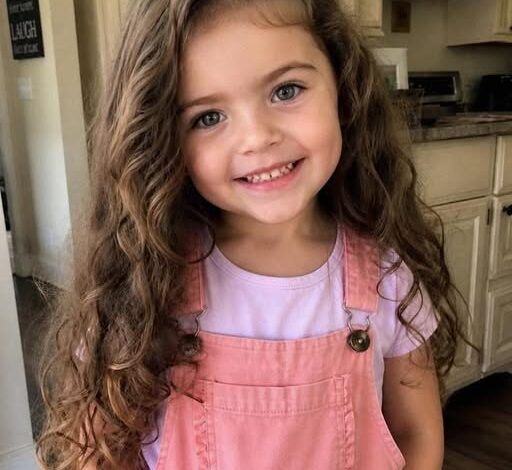
My 4-Year-Old Daughter Refused to Cut Her Hair, Crying, ‘When My Dad Comes Back, He Won’t Recognize Me’ – But My Husband Passed Away Long Ago

I walked into that salon expecting nothing more complicated than split ends.
I thought the hardest part of the day would be convincing my daughter to sit still in the chair, maybe choosing how much to take off, maybe promising ice cream afterward if she got nervous. I never imagined that a simple haircut would pull me into something much darker — into fear, secrets, and a fight I had not known was already forming around us.
Her panic over the trim was too intense to ignore. It was not the ordinary worry of a child afraid of scissors or change. It was terror. The kind that comes from being told something over and over until it becomes a rule inside your body. That fear led me to drawings she had hidden away, to small confessions spoken in whispers, to promises someone else had planted in her mind like traps.
Piece by piece, the truth began to take shape.
And then I saw Patty in her living room, wearing William’s sweatshirt as if grief had given her the right to become him. The fabric hung from her body like a costume, and suddenly everything became clear. She was not simply mourning her son. She was trying to preserve him by controlling what he had left behind.
And what he had left behind was my little girl.
Patty did not see my daughter as a child with her own fears, choices, and identity. She saw her as a living memorial. A replacement. A piece of William she could still hold, shape, and claim. Her grief had hardened into possession, and somehow she had convinced herself that love gave her permission.
The legal battle that followed was not dramatic in the way people imagine those things. There were no screaming matches in hallways, no explosive confrontations, no final speech that changed everything. It was quieter than that, and in some ways, more frightening.
It was documents.
Statements.
Records.
Dates.
Patterns.
The slow, heavy scrape of truth being placed on a mediation table one page at a time.
Patty’s version of events did not collapse because I shouted louder. It collapsed because I had paid attention. I had written things down. I had listened when my daughter was finally brave enough to speak. I had gathered the proof that showed what was really happening beneath all those soft words about family, grief, and love.
I protected my daughter with facts, not fury.
That mattered. Because fury would have been easy. Fury was right there, waiting for me every time I thought about the fear in my child’s eyes. But anger alone could not keep her safe. Preparation could. Clarity could. Evidence could.
In the end, the paperwork gave us protection, but it was not the true victory.
The real victory came later, in another salon chair.
This time, my daughter walked in holding my hand, nervous but not frozen. This time, no one had filled her head with fear. No one had told her that changing her hair meant betraying someone’s memory. No one had made her feel responsible for holding together an adult’s grief.
She looked at herself in the mirror and chose.
Just a little shorter.
Her choice. Her voice. Her reflection.
When the stylist finished, she touched the ends of her hair and studied her face carefully. Then she looked up at me and asked, “Do I still look like me?”
I told her yes.
And this time, I knew she believed me.
Because she was not being asked to carry anyone else’s sorrow anymore. She was not a symbol, not a substitute, not the last piece of someone Patty had lost. She was a little girl with her own life, her own body, her own name, and her own future.
That second trip to the salon was where I understood what we had really won.
Not revenge.
Not a legal victory.
Not the satisfaction of proving someone wrong.
We won back her right to belong to herself.