MY EMPLOYER ACCUSED ME OF STEALING A PRICELESS HEIRLOOM BUT HIS YOUNG SON EXPOSED THE TRUTH IN OPEN COURT

I gave forty years of my life to one family.
I knew the sound of every floorboard in that house, every window that stuck in winter, every cabinet hinge that needed oiling. I knew which rooms held laughter, which ones held grief, and which doors were closed when people wanted their secrets to stay hidden from the help.
I had watched children grow, marriages strain, fortunes shift, and sorrow settle into rooms long after guests had gone home. I had wiped tears from the cheeks of a frightened child. I had kept track of birthdays, medicines, schedules, letters, keys, and quiet family histories no one else bothered to preserve.
For four decades, I was trusted with everything.
Then, one Tuesday afternoon, all that loyalty was thrown away.
A priceless emerald necklace disappeared, and suddenly I was no longer the woman who had served that household faithfully for nearly half a century. I was a suspect. A thief. A convenient answer to a problem someone else had created.
The trouble had truly begun two years earlier, when Vanessa married Adam.
She entered the house like a person claiming conquered land. She moved furniture that had stood in the same place for generations. She dismissed staff who had served the family for years. She changed routines not because they needed changing, but because she wanted every corner of the house to know she was in control.
When Adam was near, Vanessa’s cruelty softened into elegance. She rarely raised her voice in front of him. That was not her style. Her cruelty was quieter, sharper, and more precise — a comment delivered with a smile, an order disguised as a suggestion, a look that reminded you exactly where she believed you belonged.
What angered her most was Ethan.
Ethan was Adam’s twelve-year-old son, a sensitive boy with tired eyes and nightmares that left him shaking in the dark. Long before Vanessa arrived, Ethan had learned that my room was safe. When the bad dreams came, he would slip down the hall in his socks and knock softly on my door.
I never turned him away.
Sometimes he talked. Sometimes he cried. Sometimes he simply sat beside me while I mended linens or made tea, needing the quiet assurance that someone was still awake and on his side.
Vanessa hated that.
She did not want Ethan comforted. She wanted him managed. Controlled. Sent away if necessary.
I saw it before anyone else did.
The trap was sprung on a Tuesday.
Vanessa came down the staircase with one hand pressed dramatically to her throat.
“My emerald necklace is gone,” she announced.
The household froze.
Adam, anxious and embarrassed, tried to calm her. But Vanessa insisted the rooms had to be searched. Every drawer, every cabinet, every private space.
Then she looked straight at me.
“We should start with her room.”
My stomach tightened.
I knew, in that instant, that something was wrong.
Adam did not want to search my quarters. I could see it in his face. But he was so desperate to keep peace with Vanessa that he agreed.
We walked together to the small room I had occupied for years. I stood in the doorway while Adam searched, his movements slow and uncomfortable. Vanessa watched from behind him, perfectly still.
Then Adam reached into my sewing basket.
His hand stopped.
When he pulled it back, the emerald necklace dangled from his fingers, glittering green beneath the dull ceiling light.
For a moment, no one spoke.
I stared at the stones buried among my thread and needles, unable to understand what I was seeing. I had never touched that necklace. I had never even wanted to touch it. Yet there it was, placed carefully where anyone could find it.
Vanessa’s face showed no surprise.
That was how I knew.
The police came. The neighbors watched from behind their curtains as I was escorted out through the front garden. Their pity was worse than anger. Pity meant they had already half-believed it.
I held my back straight.
I would not give them the collapse they expected.
At the station, during questioning, through the booking process, and later in court, my answer never changed. I did not take the necklace. I did not hide it. I did not know how it had entered my room.
My public defender urged me to consider a plea.
“It may reduce the damage,” he said.
But I had spent forty years building a name that meant honesty. I would not destroy it just because someone had made a lie look convenient.
The turning point came at the preliminary hearing.
I was sitting in the courtroom with shame pressing down on me like a physical weight when the heavy doors opened suddenly.
Ethan rushed inside.
He was still in his school uniform, his shirt untucked, his hair messy, his face pale with determination. Vanessa stood at once, hissing his name, telling him to sit down.
He ignored her.
He walked straight to the front of the courtroom and held something out to the judge.
It was my old silver thimble.
I had not even realized it was missing.
“I found this in Vanessa’s locked drawer,” Ethan said, his voice shaking. “With a memory card.”
The courtroom went silent.
The judge leaned forward.
Ethan’s hands trembled, but he did not stop.
He told the court he had seen Vanessa in the hallway late at night, opening the jewelry box. He had followed her because he had learned, painfully, that when Vanessa moved quietly through the house, trouble usually followed. He watched her enter my room. He watched her place the emeralds inside my sewing basket.
At the time, he had not fully understood what she was doing. But he knew enough to be afraid. He knew enough to look for proof.
The memory card gave him that proof.
Vanessa had installed a hidden motion-activated camera in the hallway to monitor my movements. She had meant to use it against me. Instead, it captured enough to expose the timeline, her access, and the careful preparation behind the accusation.
But the memory card revealed more than the necklace.
It revealed why Vanessa wanted me gone.
For decades, I had kept Adam’s mother’s private letters. She had trusted them to me before she died, asking me to preserve them until the family was ready for the truth. Those letters contained details about a terrible mistake Adam had made years earlier in his business, and how his father had buried the consequences to protect the family name.
Vanessa had found out about the letters.
To her, I was not just staff. I was a threat. I knew too much about the family she wanted to control. If she could destroy my reputation, no one would believe anything I said.
The emerald necklace was never the real prize.
My silence was.
Adam looked shattered when the truth came out.
After the hearing was halted and the evidence was formally entered, he found me in the hallway. His face was gray, his voice unsteady.
“I am so sorry,” he said.
The words came quickly, desperately, as if speed could make up for betrayal.
I looked at him and felt the weight of every year I had given that house.
“Your apology is late,” I told him. “And it is not enough.”
He lowered his eyes.
“I trusted you for forty years,” I said. “You trusted me until it became inconvenient.”
What I wanted was not tears or guilt. I wanted records. I wanted keys. I wanted schedules, logs, and access notes — every piece of household evidence that would prove Vanessa had been arranging my removal long before the necklace vanished.
Adam gave them to me.
And then the final truth surfaced.
In a locked closet in the east wing, Adam found packed suitcases, Ethan’s school transfer papers, medical forms, and travel plans for a boarding school halfway across the country.
Vanessa had not only planned to get rid of me.
She had planned to send Ethan away too.
He stood in the doorway, staring at his own life folded into luggage, and understood what she had been trying to do. She wanted to erase everything that connected Adam to the life he had before her — the old staff, the old memories, the child who still remembered his mother, and the woman who still knew the truth.
By sunset, Vanessa was gone.
Not dramatically. Not with a final speech. She left the house as coldly as she had entered it, carrying nothing of real value because everything she had tried to steal had already slipped from her control.
Adam offered me the sunny guest room beside Ethan’s suite.
“No more staff quarters,” he said quietly. “Not unless you want them. You belong where the family belongs.”
I did not answer immediately.
After forty years, belonging was not a word I trusted easily.
But that night, as I sat on the edge of the new bed, I heard a soft knock at the door.
I knew that knock.
Ethan stood there in his pajamas, eyes red but hopeful.
“Are you really staying?” he asked.
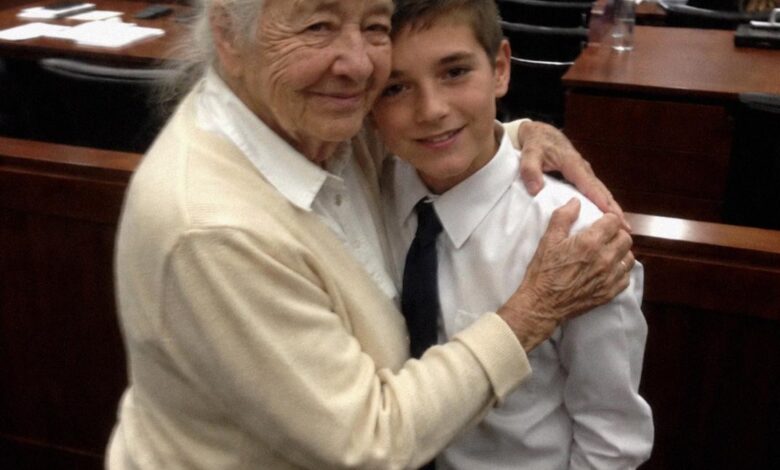
I opened my arms, and he crossed the room in three quick steps.
“Yes,” I said, holding him tightly. “I am staying.”
His small hands gripped the back of my sweater.
“She can’t send us away now, can she?”
“No,” I whispered. “No one can.”
For the first time in years, the house felt quiet in a way that did not frighten him.
The storm had passed. The lies had been dragged into the light. And the room I had been given no longer felt like a promotion or an apology.
It felt like recognition.
After forty years of being called the help, I finally understood something the child in my arms had known all along.
I had never been just staff.
I had been family.