The Day My Son Spoke Words Only My Grandfather Could Have Known and How One Innocent Childhood Memory Reopened a Garden of Love, Loss, and the Possibility That Some Promises Echo Across Generations in Ways We May Never Fully Understand

It happened on an ordinary afternoon.
There was no thunder in the sky. No flickering lights. No dramatic silence heralding the moment. I was standing in the kitchen, rinsing strawberries at the sink while my five-year-old son played on the living room rug behind me. The house smelled of soap and sunlight drifting through the open window.
And then he said it.
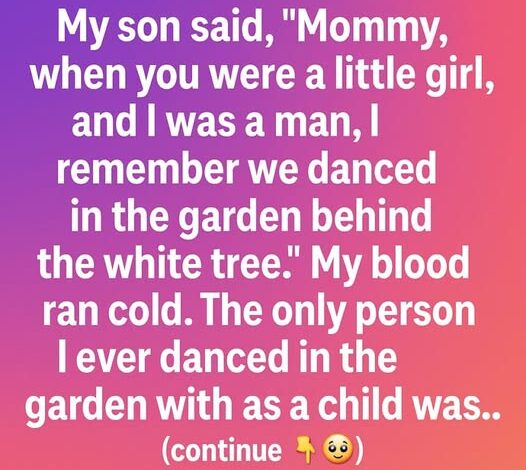
“Mommy,” he began casually, in the same tone he might use to ask for juice, “when you were a little girl, and I was a man, I remember we danced in the garden behind the white tree.”
The world tilted.
I turned off the faucet slowly, my hands dripping, my heart suddenly hammering.
“What did you say?” I asked, trying to keep my voice steady.
He looked up with perfect calm, as if what he’d just said were the most natural words in the world.
“When you were little,” he repeated, “and I was a man. We danced behind the white tree.”
A chill ran through me.
The only person I had ever danced with in a garden behind a white tree was my grandfather.
His backyard had always felt magical—not large, not elaborate, but alive with memory. At its center stood a towering white oak, pale bark glowing softly in the sunlight. He called it “the guardian of our memories.”
I must have been six or seven when our tradition began.
On warm afternoons, he’d carry out his old portable radio, its antenna bent slightly at the top. Sometimes soft jazz, sometimes the love songs of his youth would crackle through, fading in and out with static. Imperfect, yet beautiful.
He would set the radio on the patio table, step into the grass, and extend his hand.
“May I have this dance?” he’d say with a dramatic bow.
I would giggle, slip my tiny hand into his weathered one, and we would twirl barefoot beneath the white oak.
I remember the cool grass under my feet, the scent of summer air, the warmth of his hand around mine.
It was ordinary.
It was everything.
We danced slowly, spinning until I stumbled, sometimes lifting me ever so slightly off the ground so I felt weightless. Those afternoons were ours.
I never told anyone about them. Not my parents. Not friends. Not even later, when the memory became bittersweet after he passed. They were my secret treasure, tucked quietly inside my heart.
And now my son had described them.
I swallowed hard and crouched beside him.
“Sweetheart,” I whispered, “what else do you remember?”
His eyes sparkled with the thrill of a favorite story.
“You wore a yellow dress,” he said confidently. “I spun you around, and you laughed so much. You told me never to let you go.”
My knees nearly gave out.
I remembered the yellow dress. Soft cotton, tiny white flowers along the hem. That afternoon we had danced longer than usual; I had tripped, then burst into laughter as his arms caught me. “Don’t let me go!” I’d said, clinging to him. And he had whispered, “I never will.”
I had forgotten the exact words until my son spoke them. Now they echoed in my ears with startling clarity.
Tears blurred my vision.
“Why are you sad?” he asked, tilting his head, noticing the change in my expression.
“I’m not sad,” I managed, brushing a tear away. “Just remembering.”
He reached out and patted my cheek with a seriousness beyond his years.
In that small gesture, something shifted.
I had always considered myself rational, practical. I believed in memory, imagination, and coincidence. Children say strange things all the time. But I had never spoken of the white tree, the garden, or the yellow dress—not once.
That night, after tucking him into bed, I sat alone in the quiet house, my thoughts swirling between logic and longing.
Maybe he had dreamed it. Maybe children invent elaborate narratives. Or maybe—just maybe—love is not bound by the limits we assume.
My grandfather had been a steady presence in my childhood, teaching patience, gentleness, and that small moments matter more than grand gestures. When he passed, I felt the world tilt beneath me. Yet raising my son, I sometimes noticed traces of him—expressions, pauses, gestures—and had always assumed they reflected me.
Now I wondered.
In the days that followed, I asked gently if he remembered anything else. Sometimes he shrugged and returned to dinosaurs or superheroes. Other times, he added curious details.
“The tree was very tall,” he once said thoughtfully. “It made lots of shade.”
Yes. It did.
I found myself thinking less about whether his words were explainable and more about what they made me feel. They didn’t frighten me. They comforted me.
Because however it had happened—imagination, coincidence, something deeper—my son had described love. Pure, joyful love beneath a white oak tree.
I began sharing stories of my grandfather—not about dancing, but about his humor, his kindness, the way he whistled while watering plants. My son listened intently.
One afternoon, he took my hand and spun me around the living room.
“You can’t fall,” he said seriously. “I won’t let you.”
My breath caught. I laughed through tears.
“Okay,” I whispered. “I trust you.”
Over time, the intensity of that first moment softened into gentle connection. Whether or not my son had accessed a memory beyond explanation didn’t matter as much as what it reminded me of. Love continues. Promises echo. Bonds do not vanish—they transform, resurface, and live on in the way we hold our children’s hands, in the way we spin them until they laugh, in whispered reassurances.
That night, long after he slept, I stepped into our own backyard. We didn’t have a white oak, only a young tree near the fence. The air was cool. Stars scattered the deep blue sky. I felt an unexpected peace.
Some bonds don’t end. They simply change form. Maybe my grandfather kept his promise. Maybe “I never will” wasn’t limited to one lifetime or one backyard. Or maybe love imprints itself so deeply that it echoes across generations.
When my son speaks, laughs, or reaches for my hand, I feel a thread connecting past and present. I no longer feel confusion. Only gratitude.
Because that ordinary afternoon in the kitchen gave me something extraordinary: a reminder that love does not disappear.
It moves.
It grows.
It dances again.
And sometimes, when we least expect it, it speaks through the voice of a child and brings an old garden back to life.