They shuffled in, one by one, with that familiar blend of resignation and fragile hope, their movements small, deliberate, as if each step required a negotiation with time itself. Eyes rarely lifted beyond the floor tiles, patterned in muted greens and tans, worn smooth by decades of anxious footsteps. They did not look at the diplomas and framed certificates that hung on the walls like silent witnesses to expertise; those symbols of authority mattered little compared to the fragile fortress of memory each of them carried.
The question posed by the kindly doctor was deceptively simple—one they had asked countless times in clinics across the country: a date, a place, a name. To most, it would have seemed trivial, almost routine. But in that room, under the sterile hum of fluorescent lights, these small tests became battles, tiny stages upon which the human spirit performed against the quiet erasure of age.
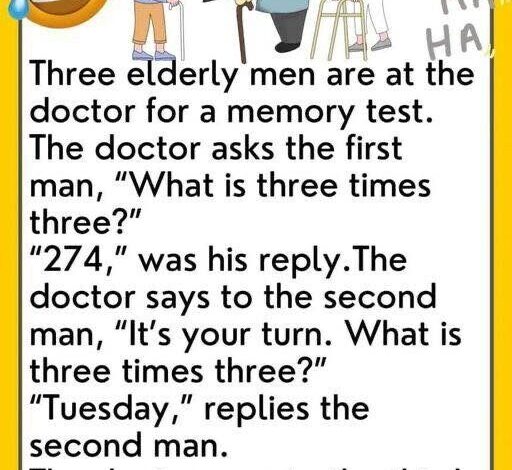
Arthur, the first to speak, hesitated. The pause stretched long, trembling and tentative, as if the words themselves were brittle and required careful handling. When he finally answered, it was not a date or a place, nor the safe, rehearsed name of someone long gone from memory. Instead, he offered a number—so improbably precise, so strangely abstract—that it sounded less like arithmetic and more like philosophy, a riddle threaded with echoes of a mind still alive, still playful.
Bernard followed, his face shadowed with uncertainty. He exhaled slowly, as if releasing the weight of a week he could no longer hold in place. “Tuesday,” he said, voice small, almost apologetic, as though the simple naming of a day might somehow anchor him in a world slipping further each hour. In his single word lay the hope that time itself could rescue him, that by grasping one fragment of the week, he might defy its unrelenting march.
Clarence came last. His eyes narrowed, a flicker of concentration crossing his features, and for a heartbeat, the room held its collective breath. He counted in silence, calculating with a precision that defied expectation. Then he spoke—and his answer, both startling and inexplicable, seemed to fracture the rules of mathematics and memory alike. For a moment, the room teetered between laughter and concern, between astonishment and the familiar ache of witnessing lives measured in fragments and fissures.
Dr. Halpern leaned back in his chair, watching them with a quiet, growing understanding. This test, the standardized grid of dates and names and numbers, had always been meant to measure decline, to catalogue the ways in which minds unraveled with age. But now it felt too small, almost cruel in its inadequacy. These weren’t failures. These were bursts of stubborn humanity, little fireworks of personality that refused to be extinguished, no matter how the years chipped away at certainty.
He made careful notes, each line written with a tenderness that bordered on reverence. Arthur’s philosophical number, Bernard’s plea to the week, Clarence’s impossible calculation—each was a declaration, a tiny manifesto: memory might be slipping, pathways might be darkened, but the essence remained. Wit, courage, and curiosity lingered still. There was an unspoken pact in the room, a shared insistence that no degree of erosion could fully erase the self.
As the patients returned to their rooms, walking slowly back through the long, echoing corridors, Dr. Halpern lingered a moment longer. He looked at the floor tiles again, noticing the subtle variations in color, the faint cracks that traced a hidden story across the linoleum. Perhaps, he thought, memory itself was like these tiles—fragmented, imperfect, but in its imperfections, unexpectedly beautiful.
He closed his notebook, the conclusion written with a quiet certainty: the test had not measured decline. It had illuminated survival—the stubborn persistence of personality, of humor, of dignity. These were not just errors; they were defiant moments of self, small but brilliant resistances against the slow, relentless tide of forgetfulness. And in them, Dr. Halpern saw something rare and fragile and magnificent: proof that even as the mind faded, the human spirit could blaze on, fully, gloriously, defiantly alive to the very end.