I Buried My Son 10 Years Ago – When I Saw My New Neighbors’ Son, I Could Have Sworn He Looked like Mine Would If He Were Alive Today

I buried my nine-year-old son a decade ago. Life had slowly settled into a quiet routine after the loss. But when new neighbors moved in next door, everything I thought I had accepted about the past unraveled in a single moment. I carried a pie across the yard to welcome them—and when their teenage son opened the door, my knees nearly gave out. He looked exactly like my boy. Same face, same hair… even the same mismatched eyes. When I rushed home and told my husband what I’d seen, he whispered a confession that changed the story of our lives.
My son Daniel died when he was nine.
He had been playing near the school entrance, kicking a ball around like he always did. A car came too quickly around the corner of a side street, and in the span of seconds everything changed. One moment he was laughing, the next he was gone.
Losing a child is the kind of pain that never really leaves you. Time passes, people expect you to heal, but grief simply reshapes itself. It becomes quieter, but it’s always there—like a scar you can feel under the skin of your heart.
For years after Daniel died, I would still turn when I heard boys laughing in the distance. Sometimes I thought I heard the sound of a ball bouncing in our driveway. For a moment my mind would believe he had come home.
Friends suggested Carl and I should try for another child. They said it might help fill the emptiness. But I couldn’t imagine starting over. The idea felt impossible.
So Carl and I settled into a quiet life in a quiet house. We learned to live around the silence.
Then one morning a moving truck pulled into the driveway next door.
Carl noticed it first. He stood by the living-room window, arms folded, watching the movers carry boxes inside.
“Well,” he said, “looks like we’ve got neighbors again.”
I leaned against the kitchen doorway and nodded.
“I’ll bake something for them,” I said. It felt like the polite thing to do, even if my heart wasn’t really in it.
That afternoon I baked an apple pie. When it cooled, I carried it carefully across the lawn and knocked on their front door.
The door opened almost immediately.
A teenage boy stood there.
I smiled out of habit—but the smile vanished before it fully formed.
The pie slipped from my hands and shattered on the porch. I barely noticed.
All I could see was the boy’s face.
It was Daniel’s face.
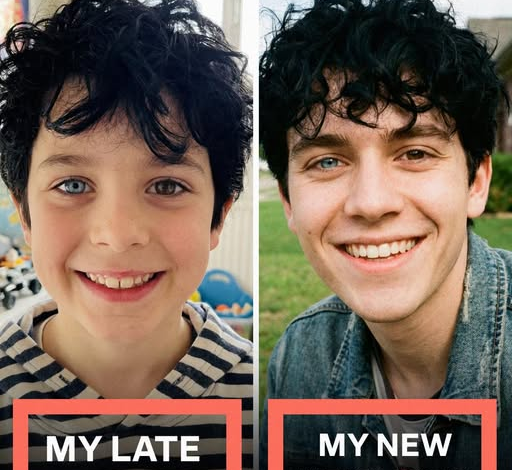
He had the same slightly curly hair, the same strong chin, the same expression Daniel used to make when he was curious about something. But the detail that froze me in place was his eyes.
One blue.
One brown.
Heterochromia.
Daniel had inherited it from his grandmother. It was something people always noticed about him.
Seeing those eyes again felt like being pulled backward in time.
“Oh my God, are you alright?” the boy asked, stepping forward to avoid the broken plate.
“Daniel?” I whispered.
He blinked in confusion.
“Ma’am? Did you burn yourself or something? Are you okay?”
He placed a hand lightly on my shoulder.
It took a moment before I could breathe properly again. My chest felt tight, like the air had disappeared from the world.
“How old are you?” I finally asked.
He tilted his head.
“Uh… nineteen.”
Nineteen.
Exactly how old Daniel would have been.
From inside the house a woman called out, “Tyler? What was that noise?”
“I’m okay, Mom,” the boy answered. “A lady dropped something.”
Mom.
Hearing him say that word to someone else felt strangely painful.
The woman appeared in the doorway behind him. I forced a polite smile.
“I’m sorry about the mess,” I said. “My son… if he had lived to grow up, he probably would’ve looked very much like your boy.”
Tyler apologized kindly for my loss, but the woman behind him suddenly looked uneasy. Her eyes moved quickly between me and her son.
Then she stepped forward.
“You need to leave,” she said sharply. “We have a lot to do today.”
Before I could say anything else, she pulled Tyler back inside and shut the door.
I stood on their porch for several seconds, unable to understand what had just happened.
Then I turned and hurried home.
Carl was sitting in the living room reading when I came in.
“You’re back already?” he asked.
I sat down beside him.
“The boy next door,” I said.
“What about him?”
“He looks like Daniel.”
Carl slowly closed his book.
“The same hair, the same face,” I continued. “Carl… he even has the same eyes. One blue and one brown.”
Carl didn’t move.
For a moment he just stared at the floor.
“I thought…” he whispered, “I thought this was buried.”
My stomach tightened.
“What does that mean?”
He covered his face with both hands. When he finally looked up, his eyes were red.
“I thought I buried that secret along with our son.”
My heart began pounding.
“What secret, Carl?”
He hesitated for several seconds before speaking again.
“When Daniel was born,” he said quietly, “there was another baby.”
I felt the room spin.
“Another baby?”
“A twin.”
He explained that the second baby had been born with severe breathing problems and rushed immediately to the neonatal intensive care unit.
“You were unconscious after the delivery,” Carl said. “You were losing blood. The doctors were trying to stabilize you.”
He told me that a hospital social worker had approached him that night about a special neonatal placement program for babies who might not survive.
“They told me the odds were extremely poor,” Carl said. “I thought he wouldn’t make it.”
I stared at him.
“And you never told me?”
Carl’s voice cracked.
“A week later the hospital called. He was still alive… still fighting. They said there was a couple willing to adopt him if I approved it.”
“And you signed the papers.”
He nodded slowly.
“I thought I was protecting you. I couldn’t bear the thought of you losing two babies.”
The realization hit me like a shock.
“So you erased him instead.”
Carl didn’t deny it.
The boy next door.
Our son.
We walked across the lawn together.
When the woman opened the door again, she looked terrified.
“Nineteen years ago,” I asked, “did you adopt a baby boy through the hospital placement program?”
Tyler appeared behind her.
“What’s going on?” he asked.
Carl looked at him carefully.
“When is your birthday?” he asked.
Tyler answered.
It was the same day Daniel had been born.
An older man stepped forward then and sighed heavily.
“We always knew this day might come,” he said.
They invited us inside and explained everything. Tyler had spent months in intensive care before he was healthy enough to leave the hospital. They had been told his biological parents believed he wouldn’t survive.
Tyler listened quietly.
“So I had a brother?” he asked.
“Yes,” I said.
“What happened to him?”
“He died when he was nine.”
Tyler lowered his head.
“That seems unfair,” he said softly. “He was born healthy… and I wasn’t.”
His adoptive mother wrapped an arm around him, and he leaned into her.
Watching that broke my heart in a different way.
He was my son.
But he was also theirs.
Later that evening Tyler came to our house alone.
“I don’t know what to call you,” he said awkwardly.
“You can call me Sue,” I told him gently.
He nodded.
“Can you tell me about my brother?”
I stepped aside and let him come in.
For the first time in years, I opened the box of Daniel’s photographs. I showed Tyler the drawings his brother made in kindergarten and the certificate he won at his first spelling bee.
I cried while telling those stories.
But for the first time in a long time, the tears didn’t feel like pure grief.
They felt like something inside me was finally beginning to heal.