Beyond the Gilded Cage, Why Barron Trumps 18th Birthday Revelation Has Shattered Every Conspiracy Theory and Left Washington Speechless

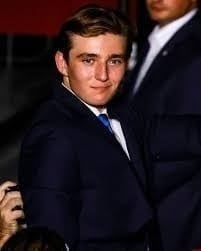
Barron Trump’s emergence into public awareness is defined less by presence than by restraint—and that, in itself, feels striking in a culture that thrives on constant exposure. Rather than stepping into the spotlight or leaning into the expectations that have surrounded him for years, he appears to be doing something far less common: setting boundaries. Not loudly, not confrontationally, but with a clear and deliberate sense of distance.
From childhood, a narrative has followed him—one shaped by legacy, projection, and assumption. The idea that he would eventually take on a public role, inherit a political identity, or become part of an ongoing national storyline was almost treated as inevitable. But what makes this moment different is the absence of that compliance.
Instead of stepping into a predefined role, he seems to be stepping back.
That choice carries weight precisely because of where it comes from. It’s not a denial of his background or the visibility that comes with his name. It’s an acknowledgment of it—paired with a decision not to let it dictate every aspect of his future. In doing so, he introduces something that often feels rare in highly visible families: the right to remain undefined.
There’s a certain clarity in that stance.
It reflects an understanding that identity doesn’t have to be performed for an audience, even when the audience is already watching. In a time when public figures—and especially those connected to power—are often expected to share, respond, and engage constantly, choosing not to participate becomes its own kind of statement.
Not a rejection of the world, but a redefinition of one’s place within it.
For many observers, that restraint resonates. It speaks to a broader tension in modern life between visibility and privacy, between expectation and autonomy. The idea that someone can carry a well-known name yet still claim space to grow, change, and remain partially unknown challenges the assumption that access is automatic.
It also shifts the conversation.
Rather than asking what role he will play or how he will fit into existing narratives, it raises a different question: what does it mean to choose your own direction when so many paths have already been mapped out for you?
In that sense, the message is quiet but firm.
A reminder that recognition does not equal ownership.
That a public identity does not erase personal boundaries.
And that stepping back can be just as intentional—and meaningful—as stepping forward.
In a world that often rewards constant visibility, choosing distance becomes its own kind of presence.