My 13-Year-Old Daughter Brought a Starving Classmate Home for Dinner – What Slipped Out of Her Backpack Made My Blood Run Cold

I used to believe that if you worked hard enough, “enough” would somehow fall into place. Enough food. Enough comfort. Enough love.
But in our home, “enough” was something I wrestled with daily — at the grocery store, in unpaid bills, and in my own thoughts.
Tuesday nights were always the same: rice, chicken thighs, a few carrots, and half an onion — stretched just far enough to feed us and maybe leave a little for tomorrow.
As I chopped vegetables, I was already calculating portions in my head, deciding which expense could wait another week.
Dan walked in from the garage, tired and worn, dropping his keys into the bowl.
“Dinner soon?” he asked.
“Ten minutes,” I replied, still doing the math.
Three plates. Maybe leftovers.
He glanced toward the hallway. “Sam finished her homework?”
“I haven’t checked,” I said. “She’s quiet — so either algebra’s winning or TikTok is.”
He smiled. “Probably TikTok.”
Just as I was about to call them in, Sam rushed into the kitchen — and she wasn’t alone.
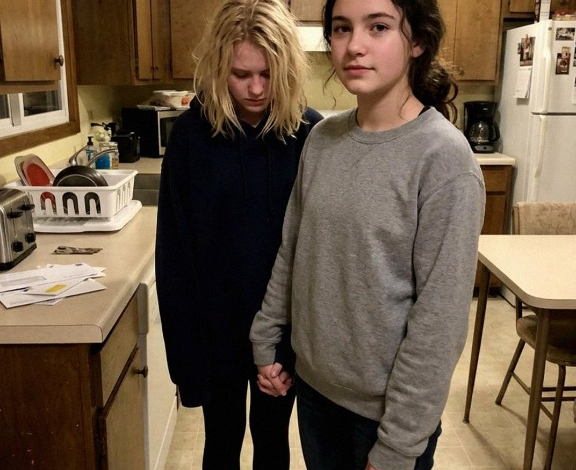
A girl followed behind her, quiet and unsure. Her oversized hoodie hung off her frame, and her hair was tied back messily. Even from where I stood, I could see how thin she was.
“Mom, Lizie’s staying for dinner,” Sam said, like it was already decided.
I froze for a second, knife still in my hand. Dan looked between us.
The girl kept her eyes down, gripping the straps of a worn backpack.
“Hi,” I said, forcing warmth into my voice. “Grab a plate.”
“Thank you,” she murmured.
At the table, I noticed everything. Lizie didn’t eat — she rationed. A spoonful of rice. One small piece of chicken. Two carrots. Every sound made her flinch slightly.
Dan tried to ease the tension. “So, Lizie — how do you know Sam?”
“Since last year,” she said quietly.
Sam jumped in. “Gym class. She’s the only one who can run a mile without complaining.”
That earned a faint smile.
Dinner stayed mostly quiet. I kept glancing at the food, silently adjusting portions in my head. Less meat, more rice — maybe no one would notice.
Afterward, Lizie hesitated near the sink, but Sam stopped her.
“You forgot dessert,” she said, handing her a banana.
Lizie blinked. “Really?”
“House rule,” Sam said. “Nobody leaves hungry.”
Lizie clutched it like it mattered more than it should.
“Come back anytime,” Dan added.
When the door closed, I turned to Sam.
“You can’t just bring people over like that. We’re barely managing.”
“She didn’t eat all day, Mom,” Sam shot back. “What was I supposed to do?”
I started to argue, but she continued.
“She almost passed out at school. Their power got shut off. She barely eats.”
My frustration faded into something heavier.
“I’m sorry,” I said quietly.
The next day, I made extra.
And the next.
By the end of the week, Lizie was part of our routine — homework at the table, quiet dinners, helping with dishes. She was always polite, always careful, always grateful.
Too careful.
One afternoon, her backpack fell open. Papers scattered across the floor — bills, coins, notices stamped with words like FINAL WARNING and EVICTION.
My chest tightened.
“What is this?” I asked gently.
She froze.
“My dad said not to tell anyone,” she whispered. “People will think we’re begging.”
“You’re not,” I said softly. “You’re struggling. There’s a difference.”
Dan joined us, and soon we called her father.
When he arrived, he looked exhausted — like someone trying to carry too much for too long.
“I thought I could fix it,” he admitted. “If I just worked harder.”
“She shouldn’t be carrying this,” Dan said. “She’s a kid.”
That night, we started making calls. The school counselor. A local food pantry. The landlord.
It wasn’t a miracle, but things began to shift.
The school stepped in. Lizie got regular meals. Her dad found temporary relief with rent. Slowly, support replaced silence.
She began staying with us a few nights each week.
And something changed.
She started smiling more. Laughing. Talking.
Helping Sam with math.
One evening, she lingered in the kitchen.
“I used to be scared to come here,” she admitted. “Now… it feels safe.”
I handed her a packed lunch.
“You belong here,” I told her.
She hugged me tightly. “Thank you… Aunt Helena.”
After she left, Sam looked at me with quiet pride.
“You saw someone who needed help,” I said. “And you didn’t ignore it.”
She shrugged, smiling. “You wouldn’t have either.”
Maybe she was right.
The next evening, both girls burst through the door, laughing.
“What’s for dinner?” Sam asked.
“Rice,” I said, smiling, “and whatever I can stretch.”
But this time, I set out four plates without even thinking.