They Cut Down Trees That Had Stood on My Family’s Land for Forty Years Just to Improve Their View, So I Used the Only Leverage I Had Left and Shut Down the Road That Led to Their Homes, Forcing an Entire Neighborhood to Face What They Had Taken and What It Would Cost to Make It Right

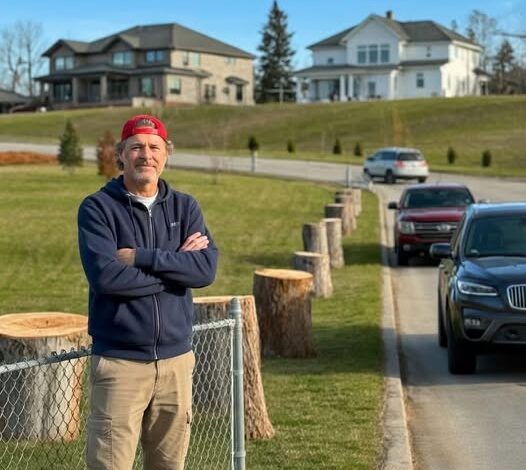
The first tree didn’t fall loudly enough to warn me. There was no shout, no message, no ring of a phone—just the distant hum of machinery beyond the ridge and a quiet assumption that whatever was happening wasn’t my concern. By the time I arrived home that evening, the damage was done. Where there had once been a line of tall, steady trees—trees my father had planted decades ago—there were now six clean-cut stumps. No branches, no leaves, no shade. Just bare earth and the sharp, unnatural outline of what had been. Beyond that empty space stood the new houses, polished and gleaming, their wide windows staring directly into my yard as if they had always had the right to see everything within it.
Those trees weren’t just part of the landscape. They were part of my life. I remembered pressing dirt around tiny saplings alongside my father, my small hands unsure how to shape something meant to outlast me. I remembered summers spent in their shade, the way sunlight dappled the yard in gentle patterns, the quiet they created between our home and the world beyond. They weren’t just trees—they were guardians, boundaries, pieces of family history rooted in soil and memory. And in a single day, they were gone.
The explanation came quickly, though it softened nothing. The homeowners association from the new development called it a “view corridor.” To them, it was an enhancement—a planning term, a line in a spreadsheet designed to increase property values, to allow uninterrupted sightlines from their new homes. It sounded clinical, almost harmless. But standing there, staring at what had been erased, I knew what it really was: a choice made without permission, an erasure of what was never theirs to erase.
That night, I didn’t storm up to their doors. I didn’t yell, or argue, or try to explain the depth of what had been lost. Instead, I went inside and pulled down the old documents my grandfather had meticulously kept: surveys, easements, land agreements. Years of paper, yellowed at the edges, each a record of decisions, rights, and boundaries. Hours passed as I sorted through them, deciphering what was still legally binding. And then I found it: a narrow easement, an almost forgotten clause defining the road leading to their development—the only road, Pine Hollow Road, which ran across land that still belonged to my family.
By morning, before the neighborhood stirred fully, I was outside. The chain I stretched across the road wasn’t symbolic. It wasn’t a temporary protest. It was heavy, anchored with a thick padlock, a physical declaration that the road they relied on crossed land that had never ceased to be ours. This wasn’t argument—it was reality.
At first, they dismissed it. People rarely take seriously what interrupts their routines. They assumed it would be a misunderstanding resolved with a phone call, a polite conversation, or a shrug. But the chain stayed. The lock stayed. Hours turned into a full day of blocked deliveries, frustrated commutes, and rising irritation. Messages flew, emails piled up, complaints gathered. None of it mattered. The law and the land held the authority, and until acknowledgment and action occurred, nothing would change.
I didn’t stand there responding to their frustration. I waited. Not out of malice, not for vengeance, but because I understood something they didn’t: some losses aren’t repaired with words alone. They require recognition. They require accountability. Only then can the balance begin to be restored.
The legal process confirmed what I already knew. Surveys were precise. Boundaries were clear. The trees had stood entirely on my property. There was no ambiguity, no shared responsibility, no gray area. Trespass. Timber removal. Property damage. The words were simple, but their weight was not. A view corridor, in their planning, had become a costly oversight—and one that had consequences.
The conversations shifted. The tone changed. It wasn’t about inconvenience anymore. It was about restitution. About repairing what had been taken. And eventually, a resolution emerged. Not quickly. Not perfectly. But clearly. The land would be restored. The loss acknowledged. And life, in some form, would move forward.
Late November arrived under a gray sky, mirroring the mood of weeks past. The trucks came first thing in the morning, delivering young sycamore trees, each root carefully wrapped, each branch bare but sturdy. Workers planted them methodically, pressing the soil firmly, making sure each tree stood upright. They were not the same trees my father had planted, nor could they ever be, but they were a beginning. A chance to rebuild, to reclaim the boundaries and memories that had been so casually erased.
I watched each tree settle into place, feeling something that wasn’t satisfaction and wasn’t relief. It was closer to balance. The first tree, upright and rooted in the same soil, was a quiet triumph. I returned to the road, still blocked, unlocked the padlock, and removed the chain. The road opened. The frustration faded. Life in Cedar Ridge resumed its rhythms.
But things had changed. The houses across the ridge no longer owned the view. They now looked upon land with history, with meaning, with boundaries. Every glance toward the horizon would remind them: not everything within sight belongs to those who see it. Land carries ownership, stories, and consequences. What is taken without consent always demands acknowledgment—sometimes immediately, sometimes slowly, but always inevitably.
Over time, the sycamores will grow. Their branches will stretch, their leaves will return, and the empty space will fill again. The view will change, incrementally and subtly. And when anyone gazes from those polished windows, they will see more than just a yard. They will see trees reborn. They will see history. They will see the quiet reminder that respect for what is rooted—whether in soil or in legacy—is never optional.