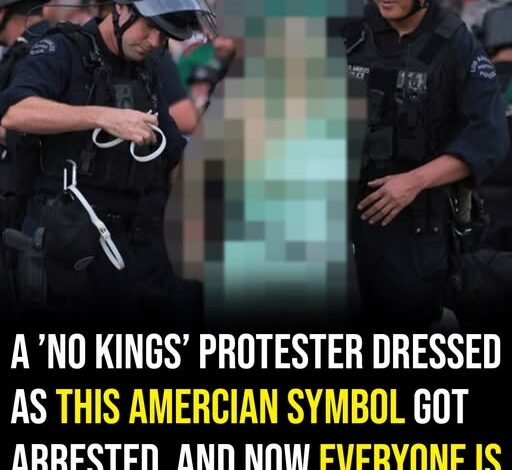
She stepped into downtown Los Angeles wrapped in foam, fabric, and symbolism—but the weight she carried had little to do with the costume itself. A plastic torch in one hand, a makeshift crown balanced on her head, and a message written not just in signs but in presence: no kings. What began as performance quickly blurred into protest, and protest into confrontation. By the end of the day, the image had changed. The torch was gone, her wrists were bound in plastic restraints, and the same figure who had walked in as a symbol now stood exposed as a person caught in the machinery of power.
Around her, the city pulsed with noise—sirens, chants, the low hum of helicopters overhead. Crowds surged and fractured, some stepping forward in solidarity, others retreating to the safety of distance. And then, almost instinctively, phones rose. Hundreds, then thousands. Screens lit up, capturing a moment that would travel far beyond that street. In seconds, what was unfolding in real time became something else entirely—a shared image, a fragment of narrative, a symbol open to interpretation.
Online, she was already known. Her posts had cut sharply through timelines—criticizing wealth, questioning institutions, mocking authority with a tone that was equal parts defiant and unapologetic. For some, she represented clarity in a confusing system; for others, she was simply another voice pushing too far. But in that moment—crown tilted, shoulders turned, hands restrained—those digital impressions faded into something more immediate and human.
The photograph spread quickly. Supporters saw contradiction: a country built on rebellion now confronting its own dissent. To them, her arrest echoed a deeper discomfort—an unease with voices that refuse to conform. Critics, however, saw something different. They pointed to order, to consequence, to the limits of protest when it crosses into disruption. The same image, two completely different readings, each reinforcing beliefs already held.
What made the moment powerful wasn’t just the arrest itself, but the transformation it captured. A figure designed to represent an idea—freedom, resistance, critique—suddenly stripped of distance and abstraction. No longer just a symbol, she became tangible. Vulnerable. Real. And that shift forced people to confront something uncomfortable: the line between performance and reality is thinner than it appears.
The crowd eventually moved on, as crowds always do. Streets were cleared, barriers reset, and the city returned to its usual rhythm. But the image remained. It lingered in feeds, in headlines, in conversations that stretched far beyond Los Angeles. It didn’t offer answers or resolve debates. Instead, it held tension—between power and protest, between image and identity, between what people believe and what they are willing to see.
Moments like this don’t define a country, but they reveal it. They expose the fractures, the competing narratives, the questions that don’t have simple resolutions. Was it a necessary enforcement of order? A suppression of expression? A staged act turned real? The answers depend on who is looking—and what they already believe.
What’s undeniable is this: the moment didn’t end when the cuffs clicked shut. It expanded. It became part of a larger conversation about authority, dissent, and the evolving meaning of public expression. The costume, once theatrical, now carried a different kind of weight—not just as a statement, but as evidence of how quickly symbolism can collide with consequence.
In the end, the image doesn’t settle anything. It doesn’t tell us what America is becoming. But it does something just as powerful—it refuses to let the question be ignored.