My 8-Year-Old Son Was Teased for Wearing Duct-Taped Sneakers – The Next Morning, the Principal Made a Call That Changed Everything

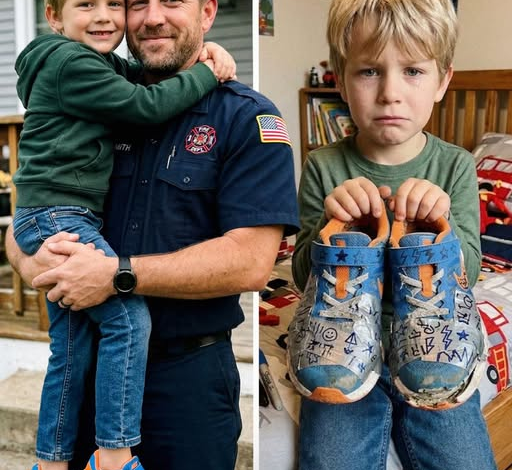
I once believed that losing my husband in a fire would be the greatest hardship my son and I would ever endure. I couldn’t have imagined that something as simple as an old pair of sneakers would challenge us in a way that would change our lives.
My name is Dina, and I’m raising my eight-year-old son, Andrew, on my own.
Nine months ago, my husband—Andrew’s father—lost his life in a fire. He was a firefighter, and on the night he died, he went back into a burning house to rescue a little girl around Andrew’s age. He saved her… but he didn’t make it out himself.
Since that night, it’s just been the two of us.
Andrew has carried the loss in a way that feels far beyond his years. He stayed quiet, strong, almost as if he made a silent promise not to break down in front of me. But there was one thing he refused to let go of—a pair of sneakers his dad had given him shortly before everything happened.
Those shoes became more than just something to wear. They were his connection to his father, and he wore them every single day, no matter the weather or how worn they became.
Eventually, though, they couldn’t hold together anymore. A couple of weeks ago, the soles completely came apart.
I told Andrew I would find a way to get him a new pair, even though I had just lost my job as a waitress. The restaurant said I looked “too sad” for customers. I didn’t argue. Money was tight, but I still planned to figure something out.
Andrew didn’t want new shoes.
“These are from Dad,” he said.
Then, without hesitation, he handed me a roll of duct tape, as if the solution were obvious.
“We can fix them.”
So I did my best. I carefully wrapped the shoes, even decorating the tape a little so it wouldn’t stand out as much.
That morning, I watched him leave for school wearing those patched-up sneakers, hoping other kids wouldn’t notice.
They did.
When Andrew came home that afternoon, he was unusually quiet. He walked straight to his room without saying a word. I gave him a little time, but then I heard it—that kind of crying that shakes you to your core as a parent.
I rushed in and found him curled up on the bed, holding those shoes like they were everything he had left.
Through tears, he finally told me what had happened. Kids at school had mocked him. They laughed at his shoes, made cruel comments, and even said things about us, calling his shoes “trash” and saying we belonged in a dumpster.
I held him until he calmed down, until he cried himself to sleep. I stayed there long after, staring at those taped-up sneakers, feeling my heart break again and again.
The next morning, I thought he’d refuse to go to school—or at least wear something else.
But he didn’t.
He got dressed, picked up the same shoes, and put them on without hesitation.
“You don’t have to wear those today,” I told him gently.
“I’m not taking them off,” he said quietly.
There was no anger—just determination.
So I let him go, even though I was worried.
Later that morning, the school called. The principal’s voice sounded off, and he asked me to come immediately.
My mind raced the entire drive. I feared the worst.
When I arrived, I was led straight to the gym.
Inside, over 300 students sat silently in rows.
At first, I didn’t understand what I was seeing. Then I noticed something that made me stop in my tracks.
Every single student had duct tape wrapped around their shoes.
Some had messy tape, others neat, some even decorated—but all of them had done the same thing Andrew had.
I spotted my son sitting near the front, looking down at his shoes.
Confused, I turned to the principal.
He explained that it had all started that morning. A girl named Laura—who had been absent—returned to school. She was the same child my husband had saved.
When she saw Andrew being bullied, she sat with him and asked about his shoes. After hearing his story, she realized who he was.
She told her older brother, Danny, a well-liked student. He went to the art room, grabbed tape, and wrapped his own expensive sneakers. Soon, other students followed.
What had been a reason for ridicule the day before had suddenly become a symbol of respect and unity.
The principal told me he had never seen anything like it. The students had gathered to honor Andrew’s father.
When Andrew finally looked up, I saw something I hadn’t seen in him since before the bullying—confidence.
The bullying stopped that day.
In the days that followed, Andrew still wore those same shoes, but now he wasn’t alone. Other kids continued to show support, and slowly, my son started to open up again.
He began talking more, laughing, sharing little stories about his day. It felt like I was getting him back.
A few days later, the school called again. This time, the tone was different—lighter. They asked me to come in again around noon.
When I arrived, the gym was full again, but this time everyone wore regular shoes.
The principal stepped forward and called Andrew up. Then a man in uniform entered—it was Jim, the fire station captain who had worked with my husband.
He spoke about Jacob—about his courage and the sacrifice he made.
Then he shared something unexpected. The community had come together to create a scholarship fund for Andrew’s future.
I couldn’t hold back my tears.
But there was more.
Jim presented Andrew with a brand-new pair of custom sneakers, designed with his father’s name and badge number.
Andrew hesitated before taking them, as if he couldn’t believe they were really his.
When he finally put them on, I saw something change in him—not just happiness, but pride.
The room filled with applause, but Andrew stood calmly, shoulders straighter than before.
He wasn’t the kid who had been mocked anymore. He was the son of a hero.
After the assembly, people came up to us—teachers, parents, even students. For the first time in a long while, we didn’t feel alone.
Before we left, the principal asked to speak with me privately. He told me he’d heard about my situation and offered me a job at the school in an administrative role.
I didn’t hesitate. I accepted.
When I rejoined Andrew, he asked if he could keep both his old sneakers and the new ones.
“Of course,” I told him.
As we walked out of the school together, I felt something I hadn’t felt in months—hope.
Not because everything had suddenly become perfect, but because people had shown kindness, and my son had found strength in himself.
For the first time since everything happened, I knew we were going to be okay.
And this time, we weren’t facing it alone.