Six Years After One of My Twin Daughters Died, My Second One Came from Her First Day at School, Saying: ‘Pack One More Lunchbox for My Sister’

There are some wounds that never really close.
They don’t always bleed in obvious ways, but they live in you anyway—in the pauses between breaths, in quiet rooms, in the moments when happiness catches you off guard and grief reminds you what it took to get there.
For me, that wound was born six years ago in a hospital room that smelled like antiseptic and fear.
I went into labor expecting to meet my twin daughters.
Instead, I was told only one of them survived.
They gave me Junie.
And they told me Eliza was gone.
Just like that.
No explanation that made sense. No goodbye. No chance to hold her. Just soft voices and phrases like “complications” and “we did everything we could,” as if those words were enough to fill the hollow that opened inside me.
They never even let me see her.
That kind of loss doesn’t leave you unchanged. It settles into your bones. It rewrites the way you move through the world.
Michael and I tried to carry it together at first. We whispered Eliza’s name in the dark like it was something fragile, something holy. We kept her alive in the only way we knew how—through memory, through imagination, through the ache of what should have been.
But grief can make strangers out of people who once knew each other by heart.
Over time, my sadness became something Michael couldn’t live beside anymore. Or maybe it was his own pain he couldn’t face. Either way, he left.
And after that, it was just me and Junie.
Me and the daughter I could hold.
And the daughter I thought I had lost.
By the time Junie started first grade, I had learned how to function around the absence.
Not heal. Not move on. Just function.
I packed lunches, folded laundry, paid bills, and smiled when people expected me to. I learned how to keep living while carrying a grief no one could see anymore.
The morning of her first day of school, Junie bounced all the way to the car in brand-new sneakers and crooked pigtails, full of nervous excitement. I waved as she disappeared through the school doors and stood there for a second longer than necessary, as if motherhood was just another word for worrying in public.
Then I went home and did what I always did when I felt anxious: I cleaned.
I wiped counters. Scrubbed the sink. Rearranged things that didn’t need rearranging. Tried to silence the unease by staying busy.
By the time the front door slammed open that afternoon, I was at the kitchen sink with soap still on my hands.
Junie burst inside flushed with excitement, backpack slipping off one shoulder.
“Mom! Tomorrow you need to pack another lunch!”
I turned, smiling automatically. “Another lunch? What for? Didn’t I give you enough today?”
She looked at me like I had missed something obvious.
“For my sister.”
I laughed at first. Not because it was funny, but because I didn’t understand.
“Sweetheart,” I said gently, “you don’t have a sister.”
She frowned immediately, stubborn in that way that always reminded me of her father.
“Yes, I do. I met her today.”
Something in my chest tightened.
“What do you mean, baby?”
“She sits next to me,” Junie said matter-of-factly, already digging through her backpack. “Her name is Lizzy. And she looks just like me.”
I stared at her.
The room suddenly felt too still.
“She looks just like you?”
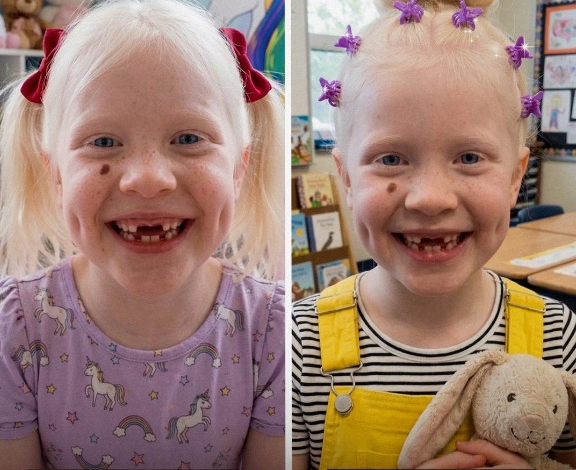
Junie nodded eagerly. “Same hair. Same eyes. Even the same freckles. Only her hair part goes the other way.”
I tried to keep my face calm, but a cold unease was already spreading through me.
“And… what does Lizzy like for lunch?”
“Peanut butter and jelly,” she said. “But she said your sandwiches have more jelly than her mom puts on them.”
I don’t think I breathed for several seconds.
Then Junie lit up. “Oh! I took a picture!”
That morning, I had tucked a little disposable camera into her backpack, thinking it would make the day feel special. A first-grade memory project. Something sweet to put in a scrapbook later.
She handed it to me proudly.
I flipped through the photos, half distracted—until I reached the one by the cubbies.
And there they were.
Two little girls standing shoulder to shoulder.
Junie.
And another child who looked so much like her it made my hands go numb.
Same curls. Same eyes. Same delicate freckles under the left eye.
I nearly dropped the camera.
“Honey,” I asked, my voice thin, “had you ever seen this girl before today?”
Junie shook her head. “No, but Ms. Kelsey asked if we were sisters. Lizzy said maybe we are.”
Maybe we are.
The words lodged somewhere deep inside me.
That night, after Junie was asleep, I sat on the couch with that photo in my lap and stared until my eyes burned. Logic fought with instinct, but somewhere under the fear, underneath the disbelief, was something even more terrifying:
Recognition.
A knowing I could not explain.
I didn’t want to hope. Hope felt dangerous.
But by morning, I knew I had to see her for myself.
The next day, I drove Junie to school instead of putting her on the bus.
She chattered the whole way there, talking about crayons, recess, and how Lizzy liked purple but maybe only because her backpack was purple and not because it was really her favorite color.
I barely heard any of it.
My hands were locked around the steering wheel so tightly my fingers ached.
When we reached the school, the parking lot was chaos—children darting across the pavement, parents calling goodbye, teachers guiding traffic with tired smiles.
Then Junie squeezed my hand and whispered, “There she is.”
I followed her gaze.
A little girl stood near the big tree by the entrance.
And for one suspended, impossible moment, it felt like I was looking at my own daughter twice.
She was there. Real. Breathing. Shifting shyly beside a woman in a navy coat.
My stomach dropped.
And then I saw someone else standing slightly behind them.
A woman I hadn’t seen in six years.
Marla.
The nurse.
Older now, but unmistakable.
The sight of her hit me like a blow.
Junie waved and ran ahead, already smiling toward the little girl.
I watched them meet like magnets, drawn together with a certainty that didn’t need explanation. Then I crossed the grass, my heartbeat pounding in my ears.
“Marla?”
She turned sharply, and the color drained from her face.
“Phoebe…”
My voice shook. “What are you doing here?”
Before she could answer, the woman in the navy coat stepped forward.
“You must be Junie’s mother,” she said softly. “My name is Suzanne. We need to talk.”
I looked from her to Marla and back again.
Every instinct in me was screaming.
“How long have you known?” I asked.
Suzanne’s composure cracked immediately. “Two years.”
The number hit harder than I expected.
“Two years?”
She nodded, tears already gathering. “Lizzy had an accident. She needed blood. My husband and I weren’t matches. So I started asking questions. Looking into paperwork. And eventually… I found the altered record.”
Altered record.
I repeated the phrase silently like my mind couldn’t process it.
“You knew for two years,” I said. “You knew my daughter was alive, and you said nothing.”
Suzanne’s face crumpled. “I was afraid.”
I laughed then, a harsh, broken sound.
“Afraid?” I said. “I buried her in my mind every single day. I mourned a child who was alive somewhere in this city, and you were afraid?”
She flinched, but she didn’t deny it.
“I told myself I was protecting Lizzy,” she whispered. “But the truth is, I was protecting myself.”
I turned to Marla.
The fury I had carried for six years without direction suddenly had a face.
“You took my daughter from me.”
Her lower lip trembled. “It was chaos that night,” she said. “There was confusion in the nursery. I made a mistake, and then when I realized what I’d done, I panicked.”
“A mistake?” My voice rose. “A mistake is a mislabeled folder. A mistake is the wrong dosage on a chart before someone catches it. You let me believe my child was dead.”
Tears streamed down her face.
“I know.”
“No,” I snapped. “You don’t.”
People had started staring. A teacher stepped closer, concern written across her face, but I didn’t care anymore.
For six years I had carried that grief alone.
Now it finally had witnesses.
The days that followed were a blur.
Meetings at the school.
Police reports.
Phone calls.
Lawyers.
Hospital administrators using careful words and practiced expressions while trying to explain the unexplainable.
Marla was reported. The hospital opened an investigation. Records were reviewed. Statements were taken.
I moved through all of it in a fog, barely trusting my own body.
Because even with the truth finally spoken aloud, my mind kept falling back into old habits. I would wake in the night with the familiar ache of loss before remembering—
Eliza was alive.
Eliza was alive.
And some part of me still didn’t know how to hold that kind of miracle and devastation at the same time.
Because what no one talks about is this:
The truth doesn’t erase grief.
It changes it.
It gives it a new shape.
Now I wasn’t grieving a dead child.
I was grieving six stolen years.
First steps I missed.
First words I never heard.
Birthdays, fevers, scraped knees, bedtime songs—all the ordinary pieces of motherhood that had been taken from me before I even knew they belonged to me.
That loss was harder in some ways, because it had a face.
It had laughter.
It had a little girl named Lizzy who didn’t yet understand why every adult in the room looked like they were trying not to fall apart.
Suzanne and I eventually sat down in a counselor’s office while the girls played on the rug nearby, building a block tower and knocking it down in fits of laughter.
I watched them together and felt something inside me break and heal at the same time.
“Do you hate me?” Suzanne asked quietly.
I looked at her for a long moment.
She looked exhausted. Guilty. Human.
And that made it harder, not easier.
“I hate what you did,” I said finally. “I hate that you knew and stayed silent. I hate that you got two years I should have had. But I can see that you love her.”
Suzanne covered her mouth and cried.
“That doesn’t make this okay,” I said. “It never will.”
“I know.”
“But she loves you too,” I continued, forcing the words through the ache in my throat. “And whatever happens next, I won’t let her be torn apart by what the adults did.”
Suzanne nodded, tears slipping down her face.
“If there’s any way for us to figure this out,” she whispered, “I want to.”
I looked over at the girls.
Junie had her arm around Lizzy’s shoulders as they argued about where the tiny toy couch should go in the dollhouse.
“They’re sisters,” I said. “That part isn’t up for debate.”
And for the first time since the truth came out, Suzanne gave me a look not of fear, but gratitude.
Later, I sat across from Marla in a mediation room and listened to her confession in full.
The babies had been switched in the chaos after delivery. Charts were mishandled. Then came panic, then lies, then more lies to cover the first one.
By morning, she said, she had convinced herself it was already too late to tell the truth.
“I kept thinking I would fix it,” she said, voice shaking. “And then one day became a week, and a week became a year, and by then I didn’t know how to undo what I’d done.”
I stared at her across that table.
“You don’t get to call this panic anymore,” I said. “You let me live inside a nightmare for six years.”
She nodded, crying openly now. “I deserve whatever happens.”
Maybe she did.
Maybe there was no punishment large enough.
But sitting there, I realized something surprising: I no longer wanted revenge as much as I wanted the truth to stay visible. No more secrecy. No more stolen time. No more letting other people decide what I could survive.
Two months later, I took both girls to the park.
It was one of those bright afternoons that almost feel staged—sunlight spilled across the grass, the smell of sunscreen and popcorn in the air, children screaming happily from the swings.
Junie and Lizzy sat cross-legged on a picnic blanket, eating melting rainbow ice cream and arguing over who had invented putting popcorn in the cone.
“I did,” Junie insisted.
Lizzy stuck out her tongue. “No, I did. You copied me.”
I laughed and reached for the disposable camera tucked beside the cooler.
That had become our thing.
A different color each time.
Pink. Lilac. Yellow.
We were filling drawers with blurry, imperfect, beautiful proof that we were here now, together, making up for lost time in the only way anyone ever can—one memory at a time.
“Smile!” I called.
They pressed their cheeks together and shouted, “Cheese!”
I snapped the picture.
And for one full second, I felt nothing but gratitude.
Not because the pain was gone.
Not because the years had been returned.
But because something had survived.
Love had survived.
Motherhood had survived.
And somehow, despite lies and silence and everything that had been taken from us, the bond between my daughters had found its way back to itself.
Junie climbed into my lap a few minutes later. Lizzy leaned against my shoulder.
“Mom,” Junie said, “are we going to get all the camera colors?”
Lizzy looked up at me hopefully. “Even green?”
I smiled and kissed the tops of both their heads.
“All of them,” I said. “That’s a promise.”
My phone buzzed then—a message from Michael, something about delayed child support, some excuse wrapped in familiar distance.
I looked at the screen for a moment, then turned it face down.
He had stepped away from this life a long time ago.
But I was still here.
And now, finally, so were both my girls.
No one could give me back the six years I lost.
No one could erase the grief, or the birthdays missed, or the version of myself that learned how to mourn a living child.
But from that moment on, the story belonged to us.
And no one was ever going to steal another day.