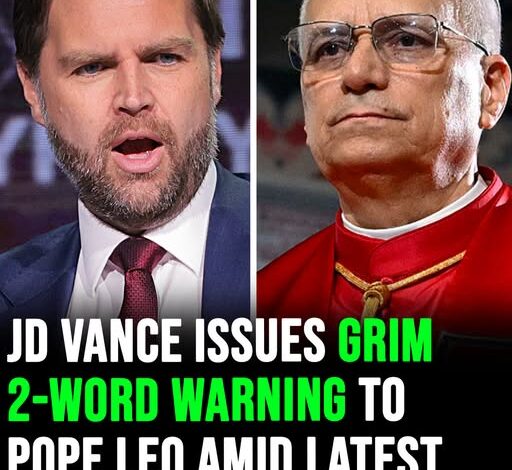
The escalating clash between Donald Trump and Pope Leo XIV has moved well beyond the realm of political rhetoric. What began as sharp criticism has evolved into a deeper, more consequential confrontation—one that touches on the authority to define morality in times of conflict. At its core, this is not simply a disagreement over policy, but a collision between two very different visions of leadership, responsibility, and what it means to act justly in a world shaped by war.
When Pope Leo XIV condemned the bombing of civilian infrastructure and warned against what he described as the “idolatry of self and money,” his message carried moral weight that extended far beyond any single nation. His words were not just directed at military decisions, but at the broader values that justify them. In doing so, he implicitly challenged the narrative of strength often promoted in political spheres—a narrative that prioritizes dominance, control, and decisive action, sometimes at the expense of humanitarian concern.
Trump’s response, and the reaction it sparked, revealed just how sensitive that challenge was. For many of his supporters, strength is synonymous with leadership, and criticism from a religious authority—especially one framed in moral or ethical terms—can be seen as an overreach. Yet the Pope’s position reflects a longstanding tradition within the Church: to speak on behalf of the vulnerable, particularly in times when their voices are drowned out by the machinery of war.
Giorgia Meloni’s intervention added another layer to the situation. By publicly calling Trump’s remarks “unacceptable,” she signaled that even within allied or ideologically adjacent circles, there are limits to what can be said—or at least to how such statements are received. Her response suggested a recognition that rhetoric, especially when it intersects with religion and global conflict, carries consequences that extend beyond domestic audiences.
The situation intensified further with JD Vance’s comments. As a Catholic convert, his decision to tell the Pope to remain within the bounds of theology—and not venture into political critique—reversed traditional expectations. Historically, religious leaders have often been seen as moral voices capable of challenging political power, not deferring to it. Vance’s framing instead positioned political authority as the ultimate arbiter, even on questions that are deeply ethical in nature.
His reference to World War II attempted to place the current conflict within a familiar moral framework—one where force is justified by the pursuit of a greater good. But in doing so, it sidestepped the Pope’s central argument: that even in justified conflicts, the cost borne by civilians—children, the elderly, the sick—must remain at the forefront of moral consideration. The Pope’s message was less about denying the complexities of war and more about refusing to let those complexities obscure human suffering.
Ultimately, this confrontation is not just about individuals or institutions. It reflects a broader tension in modern society—between power and principle, between action and reflection, between the pursuit of victory and the preservation of humanity. It raises difficult questions about who gets to speak for moral truth, and whether that truth is shaped more by authority or by compassion.
In the end, the debate circles back to a simple but profound question: whose suffering matters enough to change the course of events? And perhaps more importantly, who is willing to say “enough,” even when doing so challenges the very structures of power that define our world?