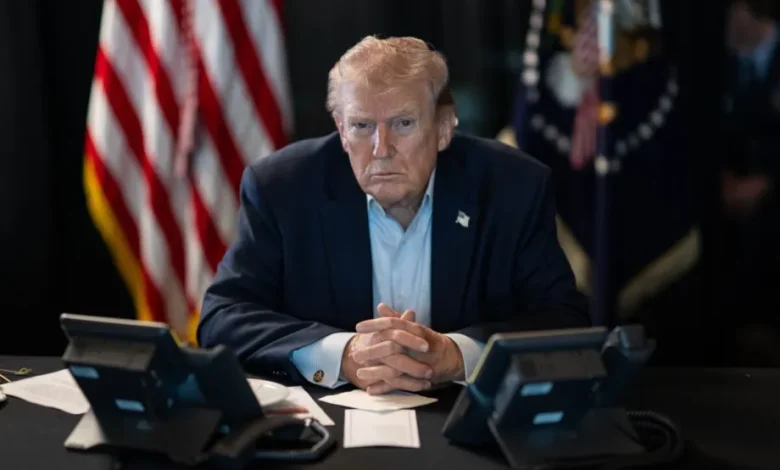
In a development that has added new tension to already strained transatlantic relations, President Donald Trump said Tuesday that the United States would move to cut off trade with Spain following a dispute over the use of Spanish military bases during the escalating conflict involving Iran. The remarks came during a meeting at the White House with German Chancellor Friedrich Merz, where the issue of military cooperation within NATO and broader European relations was expected to be discussed.
Speaking to reporters in the Oval Office, Trump expressed strong frustration with Spain’s recent decision regarding U.S. access to military facilities located on Spanish territory. According to the president, Madrid’s refusal to allow those bases to be used in operations related to potential strikes on Iran represents a serious breach of cooperation between allies.
“We’re going to cut off all trade with Spain,” Trump said during the exchange with journalists. “We don’t want anything to do with Spain.”
The comment immediately raised questions among diplomatic and economic analysts, as Spain is both a key NATO member and an important economic partner of the United States. Trade between the two countries includes a wide range of goods and services, from agricultural exports and industrial equipment to tourism and technology partnerships. A complete halt to trade would represent an extraordinary escalation in a dispute that until recently had largely been confined to defense policy.
The controversy stems from a statement released earlier by the Spanish government clarifying its position on the use of its military bases. Spanish officials said that U.S. forces had not used Spanish territory to launch attacks on Iran and emphasized that they would not permit such use going forward without explicit approval from Madrid.
Spain hosts several strategic military installations that have long been part of defense cooperation with the United States and NATO. Facilities such as Naval Station Rota and Morón Air Base play an important role in operations across the Mediterranean and the Middle East. While U.S. forces have access to these bases under bilateral agreements, Spain retains sovereign authority over how and when they are used.
In its statement Monday, the Spanish government stressed that this principle remains central to its defense policy. Officials said that Spain maintains full control over its military infrastructure and that any foreign use of those facilities must align with Spanish law and international obligations.
The clarification appeared aimed at responding to reports suggesting that the United States might use Spanish bases as staging points for potential military actions connected to rising tensions with Iran. By publicly stating that such operations would not take place from Spanish territory, Madrid signaled its intention to avoid direct involvement in the confrontation.
Diplomatic observers say the disagreement reflects broader divisions within NATO and the European Union over how to respond to the growing crisis in the Middle East. While some governments have expressed support for strong military deterrence, others have emphasized the importance of diplomatic solutions and caution against escalating the conflict further.
Spain has historically favored a more restrained approach to regional military engagement, often prioritizing diplomatic initiatives and multilateral coordination through the United Nations and European institutions. Officials in Madrid have argued that preventing further escalation in the region requires careful management of alliances and a clear commitment to international law.
Trump’s remarks, however, suggest that Washington views Spain’s position as a lack of support at a critical moment. By raising the possibility of cutting off trade, the president introduced a powerful economic dimension to what had previously been a defense policy disagreement.
Trade experts note that implementing such a measure would be complex and would likely involve negotiations with Congress, international trade bodies, and the European Union. Spain is part of the EU’s single market, meaning any major change in U.S.–Spain trade policy could potentially affect broader U.S.–EU economic relations as well.
European officials have so far responded cautiously to the statement, emphasizing the importance of maintaining dialogue between allies. Analysts point out that tensions between NATO partners occasionally arise over military operations, particularly when they involve conflicts outside Europe. Historically, such disagreements have often been resolved through diplomatic negotiation rather than economic retaliation.
The timing of the dispute is particularly sensitive given the wider geopolitical climate. With instability in the Middle East increasing and international attention focused on potential escalation between Iran and Western allies, maintaining unity among NATO members is seen by many strategists as critical.
Germany, whose chancellor was present during Trump’s remarks, has also called for coordination and careful diplomacy among Western partners. Chancellor Merz’s visit to Washington was widely viewed as an opportunity to discuss security cooperation, energy policy, and economic relations between Europe and the United States.
For Spain, the issue centers on sovereignty and domestic political considerations. Allowing foreign military operations from its territory can be controversial within Spanish politics, and governments have historically taken care to ensure that such decisions are consistent with national law and parliamentary oversight.
Spanish officials reiterated this stance in their statement, emphasizing that Madrid retains the authority to determine how its military infrastructure is used. They also stressed that Spain remains committed to its alliances and continues to cooperate closely with NATO partners on defense and security matters.
Whether Trump’s threat to halt trade will translate into concrete policy remains uncertain. Diplomatic tensions between allies often produce strong rhetoric in the short term before giving way to negotiation behind closed doors.
Still, the episode highlights how quickly disagreements over military strategy can spill into economic and political arenas. As the broader international situation continues to evolve, relations between the United States and its European partners will likely face additional tests.
For now, the dispute over Spain’s military bases has become another reminder of the delicate balance within international alliances—where questions of sovereignty, strategy, and cooperation can intersect in ways that shape both diplomacy and global trade.