Thrown Out at 15 With $9, What She Built Underground Let Her Survive a Blizzard That Killed Others

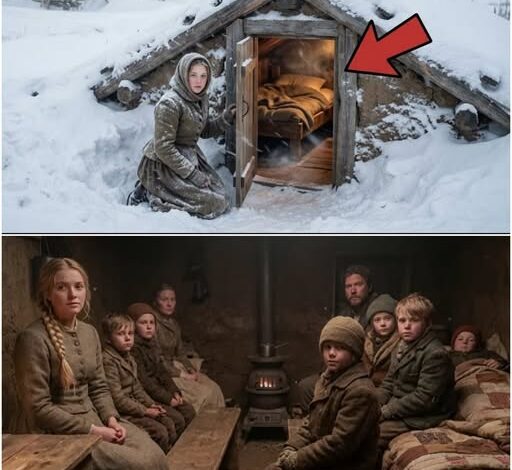
She was only fifteen—alone, with just nine dollars to her name and no one to fall back on.
There was no family waiting to help, no safe place guaranteed, no second chance if things went wrong. What she had instead was determination—and a single idea she refused to let go of.
It wasn’t an idea born from comfort.
It came from memory.
A lesson that became survival
She remembered something her father had once shown her: heat didn’t have to be wasted. Most people built fires and let warmth disappear up a chimney, vanishing into the cold air above. But if that heat could be guided—captured, redirected, and stored—it could last far longer than the flames themselves.
That thought became her plan.
She didn’t have the resources to build a traditional home. Winter was approaching quickly, and the Nebraska plains were unforgiving. Mistakes wouldn’t just be inconvenient—they could be fatal.
So she chose a different path.
She chose the ground.
Building where no one else would
Miles outside Elhorn, she found land others ignored—hard soil, isolation, and conditions too harsh for most people to consider. For her, it wasn’t a drawback. It was an opportunity.
With only nine dollars, every decision mattered.
She bought a sturdy spade, clay drainage tiles, and a small iron grate—tools that would become the foundation of her survival. The rest went toward food. There was no room for waste.
Then she began to dig.
The prairie resisted her at every step. Thick sod tangled with roots made each cut difficult. Beneath that, the soil loosened, but the effort never eased. Every shovelful meant climbing out, dumping dirt, and starting again.
Her hands blistered. Her back ached. Her body protested.
But the hole deepened.
Five feet down. Fourteen feet long. Ten feet wide.
It wasn’t just a pit.
It was the beginning of something carefully designed.
A system, not just a shelter
She knew survival would depend on more than walls—it would depend on heat.
Using the clay tiles, she created an underground flue system. Starting from a small firebox, the tiles ran beneath where she planned to sleep, stretching across the length of the dugout before reaching a chimney outlet.
The concept was simple but powerful.
Instead of letting heat escape, she forced it to travel through the tiles. The warmth spread into the surrounding soil and stones, storing energy. Over time, that heat would rise back up into the space where she lived.
She wasn’t just building a fire.
She was making it work for her.
Each detail was deliberate. The tiles were angled for airflow. Joints were sealed with clay. Stones were layered above to protect the structure and hold warmth. Everything was designed to retain and distribute heat efficiently.
Above this system, she built a raised sleeping platform—small but purposeful.
Beneath it, she packed hundreds of pounds of stones, carried one by one. These stones would absorb heat and release it slowly through the night, keeping her warm long after the fire had burned out.
Even the wooden boards of the bed were spaced carefully, allowing warmth to rise without weakening the structure.
Proving it worked
By mid-October, she tested her design.
A small fire. Just enough fuel to see what would happen.
She waited.
The smoke moved through the tiles. The ground warmed. The stones held heat. When she placed her hand on the platform, she felt it—steady, real warmth.
It worked.
Not as an idea.
Not as a hope.
But as a reality.
Doubt from others
She finished the shelter quickly after that, reinforcing the walls and building a roof that blended into the landscape. From the outside, it barely looked like anything at all.
That was intentional.
Still, people noticed—and they laughed.
A girl living underground. Clay pipes for heat. A system they didn’t understand.
They told her she wouldn’t survive winter. That the ground would freeze. That she’d be gone before the season ended.
Even the local pastor urged her to leave.
She listened.
Then she stayed.
Because she understood something they didn’t.
Working with nature, not against it
Five feet below the surface, the earth held a stable temperature—around fifty degrees. It wasn’t warm, but it wasn’t deadly.
And with her system, that baseline became an advantage.
Each time she lit a fire, the heat spread through the tiles and into the stones, building warmth that lasted for hours. While others burned large amounts of wood to fight the cold, she used only what she needed—and made every bit of it count.
Efficiency became her lifeline.
The test of winter
By December, the cold intensified.
Temperatures dropped to zero. Then far below.
Her shelter held steady.
The earth insulated her. The stored heat sustained her. Her routine—morning and evening fires—kept the system working.
Then came the storm.
On December 14th, a blizzard swept through with brutal force. Temperatures plunged to minus twenty-five, and winds roared across the plains.
Above ground, it was chaos.
Below, it was different.
The storm became a distant sound, muffled by layers of earth. Snow piled over the entrance, sealing it off—but instead of trapping her, it insulated her even more.
She stayed inside, protected.
Her system continued to function. The heat moved, the stones warmed, and the shelter held.
More than survival
What she built wasn’t luck.
It was understanding.
While others fought the environment, she worked with it. While others depended on constant fuel, she relied on stored energy.
She didn’t just endure the winter.
She adapted to it.
And when the storm finally passed, the truth became impossible to ignore.
The girl they doubted hadn’t frozen.
She had survived—because she didn’t just build a place to hide.
She built a way to live.