My Former Teacher Embarrassed Me for Years – When She Started on My Daughter at the School Charity Fair, I Took the Microphone to Make Her Regret Every Word

School had been the hardest chapter of my life.
Not because I didn’t try—I did. I studied, I showed up, I kept my head down. But there was one person who made sure none of that mattered.
Mrs. Mercer.
She had a way of finding the smallest thing and turning it into something humiliating. My clothes were “cheap.” My answers were “barely passable.” And one day, in front of the entire class, she looked straight at me and said,
“Girls like you grow up to be broke, bitter, and embarrassing.”
I was thirteen.
That night, I went home and skipped dinner. I didn’t tell my parents. I was too afraid—afraid she’d find out, afraid she’d fail me, afraid she’d make things worse. So I stayed quiet and counted the days until I could leave.
And the day I finally did, I left everything behind—including her.
Or at least, I thought I had.
Years passed.
I built a life from scratch in a different town. Nothing fancy, nothing easy—but it was mine. A steady job. A small home. And eventually, the one thing I was proudest of:
My daughter, Ava.
She was fourteen, bright, curious, full of opinions about everything. The kind of kid who filled a room without trying.
Which is why I noticed immediately when she didn’t.
One evening, she sat at the table, pushing her food around in silence.
“What happened?” I asked.
“Nothing,” she said too quickly. Then, after a pause: “There’s this teacher.”
Something in my chest tightened.
Piece by piece, she explained. A teacher who singled her out. Made comments in front of the class. Called her “not very bright.” Turned her into a joke.
“What’s her name?” I asked.
She shook her head. “I don’t know yet. She’s new. Mom, please don’t come to school. The other kids will make fun of me. I can handle it.”
But I could already see she couldn’t.
And deep down, something felt… familiar.
I planned to go to the school the very next day.
But life had other plans.
A sudden respiratory infection knocked me flat. Bed rest. Two weeks, minimum. My mother showed up that same night, took over the house, and left me with nothing but time—and worry.
Every morning, Ava walked out that door to face that classroom.
And I stayed behind.
Helpless.
“Is she okay?” I’d ask.
“She’s okay,” my mother would say gently.
But “okay” wasn’t good enough.
Then came the announcement: the school charity fair.
And something changed in Ava.
She signed up immediately.
That same night, I found her at the kitchen table, surrounded by scraps of donated fabric, carefully sewing.
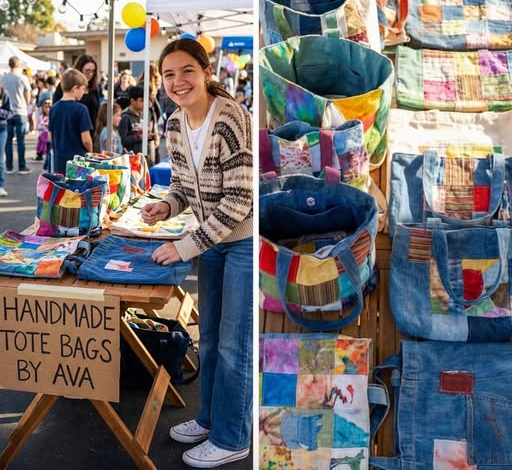
“Tote bags,” she said, not even looking up. “Reusable ones. All the money goes to families who need winter clothes.”
For two weeks, she worked every night.
I’d wake up and find her still there, stitching under the dim kitchen light, her brow furrowed in concentration. I told her she didn’t have to push so hard.
She just smiled.
“People will actually use them.”
I was proud. So proud.
But I couldn’t shake the feeling that something else was waiting.
I found out the day the flyer came home.
At the bottom, under “Faculty Coordinator,” was a name I hadn’t seen in over twenty years.
Mrs. Mercer.
I checked the school website just to be sure.
Same face. Older, yes—but unmistakable.
And suddenly, everything clicked.
She wasn’t just back.
She was in my daughter’s classroom.
The morning of the fair, the gym buzzed with noise and warmth—popcorn, laughter, chatter. Tables lined the walls, filled with handmade items and baked goods.
Ava’s table stood near the entrance.
Twenty-one tote bags, neatly arranged. A handwritten sign. And within minutes, a line of people waiting to buy them.
She was glowing.
For a moment, I let myself believe everything would be fine.
Then I saw her.
Mrs. Mercer.
She moved through the room with the same air I remembered—controlled, critical, certain of herself.
Her eyes landed on me.
“Cathy?” she said.
I nodded. “I was already planning to meet you. About my daughter.”
She followed my gaze to Ava’s table.
“Oh,” she said lightly.
She picked up one of the bags, holding it between her fingers like it didn’t deserve her full grip. Then she leaned closer to me, her voice low.
“Like mother, like daughter. Cheap fabric. Cheap work. Cheap standards.”
She set the bag down and smiled as if nothing had happened.
That was it.
Twenty years of silence ended in a single moment.
I looked at Ava—her hands flat on the table, her eyes lowered—and something inside me refused to stay quiet any longer.
Nearby, a microphone had just been set down.
I picked it up.
“I think everyone should hear this,” I said.
The room quieted.
“When I was thirteen,” I continued, “this teacher told me exactly what I would become.”
A ripple moved through the crowd.
“And today, she said something very similar to my daughter.”
Heads turned.
I held up one of Ava’s bags.
“This was made by a fourteen-year-old girl who stayed up every night for two weeks, using donated fabric, to help families she’s never even met.”
Silence.
“She didn’t do it for attention. She didn’t do it for a grade. She did it because she cares.”
Then I asked, “How many of you have heard this teacher speak to students like that?”
At first—nothing.
Then a hand.
Then another.
Then more.
One voice spoke up. Then another. Stories surfaced, one by one—not loud, not chaotic, just… undeniable.
Mrs. Mercer tried to interrupt.
But it was too late.
This wasn’t just my story anymore.
“I’m not here to argue,” I said finally. “I just want the truth to be heard.”
Then I looked at her.
“You don’t get to decide who children become.”
My voice steadied.
“You told me what I’d be. You were wrong.”
I held up the bag again.
“This is what I became. A mother who raised a kind, hardworking daughter. Someone who builds people up instead of tearing them down.”
I met Ava’s eyes.
“And she will be whatever she chooses to be.”
The applause started slowly.
Then it grew.
By the end of the fair, every single bag was gone.
Parents thanked Ava. Kids told her they loved her designs. She stood taller than I’d seen her in weeks.
And across the room, the principal was already walking toward Mrs. Mercer.
This time, she didn’t look untouchable.
That evening, as we packed up, Ava leaned against me.
“Mom,” she said softly, “I was so scared.”
“I know.”
She looked up. “Why weren’t you?”
I thought about that thirteen-year-old girl I used to be.
“Because I’ve been scared of her before,” I said. “I just wasn’t anymore.”
She smiled.
And for the first time in a long time, that part of my story finally felt finished.
Because Mrs. Mercer didn’t get to define me then.
And she doesn’t get to define my daughter now.