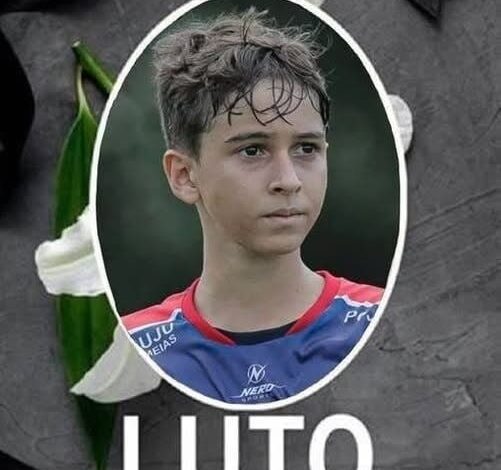
The sun hung low over the practice field, casting long, hopeful shadows across the freshly cut turf as the team assembled for their afternoon drills. Among them was a fourteen-year-old boy whose presence seemed to capture the very essence of the season. He arrived with a broad, infectious smile, exchanging playful jabs with his teammates and speaking enthusiastically about his dreams for the year ahead. To the coaches, he exemplified dedication; to his peers, he was the glue of the locker room, keeping spirits high with humor and an unwavering passion for the game. But in the span of a few minutes, the lighthearted energy of a routine practice dissolved into a scene that would leave an enduring scar on the community.
The shift from vibrant activity to life-threatening crisis was abrupt. It began with a seemingly casual remark—a sudden, sharp pain that he described as unlike any typical workout strain. Clutching his side, his face pale and drawn, he was quickly pulled from the field by coaches who sensed something gravely wrong. What began as a precaution escalated rapidly as his breathing grew shallow and rapid, his eyes wide with dawning fear. The sideline, usually a place of strategy and encouragement, became an impromptu center of urgent care.
Paramedics arrived with remarkable speed, their sirens piercing the calm of the suburban afternoon. Every second was a blur of movement—equipment in hand, urgent commands exchanged—as they fought to stabilize the young athlete. Teammates, once laughing and teasing alongside him, now stood in stunned silence, a circle of disbelief punctuated only by the beeping of medical monitors. He was rushed to the nearest trauma center, where a team of specialists worked frantically to uncover the cause, racing against time in a battle that felt impossibly cruel. Despite their efforts, the news that eventually reached waiting family and friends was a tragedy that words could scarcely capture.
The sudden loss of a fourteen-year-old at the height of his potential sent shockwaves through the town. It was a death that defied natural order, leaving his family, teammates, and the wider community reeling. In the immediate aftermath, the focus shifted toward providing comfort and sanctuary to those closest to him. Grief has taken countless forms—quiet vigils, digital memorials, heavy silences in school hallways. Counselors and community leaders emphasized the importance of letting each individual process the loss at their own pace, recognizing that for many teenagers, losing a peer is their first brush with life’s fragility.
Meanwhile, authorities and medical examiners began a careful, methodical investigation to determine what had caused such a sudden failure in a young body. Was it a rare cardiac condition? An unforeseen vascular complication? While science searches for answers to prevent future tragedies, the community has resisted speculation, instead embracing unity. They understand that a medical explanation, while important, cannot fill the empty seat at the dinner table or on the field.
A memorial at the local stadium is planned to honor his life, drawing thousands who want to remember him where he felt most alive. Coaches plan to speak not only of his athletic skill, but of his character—the way he uplifted teammates after losses, the dedication he gave to practice, and the humor that lightened even the tensest moments of the game. The stadium lights that once framed his dreams will now shine as a beacon of remembrance for a life that burned bright, if only briefly.
As time moves forward, the initial shock will soften into a quieter, enduring ache. Friends will share stories—inside jokes, dreams of championships, moments of camaraderie—that will form the foundation of his legacy. These memories ensure he is remembered not merely as a tragic statistic, but as a boy whose fourteen years were full of love, laughter, and genuine connection. He was a son who brought joy to his family, a student who brightened classrooms, and a teammate who honored the game itself.
Though the statistics are rare, the impact of such events is profound. Conditions like hypertrophic cardiomyopathy, which affects roughly 1 in 500 people, or other hidden congenital anomalies can remain unnoticed until extreme physical stress reveals them. For families, these numbers provide little solace, but for the broader community, they underscore the importance of cardiac screenings and preparedness for emergencies on every athletic field.
In the weeks and months ahead, the town will continue to rally around his family. The quiet gestures—checking in, sharing meals, saying his name—will help them navigate an unimaginable loss. School colors draped in black ribbons already serve as a visual testament to a grief shared by those who knew him and those who did not.
Ultimately, the story of this young football player is a reminder of the extraordinary impact one life can have. His dedication, his love for friends and sport, and his bright spirit have left an indelible mark. While the final moments may eventually be explained by science, the significance of his life is already etched into the hearts of the community. He lived fully, he loved deeply, and every time the whistle blows and stadium lights shine, he will be remembered.