My 12-Year-Old Son Built Wheelchairs for 3 Stray Dogs – Our Neighbor Smashed Their Shelter, but 24 Hours Later, Someone Showed up at Her Door

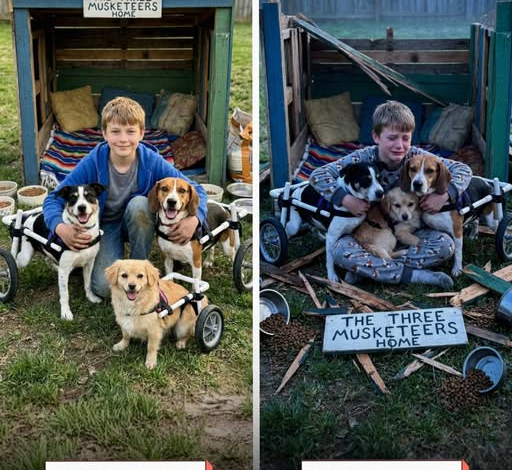
I always believed I understood my son’s kindness—until one choice turned our quiet life into something I never could have imagined. Looking back now, that was the moment everything began to change.
My son Ethan is twelve, and he’s always been different in a quiet, thoughtful way. He notices things most people overlook. If something is broken, he doesn’t just walk past it—he studies it, tries to understand it, and keeps working until he finds a solution.
I used to think it was just a phase.
Now I realize… it’s simply who he is.
One evening, as the sun was starting to set, Ethan suddenly grabbed my arm.
“Mom… they’re still alive,” he whispered, his voice trembling.
We were standing near a quiet road just outside our neighborhood. Three dogs lay in the dirt, their bodies weak and shaking. When they tried to move, their back legs dragged behind them. It was obvious what had happened—a hit-and-run.
I remember glancing around, hoping someone else would step in. Anyone.
But no one came.
We didn’t have extra money. We were barely getting by as it was.
Still… leaving them there didn’t feel like something we could live with.
So we didn’t.
We carefully lifted the dogs into the car and drove as fast as we could to the nearest veterinarian, arriving just before closing time. Ethan stayed close to me as the vet examined them one by one.
After what felt like forever, the vet let out a long breath.
“They’ll survive,” he said gently. “But… they’ll never walk again.”
Ethan didn’t answer right away. He just stared at the dogs, as if trying to process something much bigger than the words he’d just heard.
Then he looked up at me.
“Mom… don’t worry. I have an idea.”
I didn’t understand what he meant—but I trusted him.
Over the next two weeks, our backyard turned into something between a workshop and a scrapyard.
Ethan pulled out old bikes from the shed. He collected parts from a broken stroller someone had thrown away. He even asked our neighbor, Mr. Alvarez, if he could take spare wheels from unused lawn equipment.
PVC pipes piled up by the fence. Tools were scattered everywhere.
I offered to help more than once, but Ethan would just shake his head.
“I’ve got it. I just need time.”
Every afternoon after school, he worked—measuring, cutting, adjusting. Piece by piece, he was building something I had never seen before.
Wheelchairs.
For the dogs.
The first time he fitted one of them into the frame, his hands were steady.
“Hold still… I’ve got you,” he whispered softly.
I stood there, barely breathing.
For a moment, nothing happened.
Then… the wheels moved.
One step.
Then another.
Soon, the other dogs followed. Slowly, clumsily—but they were moving.
Ethan laughed, a sound so full of joy it filled the entire yard.
And in that moment, something shifted.
Not just for the dogs—but for us.
Within days, the dogs were exploring the yard, bumping into things, learning how to move again.
Ethan stayed close, guiding them like a coach.
“Easy… turn… no, not that way,” he’d say, adjusting their frames and encouraging them.
I hadn’t seen him this alive in a long time.
Then came his next idea.
“We need to build them a shelter,” he said.
He had already drawn it out on paper.
Without hesitation, he used almost all of his saved allowance—three months’ worth—to buy wood, nails, and insulation.
“Are you sure?” I asked.
“They need somewhere safe,” he replied.
So we built it together.
It wasn’t perfect. The edges weren’t even, and the paint wasn’t smooth. But it was strong, warm, and filled with blankets and old pillows.
It was enough.
That’s when our neighbor, Melinda, started paying attention.
She watched everything from her deck like she was monitoring a problem waiting to explode.
One morning, she finally spoke up.
“It’s ugly. It’s loud. It ruins my view,” she snapped.
We tried to compromise. We repainted the shelter, added plants along the fence, and even trained the dogs to stay quiet.
But nothing we did made a difference.
Because it was never really about the noise.
She just didn’t want them there.
Then, one morning—just before sunrise—everything fell apart.
Ethan ran outside with their food like he always did.
Seconds later, I heard it.
His scream.
It wasn’t loud—but it was sharp. The kind that makes your heart drop instantly.
I rushed outside.
The yard… didn’t look like ours anymore.
The shelter had been destroyed. Wood splintered and scattered everywhere. Blankets were soaked in dirt. Even part of the fence had been torn apart.
The dogs huddled together in the corner, trembling.
Ethan stood frozen.
Across the fence, Melinda stood on her deck… calmly sipping her coffee.
Watching.
We called the police, but without proof, there wasn’t much they could do.
That day, Ethan barely spoke.
He sat among the broken pieces, one hand resting gently on one of the dogs.
“I’m sorry… I couldn’t protect you,” he whispered.
It broke something inside me.
For the first time, I didn’t know how to fix things.
But the story didn’t end there.
The next morning, a black van pulled into Melinda’s driveway.
A man stepped out—well-dressed, calm, with a badge clipped to his waist.
When Melinda saw it, her face changed instantly. The coffee slipped from her hand and shattered on the ground.
His name was Jonathan, from the neighborhood association.
Instead of going straight to Melinda, he walked into our yard.
When Ethan explained what had happened, struggling through tears, Jonathan listened carefully. His expression shifted as he took in the broken shelter, the damaged fence… and then glanced toward Melinda.
“I’m really sorry this happened,” he said. “I promise I’ll look into it.”
Later, two days after that visit, Jonathan returned.
This time, he asked us to come with him to Melinda’s house.
Without a word, he pulled out his phone and played a video.
It showed everything.
Melinda, late at night, cutting through our fence… stepping into our yard… tearing apart the shelter piece by piece.
Deliberate. Careful. Quiet.
Ethan stepped forward, his voice small.
“Why?”
Melinda’s answer came out in frustration.
“It was ruining everything! The noise, the look—it lowers property value!”
Jonathan remained calm.
“Well,” he said, “thanks to Mr. Alvarez’s security camera, we now have proof.”
Her renovation request was denied. Her complaints were dismissed. And she was required to pay for all the damages—including a new shelter.
When she refused, Jonathan simply asked:
“Would you prefer we involve the police?”
She signed.
The next day, a crew arrived.
They repaired the fence and built a new shelter—strong, insulated, and far better than before.
Ethan stood nearby, watching closely, even offering suggestions.
Word spread quickly.
Neighbors started visiting. Some brought dog food, others toys. Parents came with their children.
Our yard, once quiet, became full of life.
Ethan showed the kids how the wheelchairs worked.
The dogs moved freely, confidently.
Like they belonged.
Because they did.
Melinda stayed inside most of the time after that. Curtains drawn. Avoiding everyone.
And everyone knew why.
One evening, as the sun dipped low, Ethan sat beside me.
“They’re okay now,” he said softly.
I nodded.
He leaned back, watching the dogs roll across the yard—and smiled.
And this time…
that smile stayed.