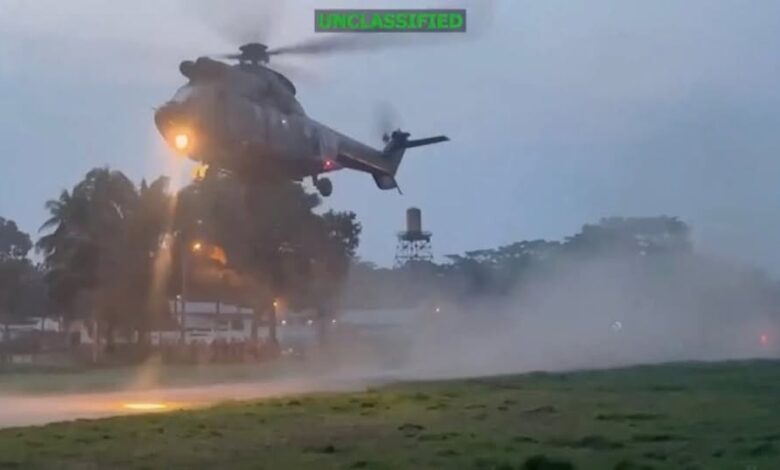
Reports of Possible U.S. Military Activity in Ecuador Spark Global Attention
The global political climate in March 2026 continues to be shaped by an overwhelming flow of information, where verified facts and online speculation often collide. A recent example emerged on March 5, when social media posts began circulating that claimed the United States had launched military operations inside Ecuador.
These claims spread rapidly through online platforms, supported by short video clips and statements from unverified sources. As the reports gained traction, observers around the world entered a period of heightened vigilance, attempting to determine whether the activity represented a genuine military deployment or simply a wave of digital speculation.
At present, neither the U.S. Department of Defense nor Ecuador’s government has issued a formal statement confirming that American forces have begun direct combat operations within Ecuador. In modern diplomacy, an action of this scale would typically involve official announcements, congressional briefings in Washington, and public statements from Ecuadorian leadership.
The absence of such confirmation suggests that the situation requires careful interpretation as information continues to circulate online.
Regional Context Behind the Concerns
To understand why these reports have caused such immediate concern, it is important to consider Ecuador’s recent political and security challenges.
Since 2024, the country has faced escalating violence tied to organized crime groups and international drug trafficking networks. In response to the growing threat, President Daniel Noboa declared a state of “internal armed conflict,” allowing the government to mobilize military resources against powerful criminal organizations.
Historically, cooperation between the United States and Ecuador has centered on intelligence sharing, counter-narcotics operations, and security training programs. These partnerships have typically focused on support roles rather than direct military intervention.
If reports of U.S. combat operations were confirmed, it would represent a significant shift in long-standing regional policy and could trigger reactions from international bodies such as the United Nations and the Organization of American States.
The Challenge of Verifying Information in the Digital Era
The situation illustrates a broader challenge facing governments and journalists in 2026: the speed at which information spreads online often surpasses the pace of official verification.
Social media posts claiming to show American aircraft, military equipment, or specialized personnel have been widely shared as evidence of an alleged operation. However, without confirmation from reliable sources, such sightings could just as easily represent routine activities such as joint training exercises, humanitarian logistics operations, or normal rotations of diplomatic security forces.
When political systems are already under strain and public trust in institutions is fragile, unverified claims about military movements can have immediate consequences, influencing markets, diplomatic relations, and public perception.
Mixed Reactions Within Ecuador
For many people in Ecuador, the possibility of increased foreign military involvement has sparked a complex public discussion.
Some citizens, frustrated by the violence associated with criminal groups, may see international assistance as a potential solution to restore security. Others remain cautious, viewing the possibility of foreign intervention through the historical lens of U.S. involvement in Latin America.
This internal debate reflects the broader geopolitical environment. The United States is already heavily engaged in security concerns in regions such as the Middle East and Eastern Europe. Opening a new operational front in South America would represent a major shift in strategic priorities and would likely carry significant diplomatic implications.
Potential Significance if the Reports Are Confirmed
If the reports circulating online were eventually verified, the implications would be substantial.
Such a development could indicate that the threat posed by criminal organizations has reached a level that local law enforcement and military resources are struggling to contain alone. It could also signal a renewed willingness by the United States to take a more direct security role in the Western Hemisphere.
Any confirmed intervention would likely become a major topic of political and historical analysis, shaping discussions about regional security policy for years to come.
For now, however, the lack of official confirmation means the situation remains uncertain.
Silence from Official Channels
One notable aspect of the current situation is the lack of public comment from key institutions.
Major military deployments are typically accompanied by press briefings explaining the purpose of the operation and its connection to national security objectives. So far, the Pentagon has not issued such a statement.
Similarly, Ecuador’s government has continued to focus on domestic anti-crime operations, with no official reference to joint military actions involving foreign forces.
This silence has left space for speculation to grow across online platforms.
The Role of Traditional Media
Established international news organizations have approached the story cautiously, waiting for multiple sources to confirm the claims before reporting them as fact.
In an age where breaking news often spreads instantly through social media, this restraint highlights the lack of reliable evidence supporting the most dramatic claims circulating online.
When credible information is scarce, speculation can quickly fill the gap—fueling anxiety for people with family members in the region and creating uncertainty for businesses operating across Latin America.
Watching for Verified Developments
Observers are closely monitoring transportation hubs, airports, and communication centers throughout Ecuador. A large-scale military operation would be difficult to conceal given modern satellite monitoring and international reporting networks.
If significant foreign military activity is indeed underway, it is likely that verifiable evidence will soon emerge beyond social media posts.
Until then, the situation remains an example of how rapidly narratives can spread in the digital age—sometimes faster than facts can be confirmed.
A Reminder of the Importance of Information Verification
Regardless of the outcome, the events of March 5 highlight the importance of digital literacy and responsible information sharing.
In today’s interconnected world, a single unverified report can quickly escalate into a global story, influencing public opinion and political discussions.
For this reason, journalists, analysts, and everyday readers must approach rapidly spreading claims with caution and seek confirmation from credible sources.
Waiting for Clarity
As developments continue to unfold, the international community remains attentive to any official statements that may clarify the situation.
Whether the circulating reports prove to be misunderstandings, routine military movements, or the early signs of a larger development, the priority remains the safety of civilians and the preservation of regional stability.
For now, Ecuador’s situation serves as a reminder that in an age of constant information flow, patience and verification remain essential tools for understanding events as they truly unfold.