Putin just made a concerning announcement about three countries – and it could pave the way for an invasion

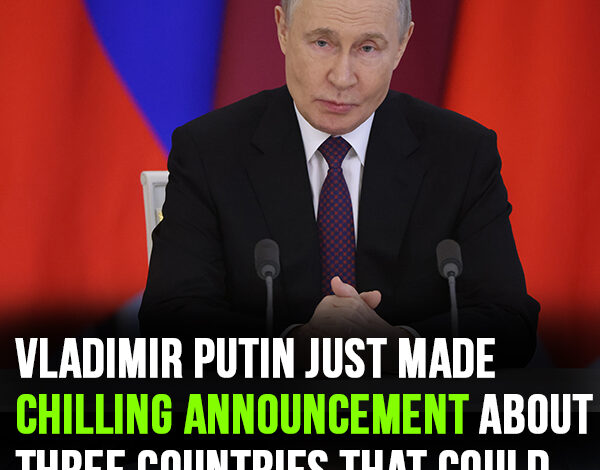
The warnings from Anton Gerashchenko do not sound like abstract speculation. They carry the weight of bitter experience, shaped by years of watching the Kremlin prepare the ground for aggression long before tanks crossed borders or missiles began falling.
To those who have followed Russia’s pattern closely, the language is familiar.
Before Georgia in 2008, Moscow spoke of protecting Russian citizens and defending vulnerable communities from alleged hostility. Before Crimea in 2014, it amplified claims of discrimination, historical injustice, and threats against Russian speakers. Before the full-scale invasion of Ukraine in 2022, the same machinery intensified again: accusations of “Russophobia,” warnings about language bans, stories of persecution, legal complaints, diplomatic outrage, and carefully staged moral panic.
Each time, the words came first.
Then came escalation.
That is what makes Gerashchenko’s warning so unsettling. He is not simply reacting to one statement or one diplomatic complaint. He is pointing to a broader method — a familiar sequence in which Moscow constructs a grievance, repeats it through official channels and state media, frames itself as the defender of supposedly oppressed Russian-speaking populations, and then uses that narrative as justification for pressure, destabilization, or force.
The legal language is rarely the final goal.
It is usually the opening act.
Complaints about discrimination, language rights, citizenship policy, and cultural identity may appear on the surface to belong to the world of courts, embassies, and international organizations. But in the Kremlin’s strategic playbook, they often serve a deeper purpose. They build a moral pretext. They create a story Russia can later point to and say: We warned you. We had no choice. We were protecting our people.
That is why the Baltic states watch these narratives with such seriousness.
Latvia, Lithuania, and Estonia understand better than most European countries that Russian pressure does not always begin with soldiers. It can begin with television broadcasts, social media campaigns, passport disputes, historical revisionism, staged outrage, cyberattacks, legal threats, and accusations repeated so often that they start to shape international conversation.
The Baltics have lived for decades beside a neighbor that treats memory, identity, and language not merely as cultural issues, but as instruments of influence.
For Moscow, Russian-speaking minorities abroad have often been presented not simply as communities with rights and concerns, but as geopolitical leverage. Their existence becomes a tool for pressure. Their grievances, real or exaggerated, are folded into a larger imperial narrative in which Russia claims the right to intervene wherever it declares Russian identity to be under threat.
That is the dangerous logic Gerashchenko is warning about.
The concern is not that every diplomatic complaint automatically means invasion. The concern is that the Kremlin has repeatedly used the language of protection as preparation for coercion. When Moscow begins loudly accusing neighboring countries of persecuting Russian speakers, the region has learned to listen carefully — not because the accusations are automatically credible, but because they may be strategically useful.
The Baltic scenario, however, is different in one crucial way.
Latvia, Lithuania, and Estonia are not Georgia in 2008. They are not Ukraine in 2014. They are not isolated states left outside the strongest military alliance in the Western world. They are members of NATO, and that fact changes the calculation dramatically.
Any open military attack against them would risk triggering Article 5, the alliance’s collective defense clause. In practice, that would mean a confrontation not only with three small Baltic nations, but with the United States, the United Kingdom, Germany, France, Poland, and the broader NATO structure. The Kremlin understands that such a step would carry consequences on a scale Europe has not seen in decades.
That does not make the Baltic states safe from pressure.
It simply changes the form that pressure is most likely to take.
A direct invasion would be extraordinarily risky. Hybrid operations are far cheaper, more deniable, and more flexible. Moscow does not need to send tanks across a border to create fear. It can use disinformation to inflame tensions. It can exploit citizenship and language debates. It can encourage mistrust between Russian-speaking communities and national governments. It can stage provocations, launch cyberattacks, weaponize migration, interfere in elections, and flood the information space with claims that the Baltic states are hostile, discriminatory, or illegitimate.
This is the gray zone where Russia has often preferred to operate.
Not peace, but not declared war.
Not open occupation, but constant pressure.
Not one decisive strike, but a long campaign of exhaustion.
That may be the real objective now. Not necessarily to launch an immediate military attack, but to test NATO’s political will, probe weaknesses in Baltic society, frighten Russian-speaking populations, and force governments in Riga, Vilnius, and Tallinn to spend energy responding to manufactured crises.
Psychological warfare matters because fear itself can become a strategic weapon.
If citizens begin to believe conflict is inevitable, society becomes anxious. If minorities are told repeatedly that they are under threat, suspicion grows. If governments are forced to respond constantly to accusations, they risk appearing defensive. If NATO allies disagree over how seriously to take each provocation, Moscow learns where the cracks are.
That is why hybrid pressure can be so effective.
It demands less risk than a conventional attack while still producing political instability. It keeps the target region tense. It forces constant vigilance. It makes ordinary policy decisions — language education, media regulation, border security, historical memory — appear not merely domestic, but potentially explosive.
For the Baltic states, this is not theoretical.
They have already faced cyberattacks, disinformation campaigns, border pressure, and repeated efforts to undermine trust in their institutions. They know that Moscow’s strategy often depends on keeping neighboring societies permanently on edge, unsure whether each incident is isolated or part of something larger.
Gerashchenko’s warning should therefore be understood less as a prediction of a specific imminent invasion and more as a reminder of a pattern.
The pattern begins with grievance.
Then comes amplification.
Then legal and diplomatic escalation.
Then pressure, destabilization, or force, depending on the target’s vulnerability and the wider geopolitical moment.
In Ukraine, the world saw how dangerous it can be to dismiss such rhetoric as mere propaganda. For years, Moscow’s accusations sounded repetitive and theatrical. Then those same narratives became part of the justification for territorial seizure, occupation, and war.
That history now shadows every Russian statement about the Baltics.
The difference is that NATO’s presence draws a hard red line. The Kremlin may test it, pressure it, mock it, or try to divide it, but crossing it openly would be a far more dangerous gamble than previous acts of aggression against non-NATO states.
Still, the absence of an immediate invasion does not mean the absence of threat.
The battlefield may be informational.
Legal.
Psychological.
Cybernetic.
Political.
Social.
The aim may not be to conquer territory tomorrow, but to weaken confidence today.
To make Baltic citizens feel vulnerable.
To make Russian speakers feel targeted.
To make NATO appear uncertain.
To make Europe argue with itself.
To keep the region permanently braced for the next provocation.
That is why Gerashchenko’s warning matters.
It asks the West to recognize the prelude before the crisis, not only the crisis after it begins. It asks NATO to treat narratives as part of strategy, not as background noise. And it reminds the Baltic states that the Kremlin’s accusations are rarely just words when they fit into a longer history of manufactured justification.
Russia may understand that an open attack on Latvia, Lithuania, or Estonia would bring consequences it cannot easily control.
But it also understands something else:
A country does not have to be invaded to be destabilized.
A society does not have to be occupied to be frightened.
An alliance does not have to be defeated militarily to be tested politically.
That may be the real danger now.
Not a sudden replay of the past in exactly the same form, but the adaptation of an old playbook to a more dangerous and more constrained environment. The Kremlin may not be preparing to storm across NATO borders tomorrow. It may instead be preparing the atmosphere — shaping fears, hardening divisions, and building a narrative it can use whenever pressure serves its interests.
For Latvia, Lithuania, and Estonia, the lesson from Georgia, Crimea, and Ukraine is painfully clear:
When Moscow begins loudly claiming it must protect people from persecution, the world should listen carefully.
Not because the claim is automatically true.
But because history has shown what can come after the claim is made.