I PAID FOR A STRANGERS BABY FORMULA, THE NEXT DAY, POLICE TOLD ME I MIGHT HAVE HELPED A KIDNAPPER

It started like any ordinary evening—one of those forgettable moments that pass without meaning.
I was standing in line at a small grocery store, holding only what I could afford. Milk. Bread. Nothing extra. My balance was low, and like every week, I was doing the quiet math in my head, making sure I wouldn’t come up short at the register.
That’s when I noticed him.
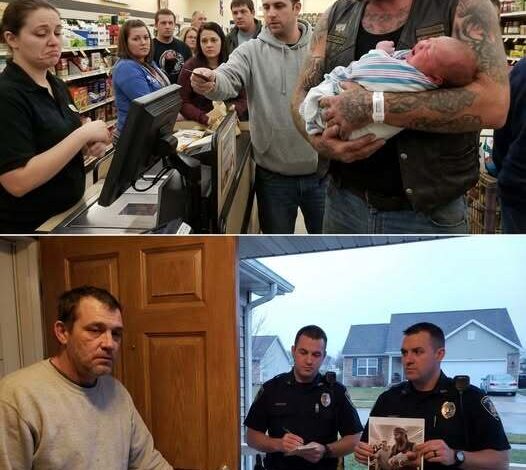
He stood a few people ahead—broad shoulders, sleeveless leather vest despite the cold, arms covered in heavy tattoos that looked like they carried stories you don’t ask about. He didn’t look like someone who needed help.
But the baby in his arms said otherwise.
The child wasn’t screaming—just crying steadily. The kind of cry that doesn’t stop, the kind that settles into your nerves. He rocked the baby with a calm, almost practiced motion that didn’t match his rough exterior.
Then everything shifted.
“Card declined,” the cashier said quietly.
He didn’t react. No frustration. No embarrassment. Just a small nod, like he expected it. He looked down at the baby and tried again.
Declined.
On the counter sat a container of baby formula—the cheapest one. I noticed because I live that way too. You don’t choose what you want. You choose what you can afford.
He paused.
The baby’s crying grew sharper.
Before I could think it through, I spoke.
“I’ll pay for it.”
He turned slowly and looked at me. His expression was unreadable—no gratitude, no relief. Just something quiet, like he was measuring the moment.
“That’s not necessary,” he said.
“It’s okay,” I replied. “Really.”
Another pause.
Then he stepped aside.
No thank you. No acknowledgment. Just silence.
I paid, took my receipt, and left, convincing myself it was nothing. Just a small act of decency.
I couldn’t have been more wrong.
The next morning, at exactly 8:12, there was a knock on my door.
Two police officers.
“Daniel Harper?” one asked.
My stomach tightened immediately.
They described the man perfectly—the tattoos, the vest, the baby.
“Did you interact with him?” the younger officer asked.
“I paid for his formula,” I said.
They exchanged a look—not dramatic, but enough to change the air.
“Did you notice anything unusual?”
I hesitated.
The image of the baby’s hospital bracelet flashed in my mind.
“I… don’t think so.”
Then they showed me a photo.
Same man. Same face.
But different.
Harder. Sharper. Dangerous.
“That’s him,” I said.
The older officer nodded.
“We believe the baby he was carrying may not have been his.”
Everything inside me dropped.
After they left, the house felt too quiet.
I stood in my kitchen, staring at the receipt.
$18.99.
Baby formula.
Something so small—until it wasn’t.
Details started rearranging themselves in my head.
The bracelet. The lack of supplies. No diaper bag. No plan.
But one thing stood out more than anything else:
He had tried to pay.
He hadn’t come in expecting help.
And when it failed… he didn’t panic.
He waited.
And I stepped in.
Hours later, the police came back.
“We found the baby,” the older officer said.
My chest tightened. “Alive?”
“Yes.”
Relief came—but not all the way.
“There’s more.”
Security footage showed he hadn’t left right after me.
He waited.
Watched me leave.
Then followed—at a distance.
A chill ran through me.
“I didn’t see him.”
“We know,” the officer said. “He didn’t want you to.”
Then they showed me another photo.
Older.
The same man—but different again. Clean. Calm. Standing beside a hospital bed, next to a woman holding a newborn.
“Marcus Hale,” the officer said.
And then the story came out.
Three years earlier, his wife had died during childbirth.
The baby hadn’t survived.
He blamed the hospital. Fought it. Filed complaints.
Nothing changed.
Yesterday, he went back.
A newborn started crying.
A nurse stepped away.
Marcus walked in… and walked out with the baby.
No violence. No struggle.
Just walking.
He had nothing with him.
No food.
No plan.
Until the store.
Until the card declined.
Until I paid.
They found the baby two blocks from my house.
Inside a parked car.
Wrapped. Warm.
Fed.
Alive.
The formula I bought had been used.
That part hit the hardest.
Because something had changed after the store.
Marcus had time to disappear.
But he didn’t.
They found him later, sitting outside the hospital.
Waiting.
No resistance.
That evening, the officers returned one last time.
“He asked about you,” one said.
“Me?”
“He wanted to know if you got home safely.”
That didn’t fit the story I thought I was part of.
Then the officer said something I can’t forget:
“He said you were the only person who didn’t look at him like he was already guilty.”
I didn’t know what to say.
Then came the final detail.
“He said when you paid… it reminded him of who he used to be.”
They handed me a folded piece of paper.
My hands shook as I opened it.
One sentence:
“You didn’t save him. You saved me from not bringing him back.”
I read it again.
And again.
Because suddenly, that look in the store made sense.
It wasn’t suspicion.
It wasn’t calculation.
It was a moment.
A decision.
Not about trusting me—
but about whether he still trusted himself.
That night, I sat at my kitchen table, staring at the receipt.
$18.99.
A number so small it usually means nothing.
But it wasn’t small anymore.
Because somewhere between that checkout line and that parked car… something shifted.
A line wasn’t crossed.
A mistake wasn’t completed.
A man who had already lost everything didn’t lose the last part of himself.
And it didn’t take something big.
Just a moment.
A choice.
A stranger who didn’t look away.
Sometimes, what keeps someone from breaking completely isn’t dramatic.
It’s quiet.
It’s simple.
It’s something that feels insignificant—
until it isn’t.