My Mother-in-Law Questioned My Baby’s Blue Eyes at Her First Birthday, But the Envelope I Placed in Front of Her Exposed Every Secret

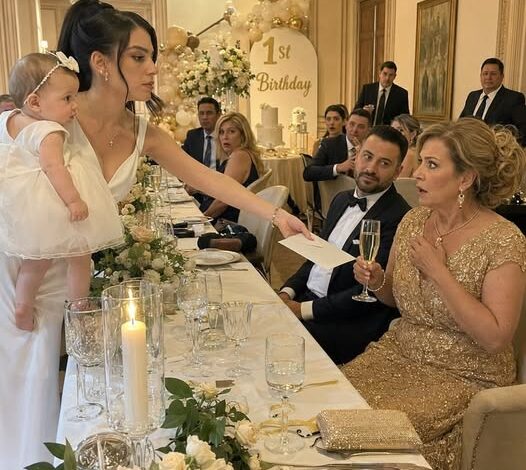
My daughter will never remember that night, but I always will.
She will not remember the way the room felt too warm, too crowded, too full of people pretending they had gathered for cake when some of them had really come for a spectacle. She will not remember the balloons tied to chair backs, the half-melted candle on her cake, or the paper plates stacked beside gifts that suddenly seemed meaningless. She will not remember the exact moment the laughter shifted — when it stopped being family noise and became something sharper, something aimed.
But I remember.
I remember the way her small body tensed in my arms when the room changed. She was too young to understand the words, but she understood the feeling. Babies always do. She felt the hostility before she could name it, felt the silence tighten around us, felt the eyes landing on me like hands. Her fingers clutched my collar, sticky with frosting, and I held her closer while twenty-five relatives sat there waiting to watch me fall apart.
They thought I had walked into their trap.
They thought I was cornered, surrounded by witnesses, too shocked and humiliated to do anything but cry. They thought the timing was perfect: my daughter’s birthday, the whole family gathered, emotions already high, no private place to hide. They believed that if they said the right cruel thing in front of enough people, I would shrink. They believed shame would do what truth never could.
They had no idea I had seen the trap long before they tried to close it.
By then, I had already noticed the missing pieces. The quiet inconsistencies. The money that moved when it should not have. The conversations that stopped when I entered a room. The little performances of concern that felt less like love and more like preparation. I had learned to stop defending myself out loud and start paying attention in silence. While they were busy building a stage for my humiliation, I was gathering the truth.
So when I laid those envelopes on the table, my hands were steady.
Not because I felt powerful. Not because I was enjoying it. Not because I wanted revenge.
It did not feel like triumph. It felt like surgery.
Necessary. Bloody. Precise.
It felt like cutting open something poisoned before it could spread any further. It felt like ending a lie that had already cost too much. The paternity test cleared my name, but more than that, it returned something to me that no one in that room had the right to take. The bank records exposed the person behind the curtain, the one pulling strings, shaping doubts, feeding suspicions, and watching the damage unfold from a safe distance.
One envelope answered the accusation.
The other revealed the motive.
For a moment, nobody moved.
The same relatives who had leaned forward when they thought I was about to be humiliated suddenly looked away. Some stared at the documents. Some stared at the table. Some stared at each other, silently searching for a way to rewrite what had just happened. The room that had been so loud minutes before became painfully quiet. It is strange how quickly people lose their appetite for drama when the truth stops entertaining them and starts accusing them back.
But even then, the documents were not what mattered most.
The proof mattered, yes. My name mattered. My dignity mattered. The fact that I could finally stop begging people to believe me mattered more than I can explain.
But the center of that night was not the paper on the table.
It was the tiny weight in my arms.
My daughter, with frosting on her fingers and one ruffle sitting crooked on her dress. My daughter, blinking up at me with blue eyes that had no idea what had just been broken open around her. My daughter, who did not need explanations or evidence or apologies from anyone in that room. She only needed me to stay steady.
So I did.
While the room behind us collapsed into whispers, excuses, and stunned silence, I carried her toward the window. The candle on her cake was still burning low, its flame trembling like it knew too much. No one was singing anymore. No one seemed to know what to do with their hands, their faces, or their guilt.
So I sang to her myself.
Softly. Quietly. Almost alone.
I sang because it was still her birthday. I sang because she deserved one gentle sound in a room that had turned cruel. I sang because I refused to let their ugliness become the only memory my body kept from that night. She touched frosting to my cheek and smiled, and for a few seconds, everything else disappeared.
The marriage had been over long before the envelopes were opened. Maybe not legally. Maybe not in ways other people could see. But it had been dismantled in secret, piece by piece, through betrayal, manipulation, and silence. By the time the truth came out, I was no longer fighting for a relationship. I was fighting my way out of a story someone else had written for me.
I fought for my daughter.
I fought for the little girl who deserved to grow up with a mother who would not disappear just because a roomful of people wanted her to. I fought so she would never learn that love means accepting humiliation. I fought so she would never watch me confuse endurance with devotion. I fought so one day, when she asks what happened, I can tell her I chose peace before bitterness had the chance to become our home.
The photograph from that night hangs on my wall now.
To anyone else, it looks simple. A birthday picture. One candle. Blue eyes. A small ruffle askew. My daughter reaching toward the cake while I hold her close. They would never guess that just outside the frame, a family was coming apart. They would never know there were envelopes on the table, voices caught in throats, and a truth so heavy it changed the shape of the room.
But I know.
I know what came before that picture.
I know what it cost to smile.
I know how hard my heart was pounding while my arms stayed steady.
That photograph is not proof that I won. Winning is too clean a word for a night like that. Too simple. Too small. There was grief in it. There was rage in it. There was the death of illusions I had once tried desperately to keep alive. There was freedom too, but freedom does not always arrive gently. Sometimes it comes carrying paperwork. Sometimes it comes with shaking hands. Sometimes it arrives in the middle of a child’s birthday party while everyone watches you decide who you are going to be.
That picture is proof that I chose.
I chose my daughter over appearances. I chose truth over comfort. I chose myself over a marriage that had already made a ghost of me. I chose not to collapse for people who had mistaken my silence for weakness. I chose not to spend another day trying to earn belief from those who enjoyed doubting me.
Most of all, I chose to stay present for the only person in that room who had never asked me to prove my worth.
One day, my daughter may ask about that photograph. She may notice the tiredness around my eyes or the way my hand is wrapped so firmly around her waist. She may ask why the picture feels happy and sad at the same time.
When she is old enough, I will tell her the truth carefully.
I will tell her there was a night when people tried to make her mother small.
I will tell her they failed.
I will tell her that love is not always soft. Sometimes love is a folder full of evidence. Sometimes it is a steady voice in a room designed to break you. Sometimes it is walking toward a window with your child in your arms and singing anyway.
She will never remember that night.
But I will remember it for both of us.
And every time I look at that photograph, I do not see the moment I lost a marriage.
I see the moment I found myself.
I see the moment I held my daughter, lifted my head, and chose the life we both deserved.