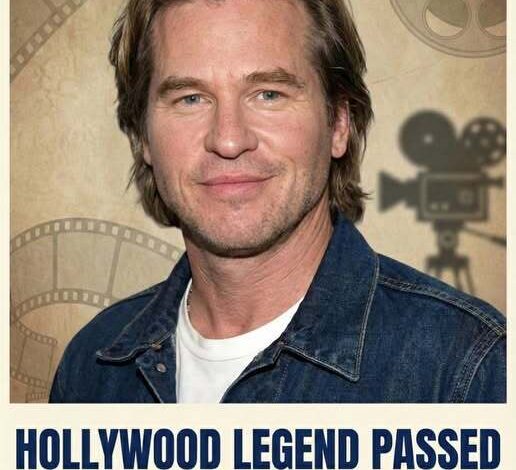
Val Kilmer’s life was shaped by remarkable talent, profound loss, and an unwavering commitment to his craft. His journey through Hollywood was anything but conventional. Rather than chasing fame or comfort, Kilmer was driven by a deep desire to uncover truth within every role he played—even when that pursuit demanded personal sacrifice. For him, authenticity mattered far more than celebrity.
Growing up in a family marked by separation and tragedy, Kilmer experienced the fragility of life at an early age. The loss of his younger brother left a lasting emotional imprint, a quiet sorrow that remained with him throughout his life. Despite this hardship, he pressed forward with determination. His acceptance into the prestigious Juilliard School was a turning point, reflecting both his natural talent and his disciplined approach to acting. To Kilmer, performance was never casual—it was a calling that required dedication and immersion.
When he entered the film industry, Kilmer quickly distinguished himself. During the 1980s and 1990s he became a prominent presence on screen, yet what truly set him apart was the intensity of his commitment to his characters. In Top Gun, he turned a supporting role into a memorable figure. With subtle gestures, controlled emotion, and minimal dialogue, he demonstrated how presence and restraint could carry as much power as words.
That commitment reached an extraordinary level in The Doors. Rather than simply portraying Jim Morrison, Kilmer immersed himself completely in the role. He studied Morrison’s voice, movements, and inner conflicts so deeply that audiences often found it difficult to separate the actor from the rock icon. By performing the songs himself and embracing the complexity of Morrison’s personality, Kilmer delivered a performance that was fearless, raw, and unforgettable.
His performance as Doc Holliday in Tombstone remains one of his most beloved roles. Sophisticated yet dangerous, witty yet tragic, Kilmer’s Holliday captured the spirit of a man confronting mortality with both elegance and defiance. The role highlighted his rare ability to combine charm, humor, vulnerability, and intensity in a single character, cementing the performance as a modern Western classic.
Offscreen, Kilmer earned a reputation for being deeply serious about his work. He held himself to high standards and rejected anything that felt superficial. While some perceived this intensity as difficult, it stemmed from a genuine respect for storytelling and the craft of acting. For Kilmer, characters deserved complete dedication, and artistic work demanded sincerity.
Later in life, his path changed dramatically when he was diagnosed with throat cancer. The illness brought enormous challenges, including the loss of his natural speaking voice after a tracheostomy. Yet even as his life shifted, Kilmer remained committed to creativity. Rather than retreat from the public eye, he chose openness—sharing his experiences, fears, and reflections with honesty.
His later years reflected a different kind of performance, one rooted in vulnerability and resilience. He adapted to new ways of communicating and continued to engage with audiences and artistic expression. His brief but powerful appearance in Top Gun: Maverick, supported by technology that recreated his voice, was deeply emotional—not merely as a moment of nostalgia, but as a testament to endurance and perseverance.
Beyond his career, Kilmer was a devoted father whose children remained central to his life. Friends and collaborators often spoke of his intellectual curiosity, kindness, and thoughtful nature. He approached life with questions, reflection, and a constant search for deeper meaning.
Kilmer’s story resists simple description. He was passionate and complex, reflective and bold. Throughout his career he pursued truth and beauty through theater, film, and personal exploration. Even in the face of profound loss and physical hardship, his creative spirit remained intact.
At the age of 65, his passing leaves a profound absence in the world of cinema. His performances endure because they were never superficial; each carried intention, depth, and his unmistakable presence. Kilmer reminded audiences that acting is not about approval or fame—it is about honesty.
He never simply appeared on screen—he arrived with complete commitment, willing to give more of himself than most would dare. His absence will be felt not only in film but also in the broader understanding that true artistry demands courage, especially when circumstances become difficult.
Val Kilmer leaves behind a legacy defined not by perfection, but by fearless devotion to the craft he loved—a body of work that continues to resonate long after the voice that once carried it was taken.