Lip reader reveals four-word remark Barron made to Ivanka during Donald Trump’s State of the Union speech

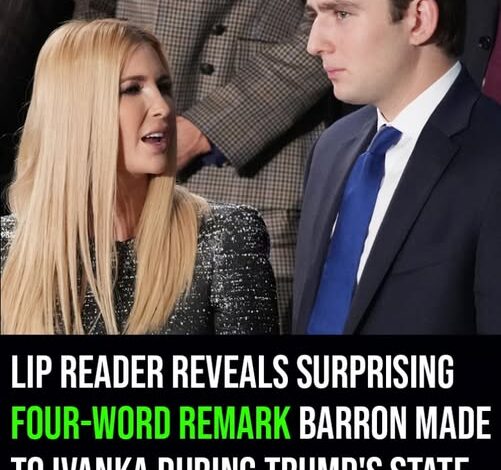
As the president addressed the nation, speaking of faith, power, and a “tremendous renewal” in American life, the cameras lingered on the family seated behind him—a carefully arranged tableau meant to convey unity, strength, and continuity. Melania, poised and elegant, drew compliments from both supporters and commentators for her composed presence. Ivanka, smiling dutifully, reflected the polished image cultivated over years of public appearances. And beside her, Barron Trump made what many called his first significant public appearance as an adult—a moment of curiosity and attention for observers accustomed to seeing him largely in private.
Yet amidst the orchestrated smiles and nods, it was a fleeting, candid exchange that cut through the political theater and captured a more human reality. When Ivanka leaned slightly toward her younger brother and asked, in the kind of low, conversational tone reserved for family rather than the public eye, “What are you doing on…?”, Barron’s response, reported as “I’m not sure, I couldn’t be a***d,” landed with surprising clarity. It was a rare glimpse of authentic adolescent honesty, unfiltered by advisers, speechwriters, or the weight of political expectation.
The remark, half-censored and casual, resonated not for its profanity but for what it revealed: the dissonance between the public spectacle of power and the private experience of growing up within it. Even in a family whose every movement is meticulously curated for cameras, Barron’s response reflected a universal truth: the confusion, fatigue, and occasional apathy of youth confronted with high expectations. The comment hinted at plans constantly shifting, responsibilities vaguely defined, and the pressure of a world in which every action is scrutinized. It suggested that no amount of privilege or access can fully insulate a teenager from feeling uncertain or disengaged.
Observers quickly noted the contrast between the highly staged nature of the event and the raw, unscripted quality of Barron’s reply. While the adults on the podium were delivering rehearsed lines about national destiny, family values, and legacy, the young man’s blunt admission provided a stark counterpoint: a reminder that life behind the polished image is often more complicated than any speech or photo opportunity can convey. For a moment, the viewer glimpsed the personal stakes, the hidden fatigue, and the quiet rebellion of a youth coming of age in extraordinary circumstances.
In a broader sense, the exchange underscored the tension inherent in public life. Families of politicians, even those born into wealth and visibility, are subjected to pressures and expectations that few outsiders can imagine. Every gesture, expression, and comment is dissected, archived, and circulated, often stripped of nuance. Barron’s remark, by contrast, was ephemeral, a single note of genuine voice amidst a chorus of staged performance. It reminded audiences that, behind the optics, there is a very human experience: navigating adolescence, finding one’s own identity, and asserting small measures of autonomy even in a household defined by spectacle.
While the moment passed quickly—lost to most viewers in the blur of camera angles, applause, and speeches—it lingered for those attuned to the subtleties of public and private life. It captured the quiet dissonance between expectation and reality, the way in which even those born into immense power still grapple with ordinary frustrations and desires. In a night built entirely on scripted lines, carefully curated smiles, and meticulous camera work, Barron Trump’s offhand comment was, paradoxically, the night’s most authentic expression of truth—a fleeting but unforgettable human moment in the midst of political theater.