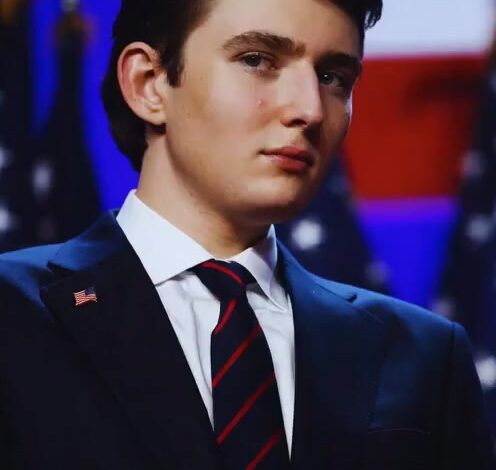
Barron Trump has spent his entire life inside one of the most recognizable families in the world, yet he remains one of its least understood members.
That contrast alone has fascinated the public for years.
The Trump family has never existed quietly. Long before politics, cameras were already part of the atmosphere surrounding them. Fame, branding, wealth, media attention, public conflict, and carefully staged visibility shaped the family’s identity for decades. Donald Trump did not merely attract attention; he built an empire around it. He understood instinctively that visibility could be converted into power, that spectacle could become strategy, and that headlines could be used like currency.
Then politics intensified everything.
Rallies.
Investigations.
Cable news arguments.
Court cases.
Social media storms.
Supporters treating the family like royalty.
Critics treating every gesture as evidence of something darker.
In that environment, most members of the Trump family became public figures in their own right. They gave interviews, appeared at campaign events, made speeches, defended the brand, entered political conversations, and learned to operate inside the same ecosystem of attention that surrounded Donald Trump himself.
Barron, however, remained different.
Quiet.
Reserved.
Carefully distant.
Visible, but rarely available.
He appeared in photographs and official moments, yet often seemed emotionally removed from the performance happening around him. He was present enough for the public to notice, but private enough that almost nobody could confidently say who he was beyond the outline created by his last name.
That mystery invited projection.
Some people interpreted his silence as arrogance. Others saw awkwardness, discomfort, intelligence, loneliness, or quiet rebellion. Some turned him into a symbol of privacy inside a family built on exposure. Others tried to read entire emotional histories into his posture, his height, his expression, or the way he stood beside his parents in public.
But beneath all those interpretations may be a much simpler truth:
Barron grew up protected on purpose.
And much of that protection appears to have come from Melania Trump.
Melania seemed to understand something about public life that many famous families either underestimate or willingly sacrifice: constant visibility changes children. It does not simply make them known. It trains them to watch themselves being watched.
For a child, that can be deeply distorting.
Ordinary development depends on privacy. Children need room to make mistakes without headlines. They need awkward phases that are not captured forever online. They need moods, silences, friendships, experiments, embarrassments, and small rebellions that do not become public material. They need the freedom to become themselves before strangers decide what they represent.
Political children are especially vulnerable to losing that freedom.
Their lives become symbolic before they are old enough to understand symbolism. Their clothing is analyzed. Their expressions are interpreted. Their absences become questions. Their presence becomes messaging. Even silence can become political.
Melania appeared determined to resist that as much as possible.
Throughout Donald Trump’s presidency and the years surrounding it, she kept firm boundaries around Barron’s public exposure. His appearances were limited. His daily life remained largely private. Interviews about him were rare. Access to him was tightly controlled, even during periods when nearly every other aspect of the Trump family was being consumed by media attention.
That choice stood out because it ran against the family’s larger pattern of spectacle.
Donald Trump has always thrived in public combat. He understands attention as oxygen. Whether in real estate, reality television, or politics, he has often used conflict, admiration, outrage, and media saturation to hold the center of the room.
Barron was largely kept away from that machinery.
Melania reportedly prioritized private schooling, controlled schedules, limited public appearances, and as much normal routine as could be preserved under extraordinary circumstances. To outsiders, that protection sometimes looked guarded or overly careful. But from a human perspective, it likely gave him something invaluable:
space.
Space to develop without performing constantly.
Space to observe before reacting.
Space to remain a child before being turned fully into a symbol.
That distinction matters.
Children raised in constant public attention often become performers before they become fully themselves. They learn optics before emotional language. They learn how to stand, smile, respond, and conceal. They become aware that every reaction may be frozen, shared, mocked, praised, or weaponized.
Barron’s public presence suggests a different kind of training.
Not performance.
Restraint.
He rarely appears emotionally reactive in public settings. At official events, campaign appearances, inaugurations, and family photographs, he often carries an expression that is difficult to decode. Composed. Reserved. Sometimes distant. Sometimes unreadable.
The internet has spent years trying to interpret that unreadability.
Does he dislike politics?
Is he shy?
Is he uncomfortable?
Is he detached?
Is he simply private?
But perhaps his restraint is less mysterious than people want it to be.
Perhaps he learned early that emotional neutrality can be a form of protection.
When you grow up around immense power and relentless scrutiny, reactions become valuable to others. A smile can be clipped into a headline. A glance can become a theory. An eye roll can become a viral political argument. A teenager’s ordinary discomfort can be turned into national commentary.
Under those conditions, stillness becomes armor.
And Barron was still a child during some of the most turbulent years in modern American political life.
He grew up as his family occupied the center of nonstop national conflict. Protests. Security details. Legal battles. Public insults. Online mockery. Fierce loyalty from strangers. Fierce hatred from strangers. Endless commentary from people who had never met him but felt entitled to interpret him.
Most adults would struggle under that kind of pressure.
A child has no reason to be expected to absorb it easily.
That is why Melania’s protectiveness reads less like image management and more like preservation. She seemed to recognize that there is a difference between being publicly known and being publicly consumed.
Many children of powerful families become extensions of their parents’ stories. They are treated as evidence, accessories, heirs, symbols, or contradictions. Some embrace that role as they grow older. Others spend years trying to recover an identity separate from the public narrative created around them.
Barron’s upbringing appears to have been shaped by an effort to prevent that absorption.
He was not pushed aggressively into campaigning.
He was not made into a regular media personality.
He was not constantly offered to the public as proof of anything.
Instead, he remained mostly outside the performance.
That may explain why fascination with him has only grown. People are curious about what they cannot access. In an era when public figures often broadcast their homes, meals, opinions, relationships, and emotions, true privacy feels almost unnatural. When someone famous does not constantly explain himself, the silence becomes magnetic.
Barron represents that silence.
People see him in limited glimpses — tall, composed, reserved — and because so little is known, imagination fills the gaps.
Some imagine brilliance.
Some imagine isolation.
Some imagine rebellion.
Some imagine loneliness.
Some imagine a future political heir.
Some imagine a young man quietly rejecting the spectacle around him.
But the truth is probably less theatrical.
He may simply have learned boundaries early.
And boundaries often look cold to people who are used to access.
The relationship between Donald and Melania likely shaped this dynamic as well. Whatever complexities exist privately within their marriage, Melania’s approach toward Barron has consistently appeared protective. During the White House years, reports often emphasized her concern with schooling, schedule, stability, and minimizing disruption to his life.
That mattered.
Childhood stability is important even for children born into privilege. Wealth does not erase emotional strain. Security restrictions, public hostility, media analysis, online cruelty, and the pressure of being attached to a globally polarizing figure can affect a young person regardless of status.
And unlike adults who choose political life, children inherit the consequences without choosing the stage.
That ethical tension has followed Barron for years. Many commentators have argued that he should remain off-limits because he entered public life involuntarily. Others ignored that boundary, discussing his appearance, height, body language, and personality with a confidence unsupported by real knowledge.
That habit reflects something uncomfortable about modern culture:
people often confuse visibility with permission.
If someone appears in public, audiences begin to feel entitled not only to look, but to interpret. To claim emotional access. To decide what silence means. To turn a young person into a symbol because symbols are easier to discuss than human beings.
But privacy still matters.
Especially for young people.
Perhaps Barron’s quietness survives because someone fought to preserve it. Perhaps his guarded public presence is not emptiness, but evidence of protection that worked. Perhaps the public knows so little because, for once, a child near power was allowed to keep something of himself.
That may prove valuable as he moves further into adulthood.
Children raised around celebrity and political power often face a complicated inheritance. They must decide what parts of the family legacy belong to them and what parts they must refuse. They must separate authentic identity from inherited expectation. They must learn whether attention feels like opportunity, burden, addiction, or threat.
Barron may one day choose public life.
He may enter business, politics, media, or something entirely separate. He may embrace the Trump name as a platform, or he may prefer a life defined by distance from it. The public will speculate either way.
But whatever path he chooses, he has already lived through a rare education.
He has seen fame from the inside.
He has seen politics turn private life into public property.
He has seen attention reward, distort, expose, and consume.
He has seen what happens when a family becomes a national argument.
That kind of observation can shape a person deeply.
Especially when paired with restraint.
In a world where young people are encouraged to perform themselves constantly, Barron’s silence feels increasingly unusual. Teenagers and young adults now often build identities through public display — posts, reactions, brands, commentary, images, metrics. Visibility has become not only common, but expected.
Against that backdrop, Barron’s refusal to constantly narrate himself feels almost countercultural.
He does not flood public spaces with opinion.
He does not appear desperate for attention.
He does not seem eager to transform mystery into personal branding.
In another era, that might have seemed ordinary.
Today, it reads as strange because restraint itself has become rare.
The public often mistakes quiet people for blank spaces waiting to be filled. But quietness is not emptiness. Sometimes it is discernment. Sometimes it is caution. Sometimes it is a refusal to give strangers more of yourself than they have earned.
Barron’s life so far suggests he learned that lesson early.
Not every thought needs an audience.
Not every feeling belongs to the public.
Not every moment must become content.
Not every child of a famous family has to become part of the machinery.
That restraint may look distant from the outside.
But from another angle, it looks like survival.
He was raised near extraordinary power and extraordinary noise, yet somehow remained partly unreachable. In a family defined by visibility, that may be one of the most unusual inheritances he received.
Not wealth.
Not fame.
Not access.
Not a famous name.
Distance.
The ability to stand near spectacle without becoming fully swallowed by it.
The ability to be seen without being entirely known.
The ability to preserve an inner life in a culture that constantly demands exposure.
That may be why Barron Trump remains so difficult for the public to define.
He grew up inside one of the loudest families in modern American life, yet he learned, intentionally or not, the power of staying quiet.
And in an age obsessed with being seen, that quiet may be the rarest form of protection he has.