The Hospital Room Secret That Shattered Our Joy, Why My Mother Saw Our Newborn and Shouted, You Cannot Keep This Baby!

In the quiet, almost clinical stillness of fertility clinics, the idea of “enough” never truly settles. It shifts, stretches, disappears just when you think you’ve reached it. For years, my husband Daniel and I lived inside that uncertainty—our lives reduced to charts, probabilities, and fragile hope. Every positive test felt like a breath held too long, followed almost inevitably by the devastation of another loss. Miscarriage became a word that no longer shocked us, just hollowed us out a little more each time.
I stopped asking why.
I stopped expecting answers.
Eventually, I began to believe that motherhood was something meant for other women—something I could stand near, but never fully enter. My name is Claire, and my path to becoming a parent wasn’t a straight line—it was a collection of quiet griefs, layered over time, threatening to erode even the strongest parts of my marriage. Daniel and I held on, but just barely.
Then, when the silence between us felt too heavy to carry, we made a choice that felt both terrifying and necessary.
We chose surrogacy.
The process was anything but simple. It wasn’t just emotional—it was precise, structured, almost mechanical. Contracts, legal language, medical protocols—it felt less like preparing for a child and more like navigating a system that demanded perfection at every step.
And then we met Mara.
She didn’t feel like part of the system. She felt like relief. Calm, steady, grounded in a way we hadn’t experienced in years. For the first time, the clinical routines—the ultrasounds, the tests—didn’t feel like warnings of something about to go wrong.
When we saw the heartbeat, it changed everything.
That small flicker on the screen wasn’t just a sign of life—it was a shift in how we allowed ourselves to feel. We stopped bracing for loss. We started planning. Dreaming. Building a nursery we had once been too afraid to imagine.
We believed we had finally made it through the storm.
The day Lily was born felt almost unreal.
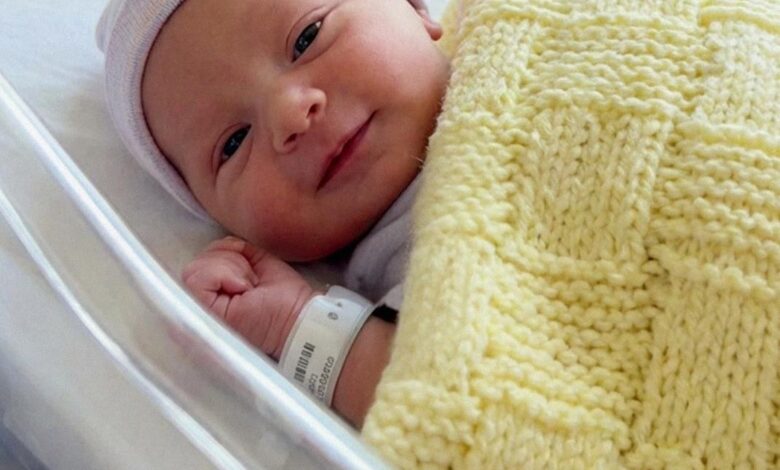
Everything was light and movement and sound—the controlled chaos of a hospital room filled with purpose. And then she was placed in my arms.
Warm. Small. Alive.
She rested against me as if she had always known me, as if she belonged there. Daniel stood beside me, his voice barely above a whisper as he said, “She’s perfect.”
And for the first time in a very long time, I believed it.
We had reached something we thought we might never have—a moment untouched by fear.
But the next morning, everything changed.
When my mother, Susan, walked into the room, something in her expression immediately felt wrong. She didn’t smile. She didn’t speak at first. She just stared at Lily, her focus fixed with a kind of intensity that made the air feel tight.
Then she said it.
“You can’t keep this child.”
The words didn’t make sense at first. They didn’t belong in that room. But the look in her eyes told me she believed them completely.
She pointed to a small mark behind Lily’s ear—a birthmark I had barely noticed.
“You had the same one,” she said. “And I’ve seen it before… on the children from the program.”
In the hallway, away from the noise and warmth of the room, she told me everything she had never said before.
Years before I was born, when she was struggling financially, she had participated in an egg donation program. It was something she had buried, convinced herself was part of a life she no longer needed to revisit.
But the mark—that detail—brought it all back.
“It’s genetic,” she said quietly. “Specific to that donor line.”
And suddenly, the possibility was there.
Not just unsettling—but unimaginable.
What if Lily wasn’t genetically mine at all?
We went back to the clinic.
This time, the calm professionalism felt different—thinner, less certain. When Dr. Harris finally spoke, there was a hesitation that told us everything before the words even came.
There had been an error.
A mislabeled sample.
A note buried in records that should never have been overlooked.
The embryo transferred to Mara… might not have been created from my genetic material.
The words landed heavily, but strangely, not in the way I expected.
Because when I looked at Lily—sleeping, peaceful, unaware of the storm around her—none of it changed what I felt.
The connection I had with her wasn’t theoretical. It wasn’t tied to data or DNA. It was real, immediate, undeniable.
Daniel stood beside me, steady as always.
“She’s our daughter,” he said.
And just like that, the confusion, the anger, the betrayal—it all shifted into something clearer.
Not simpler. But clearer.
What followed was complicated. Legally, emotionally, biologically—it was a situation no one prepares for. Questions we never thought we’d ask became part of daily conversations.
But over time, something unexpected happened.
We stopped searching for answers that would only complicate what we already knew.
We stopped asking whose she was.
And started focusing on who she was.
When we brought Lily home, the house finally felt alive in a way it never had before.
The silence that had once felt suffocating now felt peaceful. Full.
My mother stood in the doorway one evening, watching as I rocked Lily to sleep. The fear that had once filled her expression had softened into something else—something closer to understanding.
“I was wrong,” she said quietly. “You became her mother the moment you chose her.”
Our story isn’t simple. It isn’t what we imagined or planned.
It’s shaped by mistakes, by secrets, by turns we never saw coming.
But when I look at Lily—at the small mark behind her ear—I don’t see an error anymore.
I see a path.
A complicated, winding path that somehow still led her to us.
We don’t measure things in numbers anymore.
Not percentages. Not probabilities.
Now, “enough” is something entirely different.
It’s the weight of her in my arms.
The sound of her breathing.
The quiet certainty that she belongs here.
And for the first time in years, the silence in our home isn’t empty.
It’s full of something we fought for, lost hope for, and somehow found anyway.