I Married My Late Husband’s Best Friend — but on Our Wedding Night He Said, ‘There’s Something in the Safe You Need to Read’

When my late husband’s best friend asked me to marry him, I thought I had already faced the hardest parts of grief.
I said yes.
I believed the past had settled into something I could carry.
But on our wedding night, standing in front of a small safe with trembling hands, my new husband said something that made me question everything I thought I understood about love, loyalty, and second chances.
I’m 41 now, and even today, some mornings feel unreal.
For twenty years, I was Peter’s wife—not in a perfect, storybook way, but in the kind of love that actually lasts. The kind built on routine, on arguments over nothing, on laughter that comes after long days.
We had a house that always needed fixing. Two kids who filled every room with noise. A life that felt ordinary in the best possible way.
Peter used to call it that—ordinary.
He meant it as a compliment.
Six years ago, everything changed.
A drunk driver ran a red light, and suddenly, the life we had built together was gone.
I remember the knock on the door.
I remember collapsing.
After that, everything is blurred—grief has a way of erasing details, leaving only fragments behind.
But one thing remained steady.
Daniel.
Dan had been Peter’s best friend since they were kids.
Not just a friend—family.
The kind of bond built over years of shared mistakes, long conversations, and loyalty that never needed to be spoken out loud.
When Peter died, Dan didn’t ask what I needed.
He just showed up.
He fixed things around the house without being asked.
He brought groceries when I forgot to eat.
He sat with my son when words didn’t work and let him process his anger in silence.
He never made it about himself.
Not once.
“You don’t have to keep doing this,” I told him months later.
“I know,” he said. “But Pete would’ve done it for me.”
That was all.
No expectations.
No hidden meaning.
Just loyalty.
The feelings didn’t arrive all at once.
They grew slowly, quietly—almost unnoticed.
A late-night repair in the kitchen.
A shared laugh.
A moment where I realized I didn’t feel alone anymore.
When he finally told me he loved me, it wasn’t dramatic.
It was hesitant.
Careful.
Like he was afraid the words themselves might break something.
“I know it’s wrong,” he said softly. “But I can’t pretend I don’t feel this.”
But it didn’t feel wrong.
It felt… honest.
And somehow, that made it easier.
We didn’t rush.
We gave it time.
We made sure it wasn’t just grief, or loneliness, or something temporary.
And when we finally chose each other, it wasn’t out of desperation.
It was out of certainty.
Even Peter’s mother understood.
“You’re not betraying him,” she told me. “You’re living.”
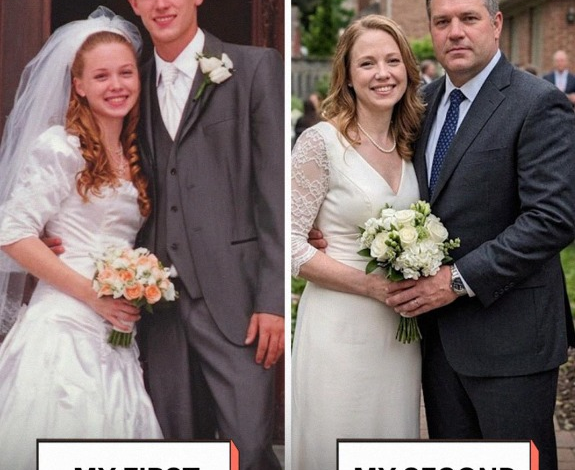
So we got married.
A small wedding.
Simple.
Real.
The kind of day that feels like a quiet beginning instead of a grand declaration.
That night, I thought everything would feel lighter.
Easier.
Like we had crossed into something new.
But when I walked into the bedroom, Dan wasn’t relaxed.
He was standing in front of the safe.
Still.
Tense.
His hands shaking.
“There’s something you need to see,” he said.
His voice barely steady.
Inside the safe was an old phone.
Cracked.
Worn.
Almost forgotten.
When he turned it on and showed me the messages, everything slowed.
It was a conversation between him and Peter.
From years before.
At first, it was nothing.
Just normal conversation.
Jokes.
Plans.
Then it changed.
Dan had written:
“Sometimes I look at what you have, and I wonder if I’ll ever get that lucky. You and Isabel just work.”
And Peter had responded:
“Don’t. Seriously. Don’t go there.”
Then:
“Promise me you’ll never try anything with her. Ever.”
I felt something inside me tighten.
Not anger.
Not exactly.
Just… understanding.
Dan sat there, breaking under the weight of something he’d carried alone.
“I forgot this conversation existed,” he said. “But when I found it again… I started questioning everything.”
He looked at me, his voice unsteady.
“What if I crossed a line I wasn’t supposed to? What if I took advantage of you when you were vulnerable?”
And then he said the thing that mattered most:
“If you think I did… we can stop this. Right now.”
On our wedding night, he was willing to walk away.
Not because he didn’t love me.
But because he was afraid he had hurt me.
I looked at him—really looked.
At the man who had never pushed me.
Never rushed me.
Never used my pain.
“Do you love me?” I asked.
“Yes,” he said. “Always.”
I held his face in my hands.
“You didn’t break a promise,” I told him softly. “Life changed. We changed. And we found each other after everything.”
Peter hadn’t planned to leave.
He hadn’t imagined this.
But if he could see us, I believed he would understand.
Not as betrayal.
But as continuation.
That night, we chose each other again.
Not as replacements.
Not as something born from loss.
But as something new.
Peter will always be part of my life.
That doesn’t change.
It never will.
But love doesn’t end when one chapter does.
It changes.
It grows.
It finds new ways to exist.
Dan isn’t a replacement.
He’s my second chapter.
And if there’s one thing I’ve learned, it’s this:
The heart doesn’t stop after it breaks.
It learns.
It adapts.
It keeps going.
And sometimes—if you’re willing to let it—
It finds its way back to love.