Calm Evening Turns Into Ice Storm Nightmare As Giant Hail Smashes Homes and Leaves Town Reeling

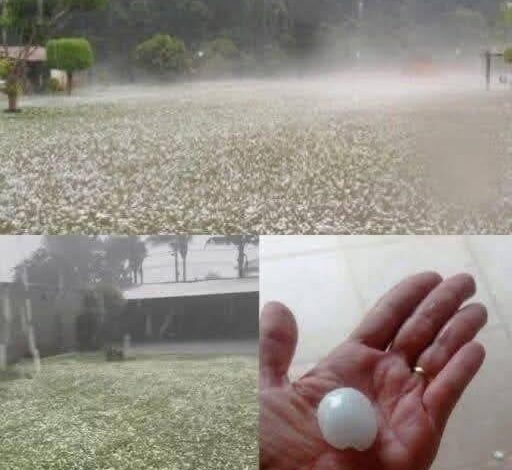
It began like any other evening—quiet, predictable, almost forgettable. Streets settled into stillness, lights flickered on behind windows, and families moved through familiar routines without a second thought. There was no urgency, no warning, nothing to suggest that the night would become anything other than ordinary.
Then the sky shifted.
At first, it was subtle. A change in the air. A distant rumble that could have easily been dismissed as another passing storm. People glanced outside, paused for a moment, then returned to whatever they were doing. Storms were nothing new. They came and went. Life went on.
But this one didn’t follow that pattern.
Within minutes, the calm fractured.
The first impact landed hard—sharp, sudden, unexpected. Then another. And another. What had seemed like ordinary rain transformed into something far more violent. Massive chunks of ice began falling from the sky, slamming into rooftops, denting cars, striking windows with a force that felt almost deliberate.
The sound alone was enough to trigger fear.
It wasn’t the steady rhythm of rainfall. It was chaos—loud, explosive, unpredictable. Each strike echoed through the neighborhood, louder than the last. People rushed toward windows out of instinct, only to retreat immediately as glass cracked under the pressure.
Panic spread quickly.
Parents grabbed their children, pulling them away from doors and windows, guiding them into hallways, bathrooms—anywhere that felt even slightly safer. Voices rose. Confusion filled the air. For a few intense moments, it no longer felt like weather.
It felt like something attacking from above.
Hailstones—some shockingly large—tore through everything in their path. Windshields shattered instantly. Metal crumpled under repeated strikes. Roofs took direct hits that left visible damage within seconds. The storm didn’t move through gently.
It hit.
And it kept hitting.
Inside their homes, people crouched low, listening.
Each impact carried a question.
Would the windows hold?
Would the roof give in?
How long would this last?
Time stretched in those moments. Seconds dragged into something heavier, longer, harder to measure. The storm showed no signs of easing, hammering down with a force that left no room for control or certainty.
And then—almost as abruptly as it began—it started to fade.
The impacts slowed. The noise softened. The sky loosened its grip. The violence above gave way to something quieter.
The storm moved on.
And what it left behind felt just as unsettling.
Silence.
Not complete silence—but a heavy, lingering stillness. Broken only by the drip of water from damaged roofs, the distant echo of car alarms, and the faint wail of sirens approaching from across town.
People stepped outside slowly, cautiously, as if the sky might turn again without warning.
What they saw didn’t feel real.
Lawns were covered in jagged ice, scattered unevenly like debris from something unnatural. Cars sat where they had been minutes earlier, now dented, cracked, or completely shattered. Glass glinted across driveways and sidewalks. Roofs showed fresh wounds—shingles torn away, surfaces punctured.
Neighbors emerged, exchanging looks more than words at first.
Conversations began in fragments.
“Did you see—”
“My window—”
“I thought it was—”
No one had a complete sentence.
Only shared disbelief.
Stories spread quickly.
One person described watching a window explode inward without warning. Another spoke of running across a room to pull a child away seconds before the glass shattered. Many mentioned the sound—how it didn’t feel like a storm at all, but something harsher, almost mechanical.
And yet, beneath the shock, something else began to surface.
Relief.
No immediate reports of serious injuries. No confirmed loss of life. In a situation that could have turned far worse, that fact grounded people in a fragile sense of gratitude.
Emergency crews arrived soon after.
Their presence brought movement, direction. Streets were checked. Damaged areas cleared. Teams went door to door, especially looking in on elderly residents and those who might have struggled to stay safe during the storm. Flashlights cut through dim homes where power had flickered—or disappeared entirely.
In some places, electricity remained unstable. Lights blinked, faded, returned briefly, then gave out again. Families gathered together in dim rooms, relying on phone screens or small lamps to navigate. Messages were sent. Calls made. Everyone trying to confirm the same thing:
Are you okay?
The storm had passed.
But its presence lingered.
For many, the emotional weight arrived after the noise was gone. The realization of how quickly everything had changed. How an ordinary evening had turned into something violent and unpredictable in a matter of minutes.
There was frustration, too.
Because damage like this doesn’t end when the storm does. It stays—in repair costs, insurance claims, disruptions that ripple through days and weeks. Cars need fixing. Roofs need replacing. Windows need covering. Life doesn’t reset overnight.
And yet, even in that, there was perspective.
People stood in front of damaged homes, surrounded by ice and debris, and acknowledged something simple:
It could have been worse.
Much worse.
Nature has a way of reminding people how little control they truly have.
One moment, everything feels stable—predictable, secure. The next, it’s chaos. No warning loud enough. No preparation complete enough.
That night became one of those reminders.
But it also revealed something else.
As the sky cleared and the storm moved on, the town began to shift—from shock to response. Neighbors checked on one another. Offers of help appeared. Small acts of support started to rebuild a sense of normalcy.
By the time darkness fully settled, something quieter had taken hold.
Resilience.
The ice would melt.
The damage would be repaired.
Life would move forward.
But the memory would stay.
Because once you hear a storm like that—once you feel how quickly everything can change—you don’t forget it.
You carry it with you.
Not just as fear.
But as awareness.
Of how fragile the ordinary really is.