My Date Paid for Dinner — But What Happened Next Left Me Shocked and Forced Me to Rethink Charm, Generosity, and the Hidden Expectations That Can Turn a Seemingly Perfect Evening Into an Unsettling Lesson About Entitlement, Control, and Paying Attention to Red Flags

When my best friend Mia suggested setting me up with her boyfriend’s friend, my instinct was to say no. Blind dates had never gone well for me, and I had learned to trust that hesitation. Still, Mia had that gentle persistence only a close friend can pull off. She painted him as kind, reliable, and “a little old-fashioned, but in the best way.” His name was Eric, and she seemed certain we’d click.
Reluctantly, I agreed to exchange numbers.
Right away, Eric stood out from the usual dating app chatter. He didn’t send one-word replies or late-night “hey” messages. His texts were thoughtful, asking genuine questions about my work, my hobbies, my family. He remembered details and referenced them later. It felt… different. Refreshing. Grounded. Adult.
After a week of messaging, he suggested dinner. He picked a familiar Italian spot downtown—nice, but understated. He asked what nights worked for me and never pressured me into anything last-minute. Everything about him felt safe.
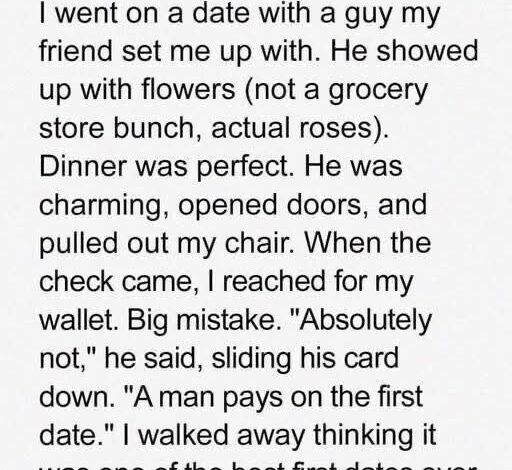
On the night of the date, he arrived early. That alone set a positive tone. When I walked in, he stood immediately, smiling, and handed me a small bouquet of roses. Sweet, perhaps a little formal, but considerate. He pulled out my chair, complimented my dress, and even gave me a tiny keychain engraved with my initial. Slightly over the top for a first date, I thought—but thoughtful nonetheless.
Dinner itself flowed effortlessly. We talked about travel, work, embarrassing dating experiences, and favorite foods. He listened, laughed in the right places, and genuinely seemed engaged. I found myself relaxing, thinking maybe Mia had been right.
When the check came, I instinctively reached for my wallet. Eric gently waved me off.
“A man pays on the first date,” he said, smiling.
It was unexpected, but not uncomfortable. After dinner, he walked me to my car, waited until I was safely inside, and didn’t make any inappropriate moves. I drove home thinking the night had been genuinely pleasant.
The next morning, I expected a simple text: “Had a great time” or “Hope you got home safe.” Instead, my inbox held an email from Eric with the subject: “Invoice for Last Night.”
I laughed at first, assuming it was an awkward joke. Curious, I opened it.
It wasn’t a joke.
The document looked like a professional invoice, listing charges line by line: dinner, flowers, the engraved keychain. Then came a line for “emotional labor.” At the bottom were instructions for repayment and a warning: failure to pay could result in “Chris being informed”—Mia’s boyfriend.
My stomach sank.
I reread the email, hoping I had misinterpreted it. I hadn’t. The tone was transactional and even threatening. The same man who had insisted on paying now seemed to think generosity had earned him a debt.
I immediately texted Mia.
Her response came in seconds: “Oh my god. He’s insane. Don’t respond.”
Together with Chris, they confronted Eric. Chris sent a mock invoice back, humorously penalizing Eric for entitlement, discomfort, and general bad behavior. The response was sharp, cathartic, and honestly a little fun.
Eric didn’t take it well. His replies turned from defensive to angry, then self-pitying. He claimed we misunderstood him, accused us of humiliation, of ingratitude. I didn’t respond. I didn’t owe him anything—financially or emotionally.
Mia and Chris cut him off completely.
In the days that followed, I replayed the night in my mind. The roses. The gift. The insistence on paying. What I had first seen as charm now looked like a form of leverage. What I thought was generosity felt conditional.
I learned something crucial: real kindness comes without an invoice. Genuine generosity isn’t a transaction, and charm paired with entitlement isn’t charm at all.
Over time, I reflected on how the experience changed my approach to dating. I became more attentive—not just to actions, but intentions. Did someone listen because they cared, or because they wanted a return? Did someone give freely, or were they tallying a ledger? Awareness became my guide, not suspicion.
I also recognized how women are conditioned to excuse discomfort, to laugh off unease, and give the benefit of the doubt even when instincts scream otherwise. That morning, I almost minimized my own reaction—an instinct as ingrained as it was dangerous.
There was a strange sense of grief too. Not for Eric, but for the version of the evening I had believed in. I had genuinely enjoyed it, felt hopeful, maybe even excited. Learning that it had been tethered to expectation was disorienting.
Yet, there was empowerment. For the first time, I didn’t explain myself. I didn’t justify my feelings. I simply disengaged—and that felt like growth.
Weeks later, Mia mentioned Eric had tried reaching out to mutual acquaintances, framing the ordeal as a “misunderstood joke” or “social experiment.” No apology, no acknowledgment of the discomfort he caused—just reframing. That said everything I needed to know.
I never replied. Silence, I discovered, can be the clearest boundary.
Now, I share this story cautiously, not to instill fear, but as a reminder: gestures should never be taken at face value without examining intent. Effort is not entitlement. Tradition is not control. Respect never keeps a ledger.
The dinner bill was paid that night. But the lesson’s cost lingered far longer—and shaped me far more deeply.
And if there’s one thing I carry forward, it’s this: attention is the most powerful currency we have. Where we choose to spend it determines who we welcome into our lives—and who we keep out.