The Miracle Of Pear The Roadside Debris That Turned Into A Heartbreaking Lesson In Survival And The Power Of Human Touch

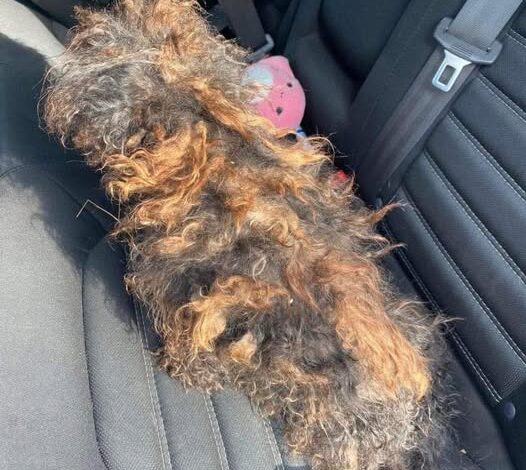
On a quiet, sunburned stretch of roadside in Missouri, something lay so still, so indistinct, that it barely registered as life. To passing drivers, it was nothing more than debris—perhaps a discarded rug, a bundle of tangled fibers abandoned without thought. It didn’t move with urgency. It didn’t cry out. It simply existed there, blending into the dull gray of asphalt and dust, as if the world had already decided it no longer mattered.
But then someone looked closer.
There, beneath the matted layers, was the faintest rise and fall—a fragile rhythm that betrayed the truth. It wasn’t trash. It was a living creature. And somehow, against all odds, it was still holding on.
That was the moment Pear’s story began.
When rescuers approached, what they found was almost unrecognizable as a dog. Her fur had grown unchecked for so long that it had fused into a dense, suffocating shell, pulling tightly against her skin and distorting her body. Every step she tried to take looked like a negotiation with pain, her limbs struggling under the unnatural weight wrapped around them. She didn’t walk so much as drag herself forward—a shadow of movement, burdened by something she could not escape.
She was lifted with extraordinary care, as though she might shatter under the wrong touch, and taken to a rescue team accustomed to the worst cases imaginable. And still, even they paused when they saw her. There are moments in rescue work when suffering stops being abstract and becomes something immediate, undeniable—and Pear was one of those moments.
What followed was not a dramatic transformation, but a slow and deliberate act of release.
The grooming process unfolded in silence, the steady hum of clippers cutting through years of neglect. Each motion was careful, almost reverent. This wasn’t about appearance—it was about freeing a body from a prison it had been forced to carry. As thick, dirt-laden mats fell away, they revealed something startling: a dog far smaller than anyone expected. Beneath the heavy exterior was a fragile frame, skin thin and sensitive, muscles trembling from exhaustion.
With every layer removed, it was as if the weight of her past was being physically lifted. Her body seemed to respond in real time, adjusting to a sensation she may not have felt in years—the simple touch of air. By the time the last of the matted fur was gone, Pear stood there transformed, yet not fully restored. She was lighter, yes—but also exposed, vulnerable in a way that revealed just how much she had endured.
The evidence of her past was written across her body. One eye was gone, leaving behind a hollow that spoke of an injury no one could fully explain. Scars traced across her skin, quiet records of hardship and survival. When food was placed in front of her, she didn’t hesitate—she devoured it with urgency, as if uncertain when the next meal might come.
And then, something shifted.
Once her hunger was satisfied, Pear collapsed into sleep—deep, unguarded sleep. Not the restless kind born of fear, but the kind that comes only when, for the first time in a long time, there is nothing left to defend against. It was the kind of rest that felt like surrender, not to danger, but to safety.
In the days that followed, her story spread quickly. Images of her transformation captured attention—the stark contrast between what she had been and what she was becoming. People saw the physical change, the small sweaters, the tentative flicker of a wagging tail. But those who stayed close to her understood that the most important change wasn’t visible in photographs.
It happened in a quiet moment.
A volunteer reached out—not to treat, not to fix, but simply to connect.
For a dog who had every reason to fear human touch, the outcome could have gone either way. She could have recoiled. She could have shut down.
Instead, Pear leaned in.
Slowly, cautiously, but with unmistakable intention, she chose contact over distance. She accepted the hand extended to her—not because she forgot her past, but because she decided it would not define her future.
That moment was small in scale, but enormous in meaning.
Rescue can save a body, but trust is something else entirely. It cannot be forced or given—it must be chosen. And in choosing it, Pear did something extraordinary. She stepped out of survival and into possibility.
Her story is not just about recovery; it’s about agency. It’s about the quiet, powerful decision to let go of fear, even when fear has been justified. It’s about the resilience that exists beneath damage, waiting—sometimes silently—for the chance to re-emerge.
Today, Pear is no longer that unrecognizable shape by the roadside. She is a living reminder that even the most broken circumstances can hold something worth saving. Her body once carried the weight of neglect, but her spirit carried something stronger: the ability to endure, and eventually, to trust again.
In the end, what makes her story unforgettable isn’t just that she was rescued.
It’s that she chose to come back.