On the morning of her father’s funeral, Hazel stood alone in the kitchen, holding a mug of coffee that had long since lost its warmth. The quiet in the house felt deeper than usual, as though every room understood the gravity of the day ahead. The familiar sounds that once filled the mornings—her father humming softly while making breakfast or the faint clinking of tools from the garage—were gone. Hoping to steady herself before leaving, Hazel opened the photo gallery on her phone and began scrolling through old pictures.
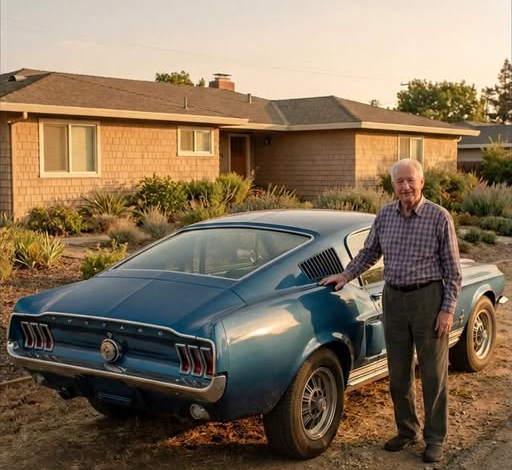
Many of the photos showed her father standing beside his cherished Shelby in the garage. In nearly every picture he wore the same proud smile, streaks of grease on his hands and a sense of quiet satisfaction in his eyes. Restoring that car had been one of the projects he loved most. Over the years he rebuilt it carefully, part by part, sometimes spending entire weekends in the garage. Hazel remembered how he used to tell her that meaningful things in life rarely came together quickly. “Patience and care,” he would say, tightening a bolt or wiping down the chrome, “that’s what makes something last.”
To him, the Shelby was never just a car. It represented perseverance, craftsmanship, and the time they had shared together in that small garage filled with tools, spare parts, and old rock music playing softly in the background. Hazel could still picture herself sitting on a stool nearby while he explained how engines worked, breaking complicated ideas into simple lessons she could understand. Those moments had shaped her more than she realized at the time.
That morning, driving the Shelby to the funeral felt like the only right choice. It was as if bringing the car meant bringing a piece of her father with her—a quiet tribute to the years he spent restoring it and the memories tied to it.
The memorial service itself passed gently. Friends, coworkers, and neighbors gathered to share stories about the man they had known. Some spoke about his kindness and how he never hesitated to help someone who needed it. Others talked about his strong work ethic and the steady encouragement he offered during difficult times. There was laughter mixed with tears as people remembered his humor and the calm way he handled life’s challenges.
When it was Hazel’s turn to speak, she stepped up slowly, gripping the podium for a moment before beginning. Instead of reciting something formal, she shared the memories that meant the most to her—those quiet evenings in the garage. She talked about how her father had taught her that every small part of an engine mattered, just like every small effort in life adds up to something meaningful. As she finished speaking, she realized those lessons would stay with her long after the sadness of the day faded.
After the service ended, people began gathering outside the church, offering hugs and quiet words of comfort. Hazel stepped outside as well, expecting to see the Shelby parked where she had left it that morning. Instead, the spot was empty.
Her heart sank.
A few yards away stood a flatbed truck, and strapped onto it was the Shelby. A man stood nearby checking something on a clipboard, clearly preparing to leave with the car. Hazel hurried closer, confused and alarmed.
That was when her stepmother Karen calmly explained that she had already arranged to sell it. The words landed heavily, like another loss arriving before Hazel had even begun to process the first one. To Karen, it seemed like a practical decision—one less responsibility, one less reminder of the past. But to Hazel, the Shelby was far more than an object. It was a symbol of her father’s patience, dedication, and love.
Just as the truck driver was about to secure the final straps, a mechanic approached Hazel with a small sealed plastic bag in his hand. He explained that during a quick inspection of the car earlier, he had discovered something tucked near the spare tire. Inside the bag were a few documents and a single envelope.
Hazel immediately recognized the handwriting on the front.
It was her father’s.
With trembling hands, she opened the envelope and unfolded the letter inside. The words were simple but deeply personal. Her father wrote about a road trip he had once hoped the family would take together in the Shelby—an anniversary journey he believed might bring everyone closer. He described the joy he felt while restoring the car, remembering how his own father had taught him patience and resilience many years earlier.
He wrote about how working on the Shelby reminded him that the most important things in life, whether machines or relationships, required care, time, and commitment. Most of all, he spoke about his hope that the people he loved would always find a way to stay connected, even when life became complicated.
As Hazel finished reading, the frustration and anger she had felt began to soften. In their place came a quiet sense of understanding. Her father had spent years trying to hold the family together, often in ways she hadn’t fully seen before.
The mechanic gently mentioned that the sale paperwork hadn’t yet been finalized. If Hazel wished, the decision could still be reconsidered.
Standing outside the church, the late afternoon sun stretching long shadows across the pavement, Hazel looked at the Shelby sitting on the truck. For a moment she could almost picture her father leaning against it in the garage, wiping his hands on a rag and smiling proudly at the work he’d done.
In that moment she understood something clearly: the Shelby carried more than metal, rubber, and paint. It held stories, lessons, and the quiet legacy of the man who had rebuilt it with his own hands.
Hazel folded the letter carefully and placed it back in the envelope. Then she made a quiet promise to herself. No matter what happened next, she would protect the memories her father had left behind and carry forward the values he had taught her—patience, resilience, and the strength to hold onto what truly matters.