I Brought My Late Grandma’s Necklace to a Pawn Shop to Pay My Rent – Then the Antique Dealer Went White and Said He Had Waited 20 Years for

I thought I was about to trade away the last piece of meaning I had left just to buy myself a little more time. I didn’t know that stepping into that pawn shop would pull open a door to a past that had been waiting for me all along.
After the divorce, I walked away with almost nothing.
A phone that barely worked. Two overstuffed bags of clothes that didn’t even feel like mine anymore. And one thing I had sworn I’d never part with—my grandmother’s necklace.
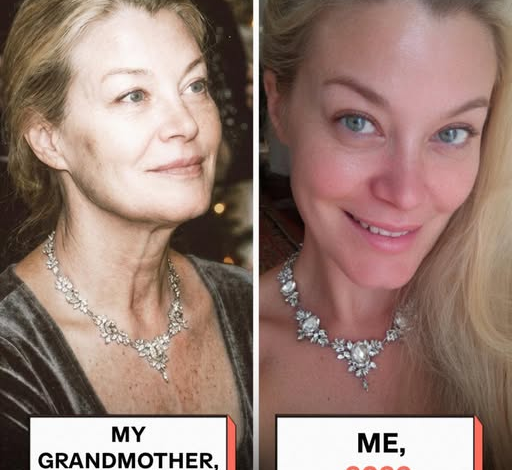
That necklace wasn’t just jewelry. It was memory. It was comfort. It was the only thing that still felt anchored to a version of my life that hadn’t completely fallen apart.
But life has a way of cornering you.
The miscarriage had already taken something out of me I didn’t know how to replace. I was still trying to breathe through that when my husband left—no warning, no hesitation. Just gone. Off chasing something newer, easier, someone who didn’t carry the weight I did.
After that, survival became mechanical.
Work. Sleep. Repeat.
I picked up every shift I could at the diner. Counted tips like they were lifelines. Smiled when I had to, nodded when spoken to, kept moving because stopping meant thinking—and thinking meant falling apart.
But there’s only so far determination can stretch when reality keeps tightening its grip.
One evening, I came home and found the notice.
Bright red. Impossible to ignore.
FINAL WARNING.
It wasn’t just paper. It was a deadline. A countdown I couldn’t stop.
I stood there for a long time, staring at it, hoping—irrationally—that it might somehow disappear if I didn’t acknowledge it.
It didn’t.
Inside, I already knew what I had to do. I just wasn’t ready to say it out loud.
That night, I pulled the shoebox from the back of my closet.
Inside, wrapped in an old scarf, was the necklace.
I hadn’t touched it in months. Maybe longer.
Holding it again felt… different. Heavier than I remembered. Warmer, somehow. Like it carried more than just memory—like it knew.
“I’m sorry,” I whispered into the quiet room. “I just need a little more time.”
I must’ve taken it out a dozen times that night. Put it back. Took it out again. Bargained with myself. Tried to imagine another way.
But morning came anyway.
And so did the truth.
The pawn shop sat in the middle of downtown—one of those places you only notice when you have no other choice.
The bell above the door rang as I stepped inside.
An older man looked up from behind the counter. Calm. Unassuming.
“Can I help you?”
I hesitated.
Then I placed the necklace down between us, like setting something fragile—or dangerous—free.
“I need to sell this.”
At first, he barely reacted.
Then he really looked at it.
Everything changed.
His hands stilled. His expression drained. His eyes locked onto the necklace like he’d seen a ghost.
“Where did you get this?” he asked quietly.
“It was my grandmother’s,” I said, a little impatient. “I just need enough to cover rent.”
“What was her name?”
Something about his tone made me pause.
“Merinda. Why?”
He stumbled back slightly, gripping the counter like it was the only thing keeping him steady.
“Miss… you should sit down.”
My stomach dropped.
“Is something wrong with it?”
“No,” he said, shaking his head. “No, it’s real. Very real.”
Before I could ask anything else, he grabbed a phone and dialed quickly.
“I have it,” he said when someone answered. “The necklace. She’s here.”
A chill ran through me.
“Who are you calling?”
He covered the receiver, eyes wide.
“The master has been searching for you for twenty years.”
Nothing about that sentence made sense.
Before I could react, a door behind the counter opened.
And then—
“Desiree?”
She looked older, of course. Time had softened her, but she still carried that same quiet elegance I remembered from childhood. My grandmother’s closest friend. The woman who used to bring pastries and laughter into our home.
The moment she saw me, something in her expression broke open.
“I’ve been looking for you,” she said.
Before I could process it, she wrapped her arms around me.
It was unexpected.
Warm.
Familiar.
And somehow grounding in the middle of everything that suddenly wasn’t.
“What’s going on?” I asked when she pulled back.
She studied my face like she was searching for something she’d almost forgotten.
“You look so much like her.”
“My grandmother?”
She nodded, then gently took control of the room.
What she told me next rewrote everything.
The woman I called Nana wasn’t my biological grandmother.
She had found me.
A baby, left alone, hidden near a walking path. Wrapped carefully. Wearing that necklace.
No note. No name. No explanation.
Just me.
And that necklace.
“She tried to find your family,” Desiree said. “We both did. But there was nothing to go on.”
So my grandmother kept me. Loved me. Raised me. Chose me.
And never told me, because she didn’t want me to feel like I didn’t belong.
By then, my entire sense of identity felt like it was shifting under my feet.
“And the necklace?” I asked.
Desiree’s expression changed.
“That was always the key.”
It wasn’t ordinary. Even back then, they knew it came from somewhere specific. Somewhere important. The kind of place where things like that don’t just get lost.
She had spent years—decades—quietly building connections, opening businesses, keeping watch.
Waiting.
“For the necklace?” I asked.
“For what it would lead us to,” she said.
“And now?”
She met my eyes.
“I already found them.”
Everything inside me stopped.
“With your permission,” she said gently, “I can call them.”
That was the moment everything truly shifted.
I nodded.
The next day, they walked through that door.
A man and a woman. Composed on the outside, but barely holding it together underneath.
The woman saw me and immediately broke.
“You’re alive,” she whispered.
And just like that, I wasn’t just someone struggling to make rent anymore.
I was someone who had been searched for. Missed. Hoped for.
They told me what happened. A kidnapping. A trusted employee. A plan that went wrong. Years of searching that led nowhere.
Until now.
“Will you come home with us?” she asked.
Home.
The word felt unfamiliar. Fragile.
But I said yes.
Their world was nothing like mine. Quiet wealth. Space. Stability.
They showed me a part of the house—an entire wing—and told me it was mine.
Mine.
For the first time in a long time, I felt something shift inside me.
Not happiness. Not yet.
But relief.
Deep, steady relief.
Later, I held the necklace again.
The thing I had almost sold for one more month of survival.
And I realized—
It hadn’t been the end of something.
It had been the beginning.
For the first time, I wasn’t trying to escape my life.
I was stepping into it.