At first, it almost looked delicate.
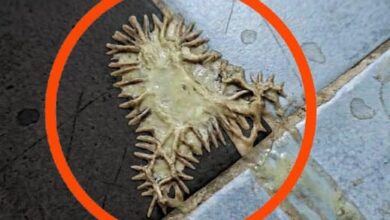
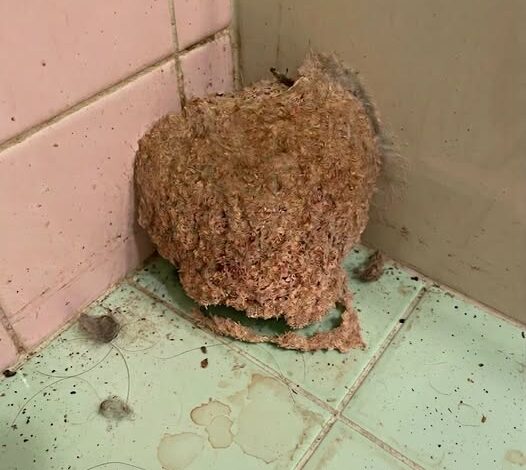
From a distance, the strange formation on the wall seemed like layers of burned paper carefully shaped into a cone. Each section had a strange, precise structure to it, almost too organized to be accidental. The cells were tucked together in a pattern that looked both fragile and intentional, like something crafted rather than grown.
For a few seconds, we simply stared at it.
None of us wanted to be the first person to say what we were all thinking:
Something was living there.
The longer we looked, the less harmless it seemed. What had appeared almost delicate at first began to feel unsettling. The shape was too structured. The color too strange. The texture looked dry and papery in some places, darker and more organic in others. It seemed wrong for a bathroom wall, wrong for a home, wrong for any place we thought we understood.
Our imaginations immediately went to the worst possibilities.
Parasites.
Mold.
A fungal growth.
Some kind of insect colony.
Something rotting inside the wall.
Every guess made it worse.
We pulled out our phones and started searching frantically, typing in every description we could think of. “Cone-shaped growth on wall.” “Paper-like nest indoors.” “Strange honeycomb structure bathroom.” “Brown layered thing on wall.” Each search brought up images that were either not close enough to be useful or close enough to make our anxiety spike.
We messaged friends.
We zoomed in on photos.
We compared it to every unsettling picture we could find online.
The more we searched, the less certain we became.
That was the worst part.
If someone had told us immediately what it was, maybe the fear would have stayed contained. But uncertainty has a way of expanding inside a room. Every unknown detail becomes a threat. Every faint sound becomes evidence. Every shadow near the wall begins to feel suspicious.
Then we remembered the buzzing.
At first, we had barely noticed it. It had been faint, occasional, easy to dismiss as something outside the window or a pipe vibrating somewhere in the wall. Houses make sounds all the time, especially older ones. A hum here, a creak there, a soft tapping that seems to disappear the moment you try to locate it.
But now, standing in front of that strange papery structure, the sound returned to memory with new meaning.
The faint buzzing had not been nothing.
Neither had the tiny bits of debris we had noticed on the floor.
We had swept them up without thinking much of it, assuming it was dust, old plaster, or something tracked in from outside. But suddenly those little fragments felt like clues we had failed to understand. The bathroom had been trying to tell us something before we knew how to listen.
When we finally learned it was a hornets’ nest, everything clicked into place at once.
The papery layers.
The organized cells.
The buzzing.
The debris.
The uneasy feeling that something hidden had been growing quietly too close to us.
The realization changed the room instantly.
Only minutes earlier, the bathroom had been part of the house — familiar, ordinary, safe. Now it felt like enemy territory. The doorframe seemed too close. The walls felt unpredictable. Even the air seemed charged with invisible movement.
Fear turned quickly into urgency.
None of us wanted to test how active the nest was. None of us wanted to find out how many hornets might be hidden inside or behind it. The idea of disturbing it accidentally made our stomachs tighten. A wrong movement, a slammed door, a careless attempt to knock it down — any of it could have turned a frightening discovery into something dangerous.
So we did the only sensible thing.
We backed away.
We shut the bathroom door carefully.
We sealed the gap as best we could.
We warned everyone in the house to stay away.
Then we called professionals.
There was a strange humility in that decision. Part of you wants to believe you can handle problems inside your own home. You want to grab a broom, a spray can, a trash bag, anything that makes you feel in control. But some situations are not meant for bravery. They are meant for caution.
This was one of them.
When the professionals arrived, their calmness made the situation feel both better and worse. Better because they knew exactly what they were doing. Worse because their seriousness confirmed that our fear had not been ridiculous.
They inspected the area carefully, explained what they could see, and prepared to remove the nest without provoking the colony unnecessarily. Watching them work from a safe distance, we felt a strange mixture of relief and dread.
Relief that help had arrived.
Dread at the thought of what could have happened if we had tried to deal with it ourselves.
The removal itself felt surreal. Something that had seemed almost mysterious and unreal suddenly became a very real threat being handled with tools, protective gear, and practiced movements. Piece by piece, the nest was removed. What had looked like a strange object on the wall revealed itself as evidence of activity, construction, and survival happening quietly inside our home without our permission or awareness.
That thought stayed with us.
The hornets had been there while we brushed our teeth.
While we washed our hands.
While we walked past the bathroom door without concern.
While we mistook warnings for ordinary household noise.
The house had continued feeling normal while something potentially dangerous developed in plain sight, disguised by our own lack of understanding.
After the nest was gone, the bathroom still felt different.
Technically, it was safe again. The professionals had handled the immediate danger, checked the area, and told us what to watch for in case there was more activity. But emotionally, the room did not return to normal right away.
We kept glancing at the wall.
We listened for buzzing that was no longer there.
Every tiny speck on the floor looked suspicious for a while.
That is what fear does after the danger passes. It lingers in the senses. It teaches the body to keep checking, even when the mind knows the threat is gone.
Still, beneath the unease, there was gratitude.
Gratitude that we noticed it before touching it.
Gratitude that no one tried to scrape it off.
Gratitude that no child or pet had disturbed it first.
Gratitude that we chose caution over pride.
Because it is easy to imagine another version of the story.
Someone sees the strange formation and assumes it is harmless. Someone pokes it with a broom handle. Someone sprays it too close. Someone tries to knock it down without realizing what is inside. Within seconds, a quiet bathroom could become chaos.
That possibility left us shaken.
But it also made the outcome feel lucky.
We discovered the nest in time. We stepped back before making things worse. We let people trained for exactly that kind of danger handle it properly.
And afterward, the lesson stayed with us.
Not every strange thing in a home should be tested by curiosity.
Not every problem needs a heroic first attempt.
Sometimes the smartest reaction is not bravery, but distance.
What began as a strange, delicate-looking shape on the wall became a reminder that danger does not always announce itself dramatically. Sometimes it grows quietly, layer by layer, behind the routines of ordinary life.
And sometimes, the moment you realize what you are looking at, the safest thing you can do is close the door and call someone who knows exactly how to open it again.