I Found a Lost Wallet at a Mechanic’s Shop and Returned It — the Next Day, a Sheriff Showed Up at My Door

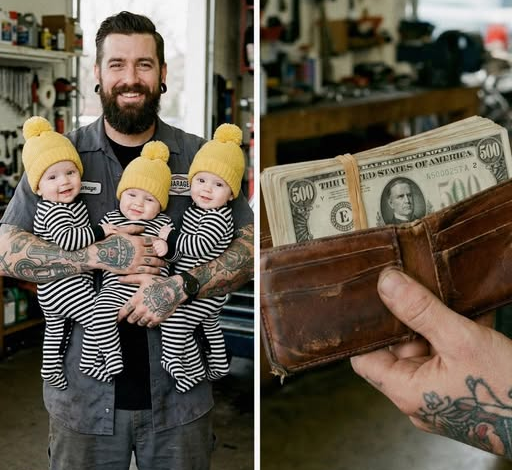
I’m Evan. A mechanic. A dad. Just a guy trying to keep three kids fed and a roof over our heads.
For most of my life, nothing has come easy. My shop is old, my hands are always stained with grease, and the bills never really stop coming. After my wife left, it became just me, my three six-year-old triplets, and my mom doing everything we could to hold things together. Some days, it feels like I’m barely keeping up.
That Tuesday felt like one of those days.
Work was relentless. Customers were frustrated. One guy yelled at me like I’d personally ruined his life. By the time the shop was closing, I was exhausted—physically and mentally.
That’s when I found the wallet.
It was under one of the lifts. Worn leather, nothing special at first glance. But when I opened it, I froze. Inside were thick stacks of hundred-dollar bills—more money than I’d seen in one place in years.
And for a moment… just a moment… I thought about what it could do.
Rent. Bills. My daughter’s shoes with holes in them.
It could’ve fixed everything. At least for a little while.
But then I saw the ID. An older man. And a note with an address.
And just like that, the decision made itself.
That night, I drove to his house. My heart was pounding the whole way. I kept thinking—what if he thinks I stole it? What if this goes wrong?
But when he opened the door and saw the wallet, everything changed.
Relief washed over his face. Real relief. The kind you can’t fake.
“This is my pension,” he told me, his voice shaking.
He offered me money. I refused.
Not because I didn’t need it—but because it wasn’t why I came.
I went home that night with nothing extra in my pocket… but somehow feeling lighter.
Like I’d done something that mattered.
The next morning, there was a knock at my door.
Loud. Official.
I opened it to find a sheriff standing there.
My stomach dropped.
Not because I thought I was going to jail—but because my kids were inside.
That’s what fear looks like when you’re a parent. It’s not about you. It’s about them.
He asked about the wallet. I told him the truth. Every word.
Then he made a call.
A few minutes later, more officers showed up—carrying boxes.
Big ones.
That’s when he told me:
“Gary is my father.”
Everything stopped for a second.
Then the boxes were opened.
Clothes. Shoes. School supplies. Groceries. Things my kids needed—things I’d been worrying about for weeks.
“A year’s worth,” he said.
I didn’t know what to say. I didn’t know how to react.
“I can’t accept this,” I told him.
But he shook his head.
“Yes, you can. You did something good. And my father wanted to do something good back.”
My mom was crying behind me.
I think that’s when it hit me.
Not the value of what they brought—but the meaning behind it.
Later, when the house was quiet again, I sat on the couch surrounded by those boxes and just… cried.
Not because I was sad.
But because for the first time in a long time, I felt seen.
That same day, I went back to Gary’s house.
I needed to thank him.
“You reminded me there are still honest people,” he told me.
But the truth is—he reminded me of something too.
That doing the right thing doesn’t always change your situation right away.
But it changes something else.
It changes how you see yourself.
And sometimes… if you’re lucky… it comes back around when you need it most.
I didn’t return that wallet expecting anything.
I did it because it was right.
But what I got in return wasn’t just help.
It was hope.
And when you’re a broke mechanic raising three kids…
Hope is everything.