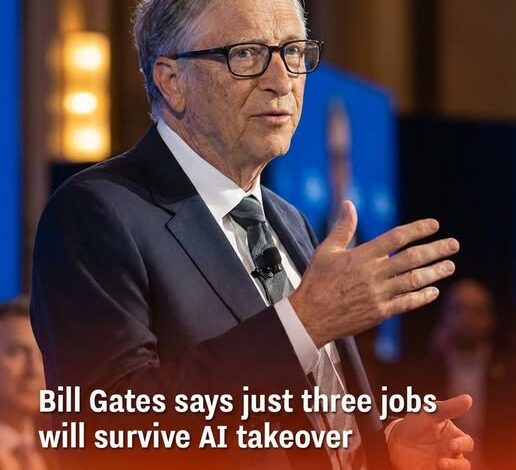
As artificial intelligence rapidly evolves from a futuristic concept into a defining force of the global economy, a pressing question is beginning to echo across boardrooms, workplaces, and households alike: Is my job next? In a world where algorithms can draft legal arguments, compose music, and even assist in medical diagnoses, the traditional idea of a stable career path is starting to feel uncertain—less like a steady climb and more like shifting ground. Yet amid this growing unease, Microsoft co-founder and tech visionary Bill Gates offers a measured perspective, identifying three categories of work he believes will remain largely resistant to widespread AI automation. His outlook serves both as a caution and as a guide for navigating a rapidly changing labor landscape.
Concerns about job displacement are not unfounded. By early 2026, generative AI had already become deeply embedded in everyday business operations, reshaping how tasks are performed and how value is created. Work that once required hours of focused human effort—data analysis, report writing, and routine decision-making—can now be completed in seconds by advanced systems. Still, Gates remains cautiously optimistic. Rather than viewing AI as a force that will eliminate human work entirely, he frames it as a transformative shift—one that will redefine roles rather than erase them. At the heart of his argument is a simple but powerful idea: while AI can replicate logic and pattern recognition, it cannot reproduce the distinctly human blend of intuition, ethical reasoning, and accountability.
The first category Gates highlights includes those who design, build, and maintain the digital systems themselves—software developers, AI engineers, and system architects. At first glance, it may seem ironic that the very creators of AI are among those least threatened by it. However, the complexity of these systems demands continuous human oversight. AI can assist with coding or optimization, but it lacks the deeper intent required to innovate new frameworks, anticipate evolving needs, or ensure that technology aligns with human values. In this evolving landscape, developers are no longer just writing code—they are shaping entire digital ecosystems, acting as stewards who guide how technology is built and used.
The second area of resilience lies in advanced scientific research, particularly in fields like biology, medicine, and healthcare. AI is already proving invaluable in processing vast datasets, identifying patterns, and accelerating research timelines. However, the breakthroughs that define scientific progress often come from creative leaps—those moments of insight that connect seemingly unrelated ideas. These “Aha!” moments rely on imagination, curiosity, and critical thinking, qualities that remain uniquely human. Moreover, decisions in healthcare frequently involve ethical considerations and nuanced judgment that cannot be fully delegated to machines, ensuring that human expertise remains central.
The third domain Gates identifies is the energy sector. As the world transitions toward more sustainable and renewable energy systems, the need for human involvement in managing physical infrastructure becomes even more critical. Operating power grids, maintaining energy facilities, and responding to real-world challenges require hands-on expertise and situational awareness. Unlike purely digital tasks, these roles exist in dynamic, unpredictable environments where human judgment is essential. Coordination, troubleshooting, and accountability in physical systems cannot be entirely automated.
Ultimately, Gates envisions the future not as a competition between humans and machines, but as a collaboration. The individuals most likely to succeed will be those who learn to work alongside AI—using it as a tool to enhance productivity, creativity, and decision-making. While certain jobs may diminish or evolve, those that endure will be defined by inherently human strengths: insight, adaptability, ethical reasoning, and the ability to navigate complexity.
For anyone concerned about the future of work, the message is clear. The key is not to compete with machines on their terms, but to cultivate the skills they cannot replicate. By positioning themselves at the intersection of human ingenuity and technological advancement, individuals can remain not only relevant, but essential in the age of AI.