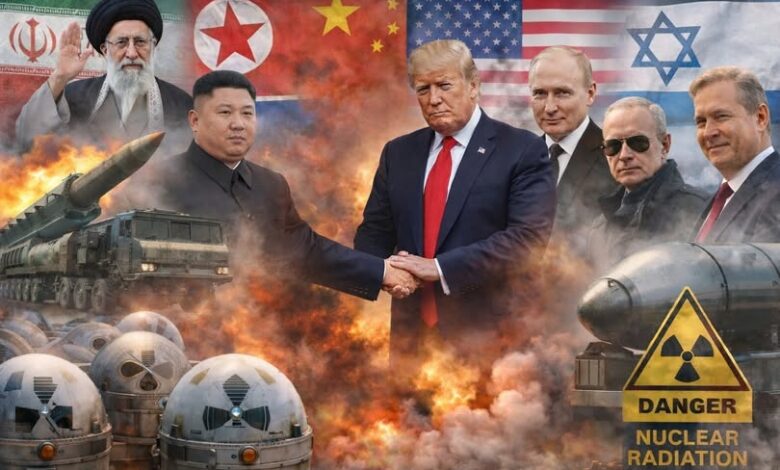
The Persian Gulf has entered a period of heightened instability after reports surfaced of coordinated strikes targeting United States military facilities across the region. Iranian state media, citing senior military figures, announced the launch of a large-scale offensive aimed at several strategic sites connected to the U.S. presence in the Gulf. The situation marks a significant escalation in tensions, shifting from diplomatic strain and indirect confrontation to open military action. As the news spread rapidly around the world, immediate consequences were seen in the form of closed airspaces, activated missile defense systems, and rising concern among civilians living near key military locations.
Early reports indicate that Al Dhafra Air Base in the United Arab Emirates was among the main targets. Residents in Abu Dhabi described hearing powerful explosions that echoed across the city, followed by visible plumes of smoke rising in the distance. International news agencies reported that authorities in the UAE reacted swiftly by closing national airspace, redirecting flights and suspending departures to minimize potential risks to civilian aviation. The base itself hosts a large contingent of U.S. personnel along with advanced surveillance and combat aircraft. Officials believe it was struck by multiple ballistic missiles, though the precise extent of the damage has yet to be fully assessed.
At the same time, Bahrain has also become part of the unfolding crisis. In Manama, particularly around the Al Jufair district, large columns of dark smoke were reportedly seen near the headquarters of the U.S. Navy’s Fifth Fleet. This facility plays a central role in coordinating American naval operations throughout the Middle East and surrounding waters, making it a critical strategic asset. Although details regarding the weapons used in this incident remain limited, the proximity of the strike to the fleet’s command center has raised serious alarm. Bahraini authorities quickly urged residents to remain indoors and avoid areas near military and government installations while the situation continued to develop.
Qatar was likewise placed on high alert as sirens sounded near Al Udeid Air Base, the largest U.S. military installation in the Middle East. Officials reported that the country’s air defense systems, including Patriot missile batteries, were activated to intercept incoming threats. According to preliminary information, at least one missile was successfully destroyed before reaching its target. Even with the interception, the atmosphere in Doha remains tense. The government has closed national airspace and implemented emergency measures, disrupting one of the busiest aviation hubs in the world.
This coordinated series of attacks signals a major shift in the security environment of the Persian Gulf. For years, tensions between regional powers have largely played out through proxy conflicts, cyber operations, and maritime incidents. Direct ballistic missile strikes against major U.S. bases represent a much more explicit form of confrontation. By publicly claiming responsibility, Iranian officials have openly challenged the long-standing American military presence that has shaped regional security dynamics for decades. The consequences extend beyond military considerations; global energy markets are closely watching the situation as the Strait of Hormuz—through which a significant portion of the world’s oil supply passes—now sits dangerously close to an active conflict zone.
Beyond the strategic implications, the human impact is becoming increasingly visible. In cities known for their towering skylines and bustling commercial centers, the sound of missile defenses and explosions has replaced everyday activity. Governments have issued shelter-in-place instructions to protect civilians, highlighting how closely military facilities and residential areas often coexist in modern urban environments. Residents in Abu Dhabi, Manama, and Doha now find themselves confronting a scenario long discussed by analysts but rarely experienced directly.
The targeting of these specific bases appears carefully calculated. Al Dhafra provides a critical platform for air operations, Al Jufair serves as the hub of naval command, and Al Udeid functions as a key logistical and operational center. Striking these locations simultaneously suggests an attempt to disrupt multiple aspects of American military capability in the region. Such actions inevitably raise questions about how the United States and its allies might respond. Many observers fear that retaliation could trigger a wider regional conflict involving multiple states.
The timing of the escalation adds further uncertainty to an already complex global environment. Diplomatic channels that once aimed to manage tensions in the Gulf now appear strained, replaced by discussions of deterrence and potential countermeasures. Governments across the region are currently focused on assessing damage, protecting critical infrastructure, and preventing further escalation.
As darkness settles across the Gulf, the region remains on edge. Reports of explosions and emergency directives illustrate the fragile nature of stability in an area that plays a crucial role in global trade and energy supply. Some emerging reports suggest that a broader coalition response involving several allied nations may be under consideration, though details remain unclear.
The coming hours and days will be critical in determining whether these strikes remain isolated incidents or signal the beginning of a larger confrontation. For the military personnel stationed at these bases and the civilians living nearby, daily routines have suddenly been replaced by the uncertainty of a rapidly evolving crisis. Once again, the Persian Gulf finds itself at the center of international attention, facing a moment that could reshape regional security and global politics for years to come.