Shopper Shocked After Discovering Unexpected Creature Inside Bag of Store-Bought Broccoli

Dinner is one of the few daily rituals many people still move through almost completely on autopilot.
After long workdays, crowded commutes, unread messages, school pickups, bills, errands, and the quiet exhaustion that seems to follow modern life everywhere, making food often stops feeling like an event. It becomes a familiar sequence of motions repeated so often that they barely require thought.
Open the refrigerator.
Rinse the vegetables.
Heat the pan.
Add seasoning.
Keep going.
That sense of routine is exactly what makes certain moments so unforgettable. When something ordinary suddenly breaks in a way the mind cannot immediately understand, the shock feels sharper.
Fear feels different in a kitchen.
Especially in a modern kitchen.
Kitchens are built around comfort and control. Even small ones are designed to feel safe, with warm lighting, clean counters, organized shelves, sealed containers, and predictable routines. People associate kitchens with nourishment, family, and calm — not danger.
That is why one man’s simple attempt to prepare broccoli for dinner turned into an experience unsettling enough to change the way he looked at grocery store produce forever.
His trip to Aldi had been completely ordinary.
That detail became important later.
There were no warning signs in the store. No damaged packaging. No strange smell. No unusual movement inside the refrigerated section. He moved through the aisles the way countless shoppers do every day, picking up practical groceries while thinking about everything except the items in his basket.
Milk.
Eggs.
Vegetables.
Coffee.
Bread.
The bag of broccoli looked just like every other bag around it.
Fresh green florets pressed against clear plastic packaging, slightly misted from the cold. It had all the visual signals shoppers are trained to trust: sealed packaging, clean appearance, normal coloring, and familiar store branding.
Nothing about it suggested there was anything inside except vegetables.
That assumption would later feel almost absurd.
But assumptions are what make routine possible.
Most people do not inspect every grocery item with suspicion. Modern food systems rely on trust. Shoppers trust that produce has passed through enough harvesting, sorting, washing, transporting, inspecting, refrigerating, and stocking to separate it from the unpredictable outdoor world where it began.
The broccoli sat in the refrigerator for several days.
Life continued around it.
The refrigerator door opened and closed. Meals were prepared. Conversations happened nearby. The appliance hummed quietly through the evenings while the sealed bag remained tucked away in the crisper drawer, unnoticed and undisturbed.
Then came the night everything changed.
The man returned home tired from work, moving through the evening more by habit than attention. It was the kind of tiredness where even simple decisions feel automatic because the day has already used up most of your mental energy.
A healthy dinner.
Something easy.
Broccoli would work.
He opened the refrigerator without thinking.
The kitchen felt calm in the ordinary way familiar rooms do at night. Light reflected softly off the counters. The outside world sat quietly beyond the windows. There was no warning before the moment arrived.
That is partly why experiences like this stay with people.
They interrupt normal life without giving the mind time to prepare.
He carried the broccoli to the counter and opened the bag casually.
At first, everything looked normal.
Green florets.
Clean stems.
Nothing obviously wrong.
Then he reached inside.
His fingers touched something alive.
His body reacted before his mind did.
He jerked backward violently, pulling his hand away as adrenaline rushed through him. For one frozen second, his brain tried to understand the sensation.
Smooth.
Cool.
Moving.
Not broccoli.
Something else.
Something living.
He stumbled back from the counter, heart pounding hard enough to make the whole room feel different. The kitchen, moments earlier calm and familiar, suddenly felt strange. Panic entered faster than logic could explain what had happened.
For several seconds, he simply stared at the open bag.
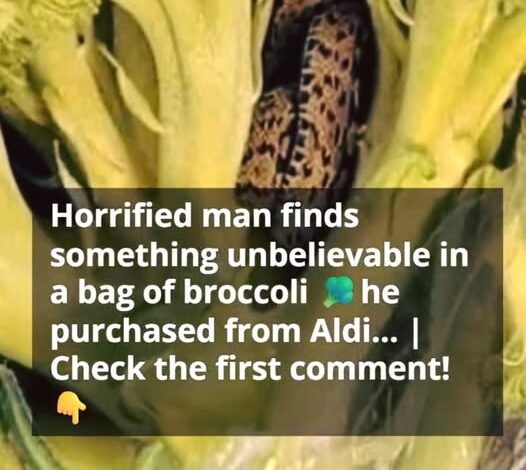
Then something moved inside the broccoli.
That was when he saw it.
A snake.
Small.
Slender.
Hidden perfectly among the green florets.
The camouflage made the discovery even more disturbing. If the snake had been obvious immediately, the shock may have been different. Instead, it had blended into the produce so completely that he only discovered it by touching it.
The realization did more than startle him.
It broke the feeling of predictability.
Modern homes often depend on the comforting belief that nature stays outside. Wildlife belongs in forests, parks, gardens, documentaries, and distant fields — not inside a sealed grocery bag sitting quietly in a refrigerator.
Yet there it was.
Alive.
Hidden.
Only inches from ordinary food.
His mind immediately jumped to worst-case questions.
Was it venomous?
Could it bite?
Had it escaped inside the refrigerator?
Were there more?
How long had it been there?
Fear grows quickly when information is missing.
The man later described feeling caught between confusion and panic, unsure whether to run from the kitchen or keep watching the bag. The snake seemed just as disoriented. Partly coiled among the broccoli, it shifted under the bright kitchen light as though confused by the sudden exposure after darkness and cold.
What made the situation even more surreal was imagining how the creature had arrived there.
Somehow, the snake had passed unnoticed through a large food supply system designed to prevent exactly that kind of incident.
Fields.
Harvesting equipment.
Sorting facilities.
Packaging lines.
Transport trucks.
Distribution centers.
Store refrigeration.
At no point had anyone seen it.
That detail disturbed people once the story spread online. It revealed something modern consumers rarely think about: even highly organized food systems still begin outdoors, inside living ecosystems.
Broccoli fields are not sterile laboratories.
They exist under open skies, surrounded by soil, insects, birds, irrigation systems, small animals, and all the unpredictable movement of nature. Snakes may pass through crops looking for shelter, food, or shade. Small creatures can hide in dense vegetation, especially plants with layered leaves and tight florets.
Broccoli, in particular, offers almost perfect cover.
Dense.
Green.
Cool.
Layered.
A small snake tucked deeply enough inside could, in rare circumstances, survive harvesting and transportation without being noticed.
Still, explanations do not always bring comfort in the moment.
All the shopper knew was that a live reptile had been hiding inside his dinner ingredients.
The kitchen no longer felt completely safe.
That emotional shift matters. People associate home with control. When something wild appears in a protected domestic space, the shock can create a memory far stronger than the actual danger. A snake outdoors is one thing. A snake hidden inside a sealed bag of vegetables in the refrigerator is something else entirely.
It crosses a mental boundary.
Trying to stay calm, the man avoided touching the bag again. The uncertainty made everything worse. Even people who know something about wildlife can struggle to identify a species under stress. Was it harmless or venomous? Young or fully grown? Frightened or defensive?
When people lack answers, fear fills the space.
Animal control professionals were eventually contacted and safely removed the snake.
Only afterward came the relief.
It was non-venomous.
Harmless to humans.
Experts suggested it likely belonged to a species more interested in small amphibians, insects, or aquatic prey than people. In reality, the snake had probably endured a frightening journey of its own. It had likely been caught accidentally, sealed inside packaging, transported over long distances, kept in cold storage, and finally exposed under bright kitchen lights by a terrified human.
From that angle, the encounter almost became mutual.
Two living creatures startled by each other inside an artificial environment neither of them expected to be in.
But emotional memory does not disappear simply because the danger turns out to be low.
Even after learning the snake posed no real threat, the man said the experience changed how he handled produce. The automatic trust was gone. Every bag of vegetables now required a careful look before he reached inside.
Once broken, trust rarely returns in exactly the same form.
Statistically, the reaction may seem irrational. Billions of produce items are eaten safely around the world without hidden snakes inside them. But the brain does not respond only to statistics. It responds to vivid memories, especially the ones tied to shock and survival.
A single disturbing experience can feel larger than its actual likelihood.
That is why the image stayed with people:
a snake hidden among broccoli under bright kitchen lights.
When the story spread online, reactions came quickly. Some people were horrified. Others were fascinated. Some joked about never buying broccoli again. Many admitted they immediately checked their own vegetables more carefully after reading about it.
The story worked online because it combined two powerful things: an ordinary domestic routine and a primal fear.
A kitchen.
A grocery bag.
A hidden snake.
It was unsettling because it reminded people that supermarkets create an illusion of separation from nature. The clean aisles, plastic packaging, bright lighting, and temperature-controlled displays make fresh produce feel distant from the messy outdoor world where it grew.
But fruits and vegetables still come from fields.
They come from soil, weather, irrigation, insects, animals, and living ecosystems. Food systems reduce risk, but they do not erase nature completely.
Sometimes nature slips through.
Food safety experts often remind shoppers to wash and inspect produce carefully — not because hidden snakes are a common concern, but because fresh vegetables naturally come into contact with dirt, plant debris, insects, and other outdoor elements before they reach stores.
That connection is part of agriculture.
And maybe that was the strangest realization of all. Grocery stores may look polished and controlled, but they remain invisibly connected to fields, ecosystems, and wild spaces far beyond the fluorescent aisles.
For the shopper, though, the experience was not philosophical.
It was personal.
What stayed with him was not just fear of snakes. It was the shock of finding something wild and alive inside a moment that should have been completely ordinary. His kitchen, once predictable and safe, had briefly become unfamiliar.
After that, preparing vegetables no longer felt automatic.
Every bag deserved a second glance.
Every handful of greens carried a small hesitation.
Not panic exactly.
Awareness.
And perhaps that awareness points to something modern life often lets people forget.
No matter how controlled our environments seem, nature is never completely absent.
It waits at the edges of supply chains, beneath soil, inside fields, between leaves, and alongside human systems more often than most people realize.
Usually, those worlds remain separate enough for comfort.
But once in a while, under bright kitchen lights during an ordinary evening meal, they collide.
And after that, even opening a simple bag of broccoli never feels quite as routine again.