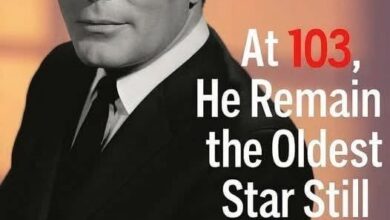
He grew up in the crossfire between ridicule and expectation, a boy caught between what the world demanded of him and what his own heart refused to surrender. In Texas, where toughness was often measured in silence, fists, and football fields, sensitivity could feel like a liability. But he would not trade his softness for safety. He would not bury the parts of himself that made other people uncomfortable.
Every insult followed him. Every punch left more than a bruise. Every whispered slur in a school hallway, every cruel laugh from boys who thought masculinity had only one shape, became part of the fire he carried inside. They tried to make him ashamed of the very thing that made him different. Instead, he learned to turn humiliation into motion.
Dance was never a passing interest. It was never a costume he could take off when the room became hostile. It was a language, a release, a way to survive inside a body the world kept trying to define for him. When he danced, he was not weak. He was not strange. He was not the boy they mocked. He was free.
For a while, football offered another possible future, one that might have satisfied the people who wanted him to fit more neatly into their idea of manhood. But when a torn knee ended that dream, he did not collapse beneath the loss. He returned to the thing that had always been waiting for him. He doubled down on the art they had told him made him vulnerable. He chose the very thing they had tried to shame out of him.
That choice would eventually reshape his life.
Hollywood would later see only the finished image: the smoldering gaze, the quiet intensity, the effortless swagger, the impossible lifts that made audiences believe love could defy gravity. On screen, he became the kind of man people projected fantasies onto — strong but tender, dangerous but gentle, wounded but magnetic. He had a rare ability to make romance feel physical and spiritual at the same time. He could move like an athlete, feel like a poet, and look like someone carrying secrets behind his eyes.
But the final cut never tells the whole story.
What audiences did not always see were the private disappointments behind the public triumphs. They did not see the empty nursery dreams, the ache of wanting children and facing a silence where that future should have been. They did not see the nights dulled by alcohol, when pain became something to numb rather than name. They did not see the grief that stacked itself inside him, funeral after funeral, loss after loss, until he began to wonder whether sorrow had chosen him personally.
Fame did not protect him from loneliness. Success did not make him immune to fear. The applause could be deafening, but it could not always reach the places inside him that still remembered the bullied boy in the hallway. The world adored his strength, but strength had often been something he built from wounds no one had stopped to heal.
And yet, he kept going.
He kept working. He kept loving. He kept returning to the body that had carried him through pain, through performance, through reinvention. Even when life became cruel, even when illness began stealing his strength, he refused to disappear quietly into bitterness. Cancer tested him in ways no role ever could. It stripped away glamour, reduced the body to a battlefield, and forced him to confront the limits of willpower. But even then, he held onto the same truth he had learned as a boy: survival is not always about winning. Sometimes it is about refusing to abandon yourself.
That was the quiet power at the center of his life. He did not become beloved because he fit perfectly into the world’s expectations. He became unforgettable because he challenged them. He proved that tenderness could be masculine, that grace could be powerful, that the thing people mock in you may one day become the reason the world remembers your name.
The boy they laughed at became the man audiences could not look away from. The dancer they dismissed became a symbol of strength. The sensitivity they tried to shame became the source of his depth, his magnetism, his art.
Through heartbreak, addiction, illness, and fading strength, he protected the part of himself others had once tried to destroy. He carried it from Texas hallways to movie sets, from ridicule to legend, from pain to legacy.
And in the end, that may be the lesson his life leaves behind: you do not abandon the part of you they laugh at. You guard it. You sharpen it. You let it teach you how to endure.
Then, one day, the world may finally understand that what they called weakness was the strongest thing you had.