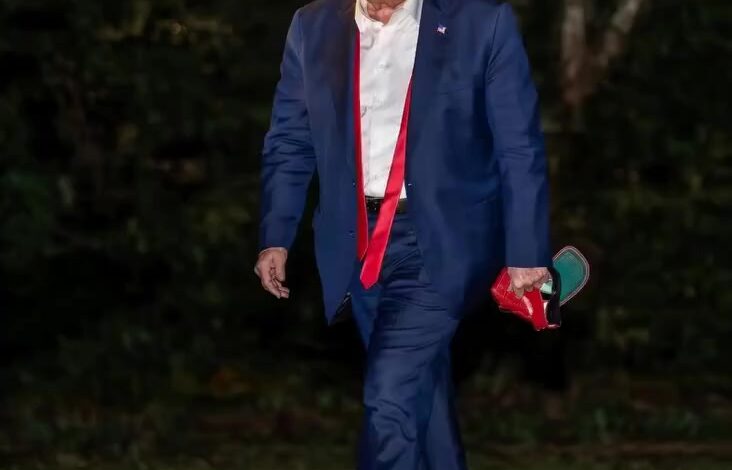
He stopped being treated like an actual person the moment the footage reached the internet.
What may have been an ordinary late-night walk became something else entirely once it was captured in grainy fragments, separated from context, and released into a culture trained to turn uncertainty into spectacle.
The images were blurry.
The lighting was poor.
The details were incomplete.
But that did not matter.
Within minutes, the footage became a blank canvas for millions of competing interpretations. To some viewers, it suggested secrecy. To others, weakness. Some saw strategy, fear, manipulation, decline, hidden power, or coded intent. Every screenshot was enlarged, sharpened, circled, reposted, and treated as evidence for whatever version of reality people already wanted to believe.
The object in his hand barely mattered anymore.
What mattered was the story people could attach to it.
That is how modern speculation works. It does not wait for facts to arrive. It feeds on absence. The less an image explains, the more people rush to explain it themselves. And once enough people begin attaching meaning to a moment, the moment stops belonging to the person who lived it.
It becomes public property.
Within hours, social media transformed a small, ambiguous human scene into a national obsession. Comment sections filled with amateur investigators drawing arrows across screenshots, slowing down videos frame by frame, comparing shadows, body language, clothing, posture, and movement as though they were decoding a matter of state security.
Some insisted the smallest detail proved everything.
Others mocked the obsession while participating in it anyway.
News panels discussed possibilities with the gravity of breaking intelligence. Influencers repackaged uncertainty into confident theories, because certainty travels faster than caution and outrage is easier to monetize than restraint.
By the next morning, the walk had become less important than the reaction to it.
And beneath the frenzy sat something more revealing than the footage itself.
The real spectacle was us.
Our discomfort with ambiguity has become almost unbearable. Silence feels suspicious now. A moment without explanation becomes an invitation to invent one. We no longer seem able to let unanswered questions remain unanswered. We rush to complete them ourselves, even when the truth is unavailable, unknowable, or simply less dramatic than we want it to be.
In that atmosphere, every gesture from a public figure becomes overloaded with meaning.
A glance becomes strategy.
A pause becomes guilt.
A stumble becomes decline.
A quiet walk becomes conspiracy.
What unfolded after those images surfaced exposed how deeply modern culture confuses access with understanding. People believe that because they can replay footage endlessly, zoom into pixels, slow down a clip, and consume hours of commentary, they are moving closer to truth.
But repetition is not clarity.
Visibility is not knowledge.
A blurry video watched a thousand times can still remain a blurry video.
The man in the baseball cap became almost secondary to the emotional machinery activated around him. He turned into a mirror, reflecting public anxiety back at itself. People projected fears, loyalties, resentments, suspicions, and hopes onto footage so incomplete that it could support almost any interpretation.
Some viewers saw corruption because they already expected corruption.
Others saw vulnerability because they wanted proof of humanity.
Some saw calculated theater.
Others saw exhaustion.
Some dismissed the entire thing as absurd.
Others treated it like a secret message hidden in plain sight.
The details changed depending on the audience.
The hunger underneath did not.
People wanted meaning. Not eventually. Immediately.
That hunger has become one of the defining features of modern public life. The internet does not merely report on ambiguity; it attacks it. It surrounds uncertain moments with theories until one of them becomes emotionally satisfying enough to feel true.
And once a theory feels true, evidence becomes almost optional.
This is not only a problem of politics or celebrity. It is a problem of attention. We have become accustomed to receiving explanations instantly. Search results, headlines, clips, posts, comments, and reaction videos all create the illusion that every moment can be decoded if enough people stare at it long enough.
But some things do not reveal themselves simply because we demand access.
Some moments remain private even when they are visible.
That distinction is increasingly hard for public culture to accept.
We often treat public figures as if appearing on camera means surrendering their right to ordinary human ambiguity. A person cannot walk quietly without becoming a thesis. They cannot carry an unknown object without becoming a mystery. They cannot look tired, distracted, calm, or unreadable without becoming raw material for strangers to interpret.
The footage revealed almost nothing concrete.
But the reaction revealed plenty.
It revealed a restless culture.
An exhausted culture.
A culture addicted to interpretation.
A culture that often prefers a dramatic explanation to a modest unknown.
And perhaps that is why moments like this linger even after the headlines fade. Not because the mystery itself is necessarily important, but because the speed of the reaction exposes something uncomfortable about us.
We do not simply watch anymore.
We assign meaning.
We turn strangers into symbols.
We turn fragments into narratives.
We turn silence into evidence.
We turn uncertainty into emotional reality.
The person at the center of the footage becomes less important than what people need him to represent. He is no longer just a man walking at night. He becomes proof of a larger belief. A confirmation of suspicion. A vessel for anxiety. A character in a story written by people who were never there.
That is the danger of the speculation machine.
It does not require malice from everyone involved. Many people participate because they are curious, bored, anxious, entertained, or simply swept into the rhythm of collective interpretation. But the result is the same: an incomplete moment becomes overburdened with meaning until the human being inside it nearly disappears.
In the end, the truth behind that walk remained unresolved.
No definitive explanation arrived.
No dramatic revelation satisfied the theories.
No final answer emerged to reward the hours of zooming, arguing, and guessing.
But perhaps that was never really the point.
Long before anyone knew what he was carrying or where he was going, the public had already revealed something more significant: how quickly incomplete information becomes emotional certainty when uncertainty feels intolerable.
The mystery remained unsolved.
But the reaction explained us perfectly.