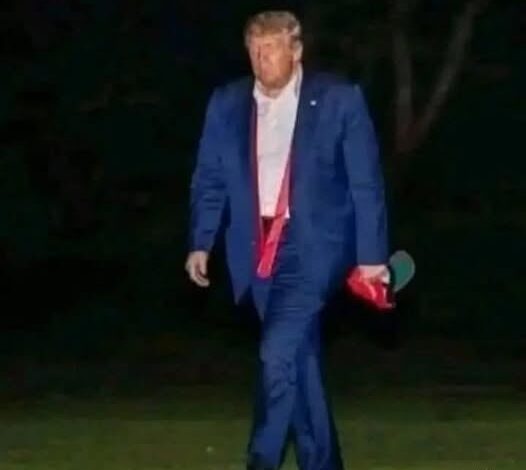
What tends to linger long after the initial frenzy fades isn’t the object itself, but what the moment exposes about us. A simple walk—something ordinary, almost forgettable—suddenly transforms into a nationwide guessing game. A blurry, low-quality image becomes a blank canvas where people project their fears, their hopes, and even their political narratives. When clear answers are missing, the human instinct is to fill in the gaps, to create meaning where none has been confirmed. And so, a man in a cap holding something small becomes less a person and more a symbol shaped by countless interpretations.
In that space of uncertainty, speculation spreads quickly. Each theory says less about the situation itself and more about the people forming it. Some see danger, others see intrigue, and still others see confirmation of beliefs they already held. The image stops being just an image—it becomes a mirror reflecting collective anxieties, biases, and imaginations.
Moments like this highlight how easily curiosity can tip into fixation. What begins as a passing interest can escalate into widespread obsession, especially in a digital world where attention moves fast and thrives on ambiguity. Public figures, in particular, exist under constant scrutiny. Even their most mundane, private actions can be captured, shared, and dissected until they take on a life of their own.
At the same time, it’s a reminder worth holding onto: not every unknown hides a deeper truth, and not every unanswered question is evidence of something larger at play. Sometimes, the mystery remains just that—a moment without context, a fragment without a full story.
In the end, what we often end up examining isn’t the subject of the image, but ourselves—our need to interpret, to speculate, and to turn uncertainty into narrative. And perhaps the most revealing part of all is not what we think we see, but why we feel compelled to see it that way.