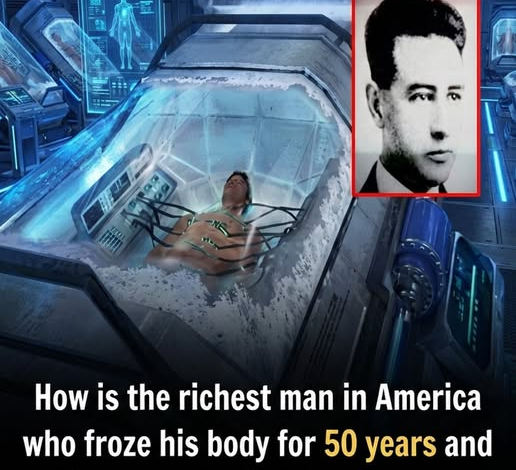
In 1967, a man named Dr. James Hiram Bedford made a decision that would ultimately place him in the history books as a pioneer of an unusual scientific experiment. Bedford was a World War I veteran and a respected psychology professor at the University of California. Later in his life, he was diagnosed with kidney cancer that had spread to his lungs, a condition that at the time offered very limited treatment options. Faced with this reality, Bedford began exploring unconventional scientific ideas about the future of medicine and human preservation. One concept that caught his attention was cryonics—the experimental practice of preserving a human body at extremely low temperatures after death in the hope that future scientific advancements might allow researchers to study or potentially restore the preserved tissues.
Bedford’s interest in cryonics was strongly influenced by a book titled The Prospect of Immortality, written by physicist Dr. Robert Ettinger. In the book, Ettinger proposed that people who could not be saved by current medical technology might one day benefit from scientific breakthroughs if their bodies were preserved carefully after death. Although the idea was controversial and largely theoretical at the time, it sparked the curiosity of many readers who were fascinated by the possibilities of future medical innovation. Bedford became one of the first individuals willing to take part in this experimental concept, seeing it not only as a personal choice but also as a contribution to scientific exploration.
On January 12, 1967, shortly after Bedford passed away, the cryonic preservation procedure was carried out. The methods available at the time were far less sophisticated than those used in modern cryonics, but researchers and volunteers attempted to apply the best techniques they knew. During the preparation process, Bedford’s blood was removed and replaced with chemical solutions designed to help protect tissues from the damage that can occur when water inside cells freezes and expands. These chemicals were intended to reduce the formation of large ice crystals that could disrupt cellular structures. After this preparation, Bedford’s body was placed inside a container designed to maintain extremely low temperatures.
The container was then filled with liquid nitrogen, a substance capable of cooling materials to approximately –196 degrees Celsius (–321 degrees Fahrenheit). At this temperature, biological processes effectively stop, which in theory allows tissues to remain preserved for extremely long periods. The purpose of the procedure was not to attempt immediate revival—something that was, and still is, beyond the capabilities of modern science—but rather to maintain the body in a stable state for potential future research or study. Supporters of cryonics believed that future generations might develop medical technologies capable of repairing cellular damage, curing diseases that are currently incurable, or even restoring preserved biological systems.
As the years passed, Dr. Bedford’s case became widely known within both scientific and public discussions about cryonics. His preservation represented one of the earliest attempts to apply the concept in practice. Over time, several organizations involved in cryonics took responsibility for maintaining the storage conditions necessary to keep Bedford’s remains preserved in liquid nitrogen. Maintaining these conditions required careful monitoring, specialized storage containers known as cryogenic dewars, and a continuous supply of liquid nitrogen to keep temperatures stable.
In 1991, more than twenty years after Bedford’s original preservation, specialists conducted a detailed examination of his remains. The goal was not to attempt revival but to assess how well the early cryonic preservation process had maintained the body over a long period. Researchers carefully inspected the container and the condition of the preserved tissues. Reports from the examination suggested that many structural aspects of the remains had remained relatively stable considering the limitations of the early technology used during the original procedure. Some expected changes were observed, but the overall findings provided valuable insight into the long-term effects of cryogenic preservation.
The examination also highlighted how much cryonics techniques had evolved since the 1960s. Modern cryonics procedures now often involve more advanced chemical protectants known as cryoprotectants, which are designed to reduce freezing damage even further through a process sometimes referred to as vitrification. Instead of forming ice crystals, vitrification aims to solidify tissues into a glass-like state that minimizes structural disruption. Although these techniques remain experimental, they demonstrate how the field has continued to develop over time.
Today, more than fifty years after his death, Dr. James Hiram Bedford’s body remains preserved in liquid nitrogen. His case is frequently referenced as the first successful cryonic preservation of a human body intended for long-term storage. While the possibility of reviving preserved individuals remains entirely theoretical and has not been demonstrated by modern science, Bedford’s decision helped bring global attention to the idea of cryonics and stimulated ongoing debates about the future of medicine, life extension, and technological progress.
Beyond the scientific aspects, Bedford’s story also raises philosophical questions about humanity’s relationship with mortality and the desire to extend life through technological innovation. For some people, cryonics represents hope that future breakthroughs might one day overcome diseases that are currently untreatable. For others, it serves as an example of how curiosity and optimism about science can inspire individuals to participate in bold experiments, even when the outcomes are uncertain.
Regardless of one’s perspective on cryonics, Dr. Bedford’s choice remains a remarkable chapter in the history of scientific exploration. His willingness to participate in an experimental preservation process reflected a belief in the power of future discovery and a readiness to contribute to an idea that, even today, continues to capture the imagination of scientists, futurists, and the general public alike.