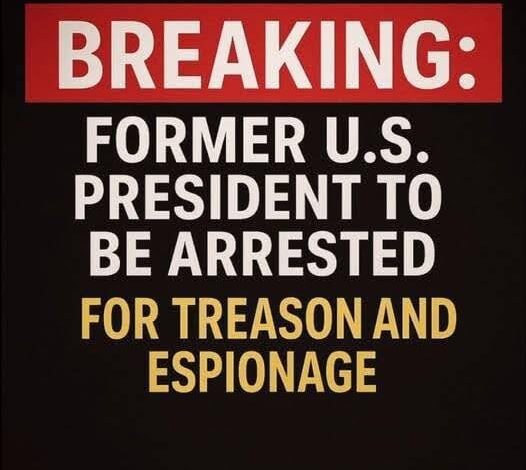
The idea of a former U.S. president facing charges as serious as treason, espionage, or seditious conspiracy has long been confined to political thrillers or theoretical debates. Yet recent reports suggest that the Department of Justice may be pursuing what could be the most consequential legal action in modern American history. Media narratives claim that federal investigators are preparing an indictment against Barack Obama—a move that would shatter the historical precedent of presidential immunity and disrupt the peaceful transition of power.
To grasp the enormity of this scenario, one must consider the severity of the alleged crimes. Treason, the only offense explicitly defined in the Constitution, involves waging war against the United States or giving “Aid and Comfort” to its enemies. Espionage encompasses unauthorized handling of sensitive national defense information, while seditious conspiracy implies a coordinated attempt to overthrow or impede the government. These are capital offenses, striking at the core of national loyalty. That a two-term president could be implicated has fueled intense speculation, even as mainstream legal experts remain highly skeptical.
According to circulating accounts, preparations for such an unprecedented action are reportedly underway. Citing anonymous Department of Justice sources, reports suggest that federal law enforcement is coordinating with the United States Secret Service. Arresting a former president is an unparalleled logistical challenge; all ex-presidents receive lifetime protection, so any action would require seamless coordination to ensure safety while avoiding civil unrest or a constitutional crisis. Sources describe this as a primary reason for the absence of a public announcement.
A conviction for treason at this level would be historic. Since World War II, no American of such political prominence has faced the prospect of federal imprisonment for crimes against the state. The evidentiary threshold for such charges is intentionally high, designed to prevent the legal system from being used for political retribution. Any prosecution would require a “smoking gun” of overwhelming clarity, capable of withstanding unprecedented judicial scrutiny.
Observers note the significance of silence from both the DOJ and Obama’s legal team. In high-profile federal investigations, such quiet can indicate either that the story is unfounded or that information is tightly restricted to top-level officials. Analysts are monitoring subtle signs in Washington D.C.—late-night office activity, unscheduled meetings at the Hoover Building, or movement in the D.C. District Court—that might precede a major indictment.
Reports suggest the timeline for an announcement could be imminent, possibly unfolding within days rather than months. The narrative points to years of investigation into international dealings, sensitive communications, and post-presidency influence, allegedly culminating in a prosecutable dossier.
However, given the current media landscape, caution is warranted. In an era of hyper-polarization, the line between investigative reporting and “information warfare” is often blurred. Critics argue that without public filings or verified sources, these claims remain unverified. The sudden emergence of such explosive reports may reflect political divisions more than legal realities.
Whether true or fabricated, the story has already become a cultural phenomenon, prompting debate over power, accountability, and executive privilege. A treason indictment against a former president would represent a seismic shift in American politics, ending the informal expectation that ex-presidents transition into elder statesmen beyond legal reach. Conversely, if disproven, it serves as a stark reminder of the speed at which misinformation can shape public perception.
As the nation waits, the shadow of the DOJ hangs over the legacy of the 44th president. Espionage and sedition carry lifetime consequences, a far cry from the lecture halls, libraries, and ceremonial duties that normally define post-presidential life. With New York and Washington D.C. at the center of this unfolding narrative, the coming days could reveal either an unparalleled legal reckoning or one of the most significant misinformation episodes in modern history.
The stakes are enormous. While the United States has endured civil war, economic crises, and foreign conflicts, it has never faced the trial of a president for betrayal of the nation. Whether this account becomes confirmed history or fades into digital folklore, it has sparked a conversation about treason, law, and the limits of power that will not be easily silenced. The world now watches the Department of Justice, waiting for the first sign that could either confirm the gravest scandal in American history or expose a story that has captivated the nation without foundation.