Vice President JD Vance Levels Explosive Accusation Against Pope Leo XIV Amid Intensifying Clash With Donald Trump Over War, Power, and the Role of Religion in Shaping U.S. Policy, Igniting a Debate That Reaches Far Beyond Politics and Into the Core of Moral Authority in a Divided World

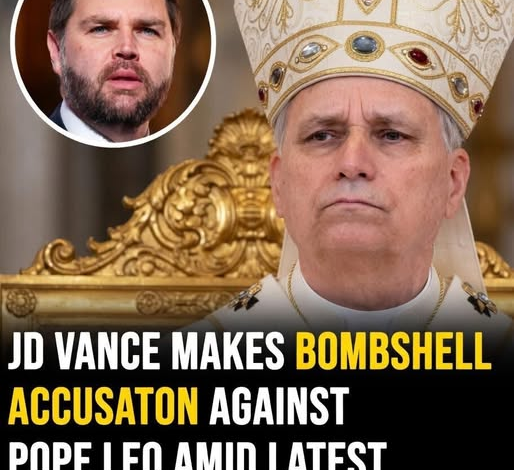
The tension between political leadership and moral authority came into sharper focus this week when Vice President JD Vance publicly criticized Pope Leo XIV, elevating what had already been a simmering disagreement into a broader debate. His remarks followed earlier criticism from Donald Trump regarding the Pope’s stance on international conflict, particularly involving Iran. What began as a policy disagreement has since evolved into something more fundamental—a question of where political decision-making ends and moral influence begins.
At its core, the conflict reflects a long-standing divide. Pope Leo XIV has consistently emphasized diplomacy, restraint, and the human cost of war. His statements tend to focus less on strategy and more on consequence—on the civilians affected, the long-term instability created by violence, and the ethical weight carried by those in power. By contrast, Trump and his allies have framed strength and decisive action as necessary tools in maintaining order and deterrence in an unpredictable world.
Vance’s intervention added a new layer. In a televised interview, he argued that the Vatican should remain focused on spiritual leadership rather than what he described as involvement in national policy debates. His position was straightforward: elected officials are accountable for decisions that affect the country, and those decisions should not be shaped by external institutions, regardless of their influence.
The comments drew particular attention because of Vance’s own background as a Catholic convert. For some, this underscored the seriousness of his position—a distinction between personal belief and public responsibility. For others, it highlighted a tension between faith and governance, raising questions about whether moral guidance can or should be separated from political action.
The Pope’s response was notably restrained. Rather than engaging in direct confrontation, he reiterated his broader message: that his role is not to dictate policy, but to speak to the moral dimensions of global decisions. In his view, remaining silent in the face of suffering would represent a failure of responsibility, regardless of political boundaries. This approach has resonated with those who see moral voices as essential in times of conflict, while critics argue that such statements inevitably carry political implications.
The significance of this exchange extends beyond the individuals involved. It touches on a broader question about influence in a globalized world. Political leaders operate within systems of governance, but they do not exist in isolation. Religious figures, international organizations, and public opinion all contribute to the environment in which decisions are made. When these spheres intersect, friction is almost inevitable.
Historically, the relationship between political power and religious authority has shifted over time. In some eras, the two were deeply intertwined; in others, they were deliberately separated. Today’s landscape reflects a more complex reality, where influence is diffuse and often indirect. The current moment illustrates how easily those boundaries can blur, especially when global crises heighten the stakes.
Public reaction has been predictably divided. Supporters of Vance argue that his stance reinforces democratic accountability, ensuring that elected officials remain the primary decision-makers. Critics, however, contend that excluding moral perspectives risks narrowing the scope of leadership, particularly in matters involving war and human impact.
Ultimately, the exchange is less about a single disagreement and more about an enduring tension. It raises questions about how power should be exercised, how responsibility should be defined, and whether moral guidance belongs inside or outside the political process.
As global challenges continue to evolve, these questions are unlikely to fade. The balance between authority and ethics—between action and reflection—remains unresolved. And how that balance is navigated will continue to shape not only policy decisions, but the values that underpin them.