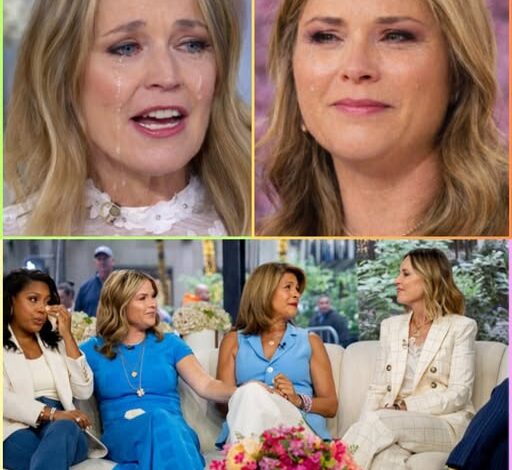
What unfolded in that studio was no longer just a segment—it became something far more personal, almost a quiet reckoning played out in real time. Jenna made a choice that television rarely allows: she chose vulnerability over control. Instead of staying within the safety of polished dialogue and rehearsed emotion, she stepped beyond it, pulling back the curtain on a life that had long been lived under expectation.
She spoke not as a host, but as a person who had been carrying too much for too long.
She talked about the weight of growing up in the public eye, of being shaped by a role she never fully chose—first as a daughter in the national spotlight, then as a figure expected to remain composed, warm, and endlessly “fine.” She admitted to the quiet exhaustion of performing happiness, of smiling on cue while something inside her was slowly coming undone.
For years, she said, she had mastered that performance.
But it came at a cost.
Behind the camera-friendly warmth was grief left unspoken, pressure that never quite lifted, and a growing realization that pretending everything was okay was not strength—it was erosion. The moment she recognized that truth became a turning point. And instead of hiding it, she brought it into the open.
The control room, trained to manage unpredictability, scrambled to regain structure. But Jenna didn’t stop. She stayed in that moment, allowing it to unfold without filters, without retreat.
And in doing so, she changed the atmosphere entirely.
Savannah’s reaction became just as powerful. At first, there was silence—genuine, unguarded surprise. The kind that cannot be scripted. Then, slowly, she reached across and took Jenna’s hand, letting go of the teleprompter, letting go of the role, and stepping fully into the moment beside her.
It was no longer about hosting.
It was about witnessing.
For viewers, something shifted. This wasn’t just another piece of morning television designed to fill time—it felt personal, almost confrontational in its honesty. People watching saw something familiar in Jenna’s words: the masks they wear, the smiles they maintain, the quiet spaces where they hold everything together while appearing unaffected.
That’s why the clip spread so quickly.
Not because it was chaotic or sensational—but because it broke the unspoken agreement of performance. For a brief moment, the structure of television gave way to something real. The lines blurred between public and private, between persona and person.
And in that opening, people didn’t just watch.
They recognized themselves.
Because what Jenna revealed wasn’t unique to her life—it was something many carry quietly. The difference is, she said it out loud.
And for once, the performance stopped.
And the person stepped through.