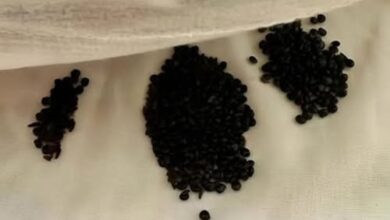
I found this in my girlfriend’s bathroom. We’ve been looking at it for an hour now and still can’t figure out what it is.

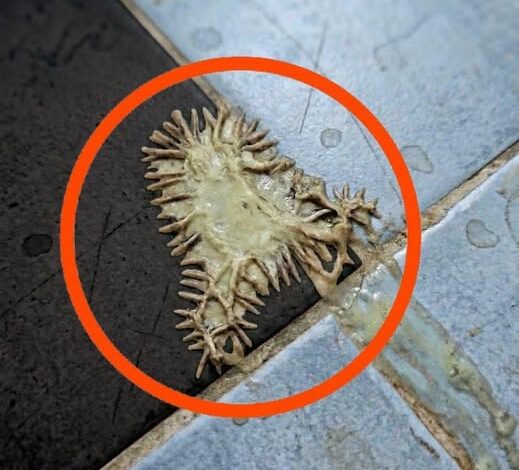
It sat there on the cold bathroom tiles, small and unassuming at first glance, yet completely out of place—like something that had no business existing in such a clean, controlled space. The overhead light cast a dull shine across the floor, making the thing glisten slightly, which only made it more unsettling. My girlfriend and I stood frozen in the doorway, staring at it far longer than either of us wanted to admit. It wasn’t moving, it wasn’t doing anything at all, and yet it carried a strange, quiet presence that made the room feel different.
Up close, it looked even stranger. It had no clear shape, no obvious structure—just a damp, irregular clump that seemed almost organic, like it had grown there rather than fallen. The edges were uneven, slightly translucent in places, and its texture made it difficult to categorize. It didn’t resemble anything we could confidently name, and that uncertainty made it feel far more threatening than it probably was.
We began trying to explain it, throwing out possibilities one after another, each more unsettling than the last. Was it some kind of parasite? A strange fungal growth? Something leaking from behind the walls that shouldn’t be there? The bathroom, which had always been a normal, mundane space, suddenly felt wrong—as if something hidden had revealed itself.
The longer we stood there, the more our imaginations took over. Every possibility seemed to lead to something worse: contamination, hidden damage, something living where it shouldn’t be. We lowered our voices without realizing it, as if speaking too loudly might somehow disturb whatever it was. At some point, the fear started to feel almost absurd—we were two grown adults, hesitating to approach a small, silent blob on the floor—but that didn’t make it go away.
We circled around it cautiously, careful not to get too close. My girlfriend voiced concerns about toxins, about whether it could be dangerous to touch or even breathe near. I tried to stay calm, offering logical explanations, but even as I spoke, I could feel that same unease creeping in. The real problem wasn’t the object itself—it was the fact that we didn’t understand it. And in that gap of understanding, our minds filled in the worst possibilities.
Time seemed to stretch as we debated what to do. Should we remove it? Leave it alone? Call someone? It was ridiculous, really, how much weight this tiny, shapeless thing had taken on in our minds. Yet neither of us was willing to be the first to reach down and touch it.
Eventually, curiosity—and a bit of stubbornness—won out. After some cautious research and a fair amount of hesitation, we discovered what it actually was: a type of slime mold. Harmless. Common in damp environments. Strange-looking, yes, but entirely benign.
The relief didn’t come all at once. It crept in slowly, replacing the tension that had built up over those long minutes. Nothing dangerous, nothing invasive—just an odd, natural occurrence that had wandered into the wrong setting. We cleaned the tiles thoroughly, opened the windows to let fresh air in, and gradually the bathroom began to feel normal again.
Later, we laughed about it—about how something so small and harmless had managed to completely disrupt our sense of comfort. But even as we joked, there was something lingering beneath it all. The experience had exposed how fragile that sense of normalcy really is. All it took was one unfamiliar detail in a familiar place to make everything feel uncertain.
Now, whenever I step into that bathroom, I still glance at the floor without thinking. Not because I expect to find anything unusual, but because that moment left an impression. Once you’ve seen something ordinary become strange, even briefly, it changes the way you look at things. The space is the same, the tiles are clean, everything is as it should be—but there’s always that quiet awareness in the back of your mind, reminding you that the unexpected can appear anywhere, at any time.