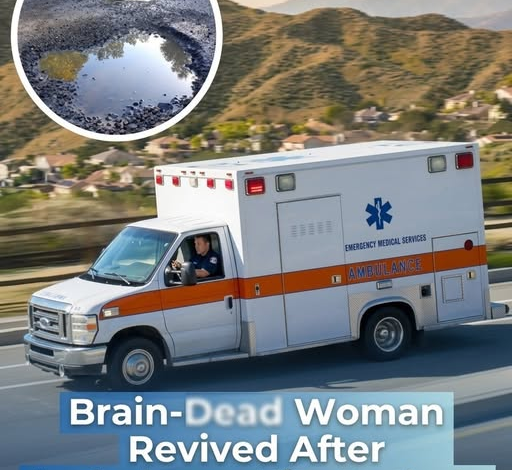
In Uttar Pradesh, the story of 72-year-old Shakuntala Devi has captured attention not just for its emotional weight, but for the unsettling questions it raises about life, death, and medical certainty. What began as a family’s quiet acceptance of loss took an unexpected turn—one that challenges how we understand the boundary between life and death.
According to reports, Shakuntala Devi had been declared brain-dead, a diagnosis that typically indicates an irreversible loss of all brain function. Her family, overwhelmed with grief yet trusting in medical authority, began preparing for her final journey home. The atmosphere was one of closure—heavy, still, and filled with the quiet finality that follows such a diagnosis.
But during the ambulance ride, something extraordinary reportedly occurred. A sudden jolt—caused by a deep pothole—disrupted the stillness. In the aftermath of that impact, signs of life appeared. She began to breathe.
The paramedics, caught between shock and urgency, acted quickly, redirecting the ambulance to the nearest hospital. There, doctors confirmed that she was alive and in stable condition—an outcome that seemed to contradict the earlier diagnosis.
While the story feels almost miraculous, cases like this—though rare—often point to complexities rather than impossibilities. The determination of brain death is one of the most rigorous processes in medicine, involving multiple tests to confirm the absence of brain activity. However, errors can occur due to factors like incomplete testing, misinterpretation, or conditions that mimic brain death, such as severe metabolic imbalances, hypothermia, or certain drug effects.
It’s also important to clarify that true brain death, once correctly diagnosed, is considered irreversible. Situations where patients appear to “return” are more likely instances where the initial diagnosis was inaccurate or incomplete, rather than a reversal of death itself.
What this case ultimately highlights is not a violation of medical science, but its limits. Medicine operates within probabilities and protocols, not absolute certainty. Human biology—especially the brain—remains deeply complex, and rare events can expose gaps in understanding or execution.
For the family, however, the experience transcends explanation. What they believed was the end became an unexpected continuation—a moment where grief gave way, however briefly, to disbelief and hope.
Stories like this resonate because they sit at the intersection of science and emotion. They remind us that while medicine strives for precision, life itself can still surprise us in ways that feel almost beyond explanation.