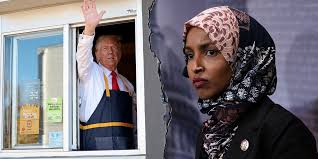
A new political clash between former President Donald Trump and Representative Ilhan Omar gained attention after an image posted online quickly ignited debate across social media. Trump shared a photo of himself waving from the window of a McDonald’s drive-thru, a moment that supporters framed as a lighthearted campaign stop but that critics viewed as a pointed response to comments Omar had recently made about deportation fears and immigration policy.
What might have otherwise been dismissed as a routine campaign moment quickly took on symbolic meaning once it spread online. For some observers, the setting—an iconic American fast-food chain—was interpreted as a deliberate nod to cultural identity and populist imagery. Others saw the post as part of a longer pattern of political messaging directed at Omar, whose background as a Somali-born refugee has frequently been referenced by her critics.
The exchange quickly moved beyond a single social media post. Commentators and political figures on both sides weighed in, turning the moment into the latest chapter in a long-running and often heated political rivalry between the two figures.
Trump later addressed the controversy while speaking to reporters during travel on Air Force One, where he reiterated criticism of Omar and revived several allegations about her past that have circulated in political discourse but remain widely disputed. His remarks broadened the scope of the confrontation, touching not only on Omar personally but also referencing issues tied to immigration and refugee communities more broadly. Those comments prompted immediate reactions from advocacy groups and political leaders who argued that generalizations about entire communities can deepen divisions.
As the discussion unfolded, the argument increasingly shifted from a personal exchange between two political figures to a broader debate about immigration, national identity, and the meaning of citizenship in modern American politics. Supporters of Trump viewed the dispute as part of a larger conversation about national security and immigration policy, while critics argued that the rhetoric risked stigmatizing immigrant communities.
Representative Omar responded quickly, pushing back strongly against the accusations and framing Trump’s remarks as politically motivated attacks. She described the claims as unfounded and said they were meant to distract from policy debates affecting her constituents. In her response, she emphasized her role as an advocate for immigrant families and democratic institutions.
Omar has often highlighted her own personal story when addressing criticism. Born in Somalia, she fled the country during the civil war as a child and spent time in a refugee camp in Kenya before eventually resettling in the United States with her family. Years later, she became one of the first Somali-American members of Congress, a trajectory that many of her supporters view as an example of the opportunities the United States can offer immigrants.
The confrontation has once again illustrated how deeply divided public opinion has become around issues such as immigration, identity, and national belonging. For some Americans, the clash represents a defense of national values and security; for others, it highlights concerns about rhetoric that they believe targets minority communities.
As reactions continue to circulate across news outlets and social media platforms, the exchange between Trump and Omar reflects a broader struggle playing out within American politics—one centered on competing visions of the country’s identity and future. The intensity of the debate underscores how these issues remain among the most emotionally charged and politically consequential topics in the national conversation.