The Hidden Meaning Behind the Three-Dot Tattoo, From Prison Codes and Loyalty Symbols to Cultural Identity, Street Survival, and Personal Stories That Turn a Simple Mark Into One of the Most Misunderstood and Powerful Tattoos in the World Today

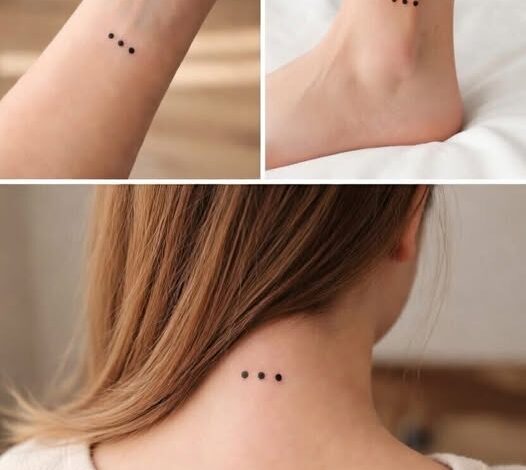
At first glance, the three-dot tattoo seems almost deceptively simple—a tiny cluster of dots that could be overlooked or dismissed. Yet behind its minimalist design lies a complex and often misunderstood symbol, shaped by culture, environment, and deeply personal experiences. Typically placed on the hand—between the thumb and forefinger, along the knuckles, or even on the wrist—it is small enough to go unnoticed by some, yet instantly recognizable to those who understand its significance. For some, it evokes the moral lesson of the “Three Wise Monkeys”: see no evil, hear no evil, speak no evil. But this widely recognized interpretation barely scratches the surface. In certain subcultures, particularly prison systems, gang environments, and some street communities, the three dots carry a far deeper, more specific message—one tied to silence, loyalty, and an unspoken code of conduct that can govern survival and social order.
Within prison culture, the tattoo is more than decoration—it is a quiet declaration of allegiance and philosophy. It signals adherence to a rigid, unwritten rule: do not talk, do not betray, do not cooperate with authorities. In a world where trust is scarce and consequences can be life-altering, silence becomes a strategy for protection, and the tattoo becomes an emblem of that mindset. The placement on the hand is intentional: it is visible enough for those who know the code to understand, yet subtle enough to avoid drawing unnecessary attention from outsiders. In this context, the three dots communicate volumes without a word, identifying someone who respects the rules, values discretion, and understands the delicate dynamics of survival in a high-stakes environment.
Beyond signaling silence, the tattoo also represents connection, camaraderie, and a sense of belonging. In spaces where isolation can be dangerous, shared symbols create bonds between individuals who might otherwise be strangers. The three dots can indicate that the wearer is part of a group, understands the unspoken rules, or values loyalty above self-interest. In these environments, the tattoo functions as a kind of language—its meaning understood without needing to be verbalized. It becomes a badge of mutual recognition and shared experience, a compact but potent reminder that identity is defined as much by the people around you as by your own actions.
The symbolism of the tattoo can also evolve to be intensely personal. Variations in spacing, size, or additional dots may denote time served, challenges overcome, or milestones endured. In this sense, what appears to be a simple pattern can encapsulate years of history and experience. The tattoo transforms into a living record of hardship, resilience, and personal growth—a permanent mark of memory that cannot be erased like written records or digital histories. For many, it is a tangible link to past struggles, a reminder of endurance and lessons learned, carried forward as both a warning and a badge of honor.
Outside prison and gang contexts, the three-dot tattoo has taken on additional cultural meanings. In Latin American communities, for instance, it is often associated with the phrase “Mi Vida Loca,” or “My Crazy Life.” Here, it symbolizes a lifestyle defined by risk, unpredictability, and defiance of societal norms. It reflects a narrative of living on one’s own terms, embracing chaos, and surviving outside the ordinary. Across these different environments, while the specifics shift, the underlying message remains consistent: the three-dot tattoo is about identity, choice, and the lived experience that sets the wearer apart from conventional society.
Yet this symbolic power carries risks. Outside the communities where it originated, the tattoo can invite misunderstanding, judgment, or even legal scrutiny. Casual observers may assume criminal affiliation, past violence, or other connections that are not necessarily true, impacting relationships, career opportunities, and public perception. For those who have moved beyond the circumstances that inspired the tattoo, it can become both a reminder of a difficult past and a challenge to navigate societal assumptions—a visual representation of how hard it can be to escape history.
Over time, however, the meaning of the three dots is not fixed. Many wearers reinterpret the symbol, assigning it significance tied to personal growth, resilience, or transformation. What may have begun as a mark of survival and adherence to a strict code can evolve into a testament to lessons learned, boundaries respected, or life lived with integrity. Tattoos, much like people, are not static; their meanings shift, adapt, and deepen over time. For some, the dots remain rooted in their origins, while for others, they become part of a larger narrative—a visual thread that ties past, present, and future together.
The elegance of the three-dot design lies in its simplicity. Unlike elaborate tattoos, it does not rely on detail to convey its message. Its power comes from context, placement, and the personal experiences of the wearer. Minimalism allows the symbol to exist in multiple interpretations simultaneously, adapting to diverse cultures and life stories while maintaining a core identity.
Ultimately, the three-dot tattoo is a study in contrast: small yet profound, silent yet communicative, personal yet widely recognized. It represents loyalty and discretion, individuality and shared experience, survival and identity—all within a few simple marks. Whether viewed as a mark of past hardship, a symbol of community, or a reflection of a life lived outside conventional boundaries, the three dots endure as a powerful reminder that even the tiniest symbols can carry stories that are immense, layered, and deeply human.