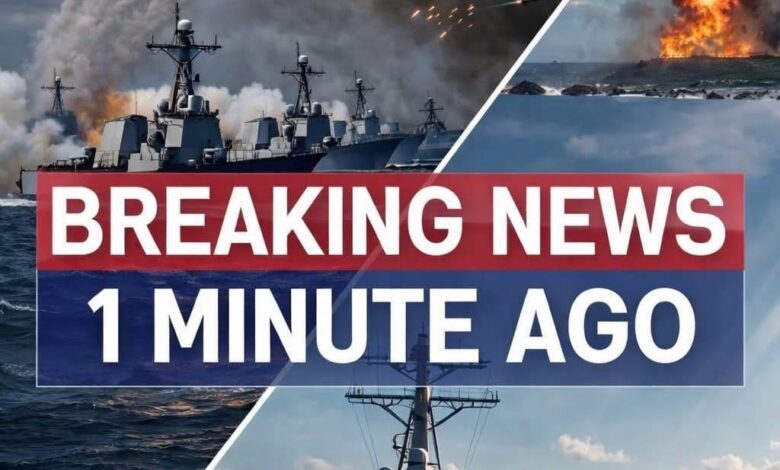
The Red Sea, long considered one of the world’s most important maritime corridors, has increasingly become a zone of military tension. In March 2026, a U.S. Navy destroyer operating in these strategic waters reportedly faced an intense attack in which 36 missiles were launched within just 22 minutes. The incident highlights how rapidly modern naval confrontations can unfold and underscores growing concerns about security along a route vital to global trade.
A New Level of Naval Threat
Military analysts describe the attack as a “saturation strike.” In this type of operation, an attacker launches many missiles in rapid succession with the aim of overwhelming a ship’s defensive systems. Rather than relying on a single strike, the strategy is to flood the target’s radar and defensive network with multiple incoming threats at once.
Modern warships like U.S. destroyers rely on integrated systems—such as the Aegis Combat System—that combine radar tracking, computers, and interceptors to detect and destroy incoming missiles. However, a large number of simultaneous threats can force the system to rapidly prioritize which targets pose the most immediate danger.
The goal of a saturation attack is simple: create enough chaos that one missile slips through defenses.
How Modern Warships Defend Themselves
To counter such threats, naval vessels rely on layered defense systems designed to intercept missiles at different distances:
- Long-range interceptors (such as Standard Missiles) attempt to destroy threats far from the ship.
- Medium-range missiles, like the Evolved SeaSparrow system, engage targets that get closer.
- Close-range defenses, including the Phalanx Close-In Weapon System (CIWS), act as the final protective barrier by firing extremely rapid bursts of ammunition at incoming projectiles.
These layers are designed to ensure that even if one defense fails, others remain available.
Strategic Importance of the Red Sea
The location of this confrontation makes the event especially significant. The Red Sea connects to the Suez Canal, one of the most critical shipping routes in the world. Roughly 12% of global trade passes through this corridor, including large volumes of energy supplies and manufactured goods.
When security threats escalate in this region, the effects ripple across global supply chains. Shipping companies may reroute vessels around the Cape of Good Hope, a much longer and more expensive journey. Insurance costs for cargo vessels can also rise sharply during periods of heightened risk.
A Growing Challenge for Maritime Security
Incidents like this highlight several emerging challenges in modern naval conflict:
- Advanced missile technology has become more widely available.
- Asymmetric warfare allows smaller groups to challenge powerful naval forces.
- Economic pressure can arise when relatively inexpensive weapons force defenders to use far more costly interceptor systems.
These dynamics create a difficult balance for military planners tasked with maintaining safe shipping lanes.
A Complex Global Environment
The confrontation also occurs against a broader backdrop of geopolitical tensions across multiple regions. Conflicts and instability in nearby areas can contribute to an increasingly volatile security environment along major maritime routes.
Military experts emphasize that many such engagements occur in conditions of limited verified information, where conflicting reports and operational secrecy make it difficult to confirm all details immediately.
The Bigger Picture
Ultimately, incidents like this serve as a reminder of how critical maritime security is to the modern world. The ability to move goods across oceans supports global economies and supply chains. When those routes become contested, even localized clashes can have far-reaching consequences.
For now, naval forces from several countries continue to operate in the region to safeguard shipping traffic and maintain stability along one of the world’s most important waterways.