That morning, I walked onto the veranda and noticed something unusual moving inside the wall.

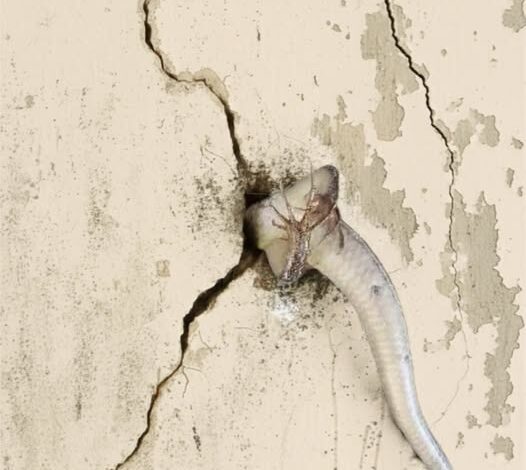
I forced myself to move closer, though every step felt like a negotiation between panic and a strange, guilty curiosity I could not quite explain. Part of me wanted to run, to shut the door, to pretend I had never heard the scratching inside the wall. Another part of me needed to know what was there. The sound was too frantic to ignore, too alive to dismiss as imagination. So I kept inching forward, heart pounding, breath held tight in my chest, my mind filling in the darkness with every terrible possibility.
At first, all I could see was movement—a thin shape twisting in the crack, jerking and struggling in a way that made my skin crawl. My fear turned it into something larger than it was, something sinister, something waiting to lunge. But as I leaned closer, the truth began to separate itself from the nightmare I had built around it. It was not sliding with the smooth, deliberate motion of a snake. It was not hunting, watching, or threatening me. It was flailing. Clawing. Trapped.
Then I saw it clearly: a smooth little body, tiny legs pressed awkwardly against the wall, glossy skin catching the light in brief flashes. A skink. Not a monster. Not some horror rising out of the house. Just a small, frightened creature wedged in a place it could not escape, using the last of its strength to fight against a crack that had become a prison.
Something inside me changed almost instantly. The fear that had been gripping me began to loosen, replaced first by pity, then by a heavy sense of responsibility. I had spent the last few minutes imagining it as a threat, when all along it had been the one in danger. Its movements no longer looked disgusting or terrifying; they looked desperate. Suddenly I was not thinking about how afraid I was. I was thinking about how long it had been stuck there, how exhausted it must have been, and whether I could get it out without hurting it.
My hands were shaking as I reached toward it. Every instinct in me still expected the worst. I imagined it biting me, thrashing free, falling, vanishing into some worse place inside the wall. I was half certain I would panic and drop it, half convinced that my attempt to help would somehow make everything worse. But I moved slowly, gently, trying to keep my breathing steady while I worked it free from the narrow crack.
For a moment, it resisted, not because it was aggressive, but because fear had taken over both of us. Then, with one careful movement, it came loose. I held it only briefly, just long enough to carry it away from the trap that had nearly swallowed it. It paused there for a heartbeat, still and weightless, as if deciding whether the danger had truly passed. Then it darted away, quick and silent, disappearing into the world as if it had never been there at all.
Afterward, the room felt strangely quiet. The scratching was gone. The dread was gone too, though my body was still buzzing from it. Later, when I learned that skinks are harmless, shy creatures that usually want nothing to do with people, I felt almost embarrassed by the terror I had built around one small animal. The horror had not really belonged to the skink. It had belonged to me—to my imagination, my reflexes, my habit of turning the unknown into something dangerous before I understood it.
But there was something comforting in that realization. Helping it had done more than save a trapped creature. It had interrupted a fear I had allowed to grow too large. For once, I had moved toward what scared me instead of away from it, and what I found there was not a monster, but a life asking for help. Oddly, that left me calmer than I had been in a long time. The skink disappeared in seconds, but the lesson stayed: sometimes what frightens us most is not the thing itself, but the story we tell ourselves before we get close enough to see it clearly.