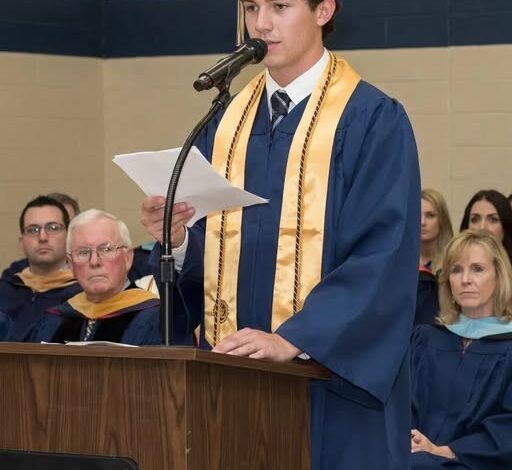
My Son’s Valedictorian Speech Stopped Halfway Through – Then He Looked at His Stepfather and Said, ‘Now Everyone Will Find Out What You Did’

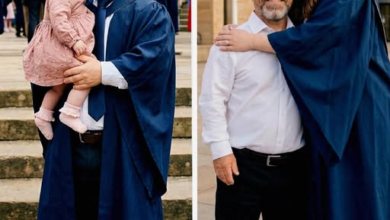
She wrapped both arms around him and held on like she thought he might disappear if she let go.
Not the polite kind of hug people give in public. Not the brief, careful kind meant to avoid embarrassment.
This was something else entirely.
Something desperate.
Something ancient.
Like she had been holding that moment inside her body for years and only now, finally, had a place to release it.
For a long moment, nobody in the gym moved.
Even the noise seemed to hesitate.
The squeak of shoes on polished wood stopped.
The rustle of programs faded.
The air itself felt suspended, as if the building had forgotten what it was supposed to be doing.
The principal stood frozen near the edge of the stage, mouth slightly open, a microphone still hanging uselessly at his side.
Teachers sat rigid in their seats, some with hands over their mouths, others already wiping their eyes without fully understanding why they were crying.
Parents who had come expecting speeches and diplomas now sat in stunned silence, witnessing something that didn’t belong in a graduation ceremony at all.
This wasn’t performance.
This wasn’t celebration.
This was exposure.
Something raw being seen in public for the first time.
I don’t remember deciding to stand up.
There was no thought behind it.
Only movement.
One moment I was in the bleachers, surrounded by folding chairs and murmuring voices.
The next, I was walking down the aisle between rows of students and families, my footsteps louder than they should have been.
My daughter followed behind me without hesitation, her small steps quick and uneven, like she understood instinctively that this moment had crossed some invisible boundary.
Patrick called my name from somewhere behind us.
I heard him.
But I didn’t stop.
I couldn’t.
Because something inside me had already started rearranging itself.
Not emotionally at first.
Structurally.
Like a picture that had been hanging slightly crooked for years suddenly snapping into alignment.
All the moments I had dismissed as confusion began shifting into place.
The awkward silences at birthdays.
The way Caleb sometimes went quiet when family was mentioned, as though stepping carefully around something sharp.
The holidays where he seemed present but not fully there.
The questions he stopped asking too early.
The letters he said he never received but didn’t know how to question without sounding ungrateful.
At the time, I had explained it to myself in the simplest way possible.
Distance.
Time.
Grief.
Life pulling people apart in quiet, natural ways.
But standing there, walking across that gym floor, I understood something I had never allowed myself to consider.
None of it had been natural.
Someone had been shaping that distance.
Quietly.
Carefully.
Consistently.
Not with violence.
Not with confrontation.
With absence.
With removal.
With silence that had been engineered, not accidental.
Someone had been deciding what Caleb was allowed to know.
Who he was allowed to hear from.
Which relationships were allowed to continue breathing.
And which ones were allowed to die unnoticed.
And that someone was my husband.
The word landed in my mind differently than it ever had before.
Not as a role.
Not as a partner.
But as a point of fracture in a story I had believed was simply unfortunate.
By the time I reached Caleb, he was still holding his grandmother.
Both of them were shaking now, not from shock anymore, but from release.
The kind of crying that comes after years of pressure finally finding an exit.
The kind that doesn’t feel like collapse.
It feels like survival.
His grandmother looked up as I approached.
For a second, I saw recognition pass through her face—hesitation, fear, memory, and then something softer breaking through all of it.
She stepped toward me before I even spoke.
Her hands were trembling so badly I could see it in her fingers before she even reached for mine.
“I wrote him every month,” she said.
No preface.
No explanation.
Just that.
As though the sentence had been waiting years to be spoken.
“I wrote every single month.”
Her voice cracked on the last word.
I couldn’t answer.
My throat refused.
She swallowed hard, forcing herself to continue anyway.
“I thought he hated me.”
That was when her composure finally broke.
Not loudly.
Not dramatically.
But in a way that made it worse.
Because it wasn’t anger.
It was grief that had been misdirected for years.
Grief that had been turned inward and mistaken for guilt.
Grief that had lived too long without correction.
The realization hit me then with a different kind of force.
This wasn’t just Caleb’s loss.
It wasn’t just my shock.
It wasn’t even just the exposure of deception.
It was something wider.
Older.
Heavier.
A chain of missed connections that had been quietly accumulating for years.
A family severed not by distance, but by interference.
I started crying again.
Harder this time.
Because I could suddenly see all the invisible losses at once.
Not just what Caleb had been denied.
But what she had been forced to believe she lost.
Every birthday card returned unopened.
Every letter she assumed was ignored.
Every holiday she spent staring at a phone that would never ring.
Every moment she had told herself she had failed as a grandmother.
Behind us, the gym was no longer functioning as a ceremony space.
The graduation had dissolved completely.
Caps had stopped being noticed.
Names were no longer being called.
Nobody was listening to announcements anymore.
The truth had taken the room and refused to give it back.
Patrick stood near the bleachers.
Alone.
That was what struck me most.
Not that people avoided him deliberately.
But that distance formed naturally around him, like water flowing away from something that no longer belonged in its current shape.
The explanations he had rehearsed earlier—whatever version he had intended to offer—were gone now.
There was no audience left for them.
No structure for them to land inside.
Just silence.
And consequence.
My daughter tugged at my sleeve again, more urgently this time.
“What happens now?” she asked.
Her voice was small, but steady.
Children always ask the clearest questions at the worst possible moments.
I looked at Caleb.
Still holding his grandmother.
Still shaking, but differently now.
Like something inside him had finally stopped being held together by tension alone.
I looked at Patrick.
Standing apart from everything he had tried to control.
And I realized the answer wasn’t complicated at all.
It had only ever been obscured.
“The truth happens now,” I said.
Leaving the gym didn’t feel like an exit.
It felt like crossing into something else entirely.
A version of life where nothing could be maintained by silence anymore.
We didn’t leave together in the way families usually do.
We separated into truths.
Caleb walked beside his grandmother.
My daughter stayed close to me.
And Patrick followed behind for a while, speaking in fragments that didn’t connect to anything anymore.
“I was protecting him.”
“I didn’t want him hurt.”
“You don’t understand the context.”
Each sentence fell shorter than the one before it, like they were losing structural support midair.
Because explanation requires trust to function.
And trust had already collapsed.
The facts didn’t need interpretation anymore.
They simply existed.
Letters intercepted.
Cards hidden.
Voicemails erased.
A history redirected without consent.
There was no version of those actions that transformed into protection.
Only control.
Only removal.
Only loss disguised as care.
Eventually, even his voice stopped following us.
Not because anyone told him to be quiet.
But because there was nothing left for it to attach itself to.
Outside, the June air hit differently than it should have.
Too sharp.
Too real.
As if the world beyond the gym had not been prepared for what had just occurred inside it.
People stood in small clusters in the parking lot, pretending not to watch us while watching anyway.
I couldn’t blame them.
Moments like this don’t stay contained.
They spread.
Patrick followed us out again.
Still trying.
Still reaching for some version of the story that could be salvaged.
“I did what I thought was best,” he said.
But even he seemed to hear how thin that sounded now.
Caleb finally stopped.
He turned around slowly.
His face was red from crying, but steady in a way I hadn’t seen before.
“You stole years from us,” he said.
No shouting.
No shaking voice.
Just certainty.
Patrick opened his mouth.
Nothing came out.
Because there is no defense that fits inside that sentence.
Time cannot be returned.
Not explained.
Not rebalanced.
Not softened.
Caleb’s grandmother stepped closer to him then, gently, as if afraid he might still disappear if she moved too quickly.
She placed her hand on his arm.
And said the words that seemed to carry more weight than everything else combined.
“None of this is your fault.”
Something in him broke open at that.
Not in a destructive way.
In a releasing one.
I saw it in his posture first.
The way his shoulders dropped slightly.
The way he exhaled like he had been holding his breath for years without realizing it.
Over the following weeks, the truth didn’t fade.
It multiplied.
Boxes appeared.
Stored evidence.
Letters sorted by year.
Photographs still sealed in envelopes.
Returned gifts never delivered.
Voicemails preserved and replayed like evidence in a trial no one had known they were part of.
Hundreds of them.
A timeline of attempted connection interrupted at every possible point.
Each one addressed to a version of Caleb who never got to receive them.
Thirteen.
Fourteen.
Fifteen.
Sixteen.
Seventeen.
Eighteen.
Each year layered with proof that love had been trying to reach him the entire time.
And failing only because someone had been standing in the way.
Three weeks later, the hardest night came without warning.
We were at the kitchen table.
The letters spread out in uneven stacks.
His grandmother reading some aloud when her voice held steady enough.
Caleb reading others himself, slower, like each sentence required space to land.
At one point, he stood up abruptly and walked outside.
No explanation.
No words.
I followed after a moment and found him on the porch, sitting forward, elbows on his knees, holding a folded letter like it weighed more than paper should.
He was crying quietly.
Not the kind that asks to be seen.
The kind that exists even if no one is watching.
I sat beside him without speaking.
Minutes passed.
Then he finally asked, without looking up,
“Do you think Dad would be angry?”
I knew exactly who he meant.
And I answered honestly.
“No.”
He nodded once.
As if that was something he had been trying to believe already.
Months later, people still ask about that day.
They ask about shock.
About embarrassment.
About whether it should have been handled privately.
But privacy is what allowed it to happen in the first place.
Silence is what made it possible.
And silence is what protected it for years.
The truth needed witnesses because it had been denied them for too long.
And that gym—chaotic, broken, exposed—was the first place where nothing could be hidden anymore.
When I think back now, I don’t remember the humiliation people expect.
I remember a grandmother refusing to let go.
A boy finally hearing what had been taken from him.
A family realizing that absence had not been natural at all.
And what came after.
Not perfection.
Not instant healing.
But something quieter.
Sunday dinners that slowly became real again.
Old photographs spread across tables like evidence of continuity.
Stories filling in gaps that had been left empty for years.
A life not repaired all at once.
But returned.
Piece by piece.
Not because the damage was undone.
But because the truth finally had room to exist where silence used to be.
And in the end, that was what Patrick never understood.
You can interrupt connection.
You can delay it.
You can obscure it.
But you cannot erase something that was real to begin with.
Eventually, if given even the smallest opening, it finds its way back.
Not loudly.
Not quickly.
But inevitably.
Like something remembering where it belongs.